“I had a candidate, female, who we wanted to hire. Her salary ask was significantly lower than her worth – especially considering location. The hiring manager came to me. He said he was uncomfortable with her salary ask, and wanted her to get paid the same as the other people (basically men) in this position. We sent her the offer she deserved.
I didn’t need to champion equity. I didn’t have to advocate or advise, though I would have stepped in if he hadn’t first. The right thing to do is second nature with good leadership.
She took the offer.
Candidates don’t always know what’s going on in the background. But when you find a company that leads with integrity, they have your back before you walk through the door.
Cheers to the men in leadership who are true allies for the women in their industry. I can’t say this enough.”
Are you also cheering for great men in leadership who are true allies for women?
You might want to rethink that.
My immediate response to this post was:
Why would the hiring manager need to ask to pay her more? That doesn’t make sense.
He’s the hiring manager – the person with the authority to determine who gets hired and how much they get paid…unless…he was considering taking her offer…even though he knew it was unfair. So, his so-called discomfort was really him wondering: Should I do it? Can I get away with it?
Faced with a controversial decision, he decided to follow the male-dominated workplace rule: Get a buddy.
So, he relayed the story as a way to bounce the idea off someone else.
It probably took less than a minute for him to figure out that he didn’t have a buddy in this and he needed to pay her fairly.
This manager wasn’t a great example of a true ally of women. He is an example of a cheapskate manager who frequently suffers from bouts of questionable integrity. (I know these guys well.)
On the other hand, a man who is a great ally of women and a true leader would have already determined a salary range for the position that was fair and equitable to other employees. He wouldn’t have been silent after her unfair salary request (as he quietly pondered it.)
Instead, he would have replied with “Good news, this position pays more than that so if we offer you this position, I suspect you will be very happy with our offer.” (Yes, these guys do exist.)
Remember, if your offer isn’t countered, it is probably well below what they are willing to pay. So, when you are asked what salary you want, don’t give a number. Instead ask for the pay range or the “banding” for the position. Once you know this, you can negotiate based on your experience and skills.
It’s important for women to understand how things really work otherwise we can misread a situation.
Confidence is a quality that seems to distinguish between men and women. Men seem to naturally have it.
However, after working with so many men I know this isn’t true. The truth is men are just better at covering up their lack of confidence. This is because the male-dominated workplace expects men to know what to do and how to get things done. It rewards men on this premise. Therefore, men are afraid to admit it when they don’t know what to do.
As a woman working with and supervising men, I had to become very good at detecting when men were giving me a line of BS in order to hide the fact that they really didn’t know what to do.
I also had to be very assertive in calling them out on it whenever my BS detector went off. However, I had to be careful in how I did it. I couldn’t criticize or make them feel incompetent because that alienated them. It was learned dance that began with me just saying “No, that’s not going to work” and holding my ground when faced with (sometimes intense) challenges.
As women, we need to understand that most men derive their sense of self and their value from their professional expertise. If their expertise is questioned, then so is their right to be in their job. In response, men can pout, disappear and avoid you for a very long time.
Consider this.
Do you expect your boss to have all the answers?
Have you ever asked your boss what to do in a particular situation and have him just throw out an answer – sometimes accompanied with anger and yelling. We feel like he just wants to get rid of us and we question if we just hurt our career.
So we go and do what we were told to do. However, often it doesn’t quite work and we don’t know what to do. We know we certainly can’t go back and ask our boss again. We get frustrated and especially frustrated with our boss. But the truth is, we should be looking in the mirror instead.
Our fundamental problem is that we were conditioned to take direction from above and not conditioned to problem solve for ourselves.
We like this conditioning because it makes our life easy. It gets us off the hook. It keeps us from being responsible and accountable.
This is the attitude we need to change!
Problem-solving is one of the greatest challenges our workplaces face. Because our workplaces are made up of people, many workplaces don’t want to admit it when they don’t know what to do. Instead of admitting they don’t have a solution, they would rather fumble around making mistakes, wasting time and money.
Admitting we (as in ourselves) don’t know what to do is the first step in problem solving. However, too many women have been conditioned to be afraid to admit they don’t know what to do. This is a cycle we have to break – and as women, we best suited to do it.
Unlike men, women will naturally ask other women for help. And most of our female colleagues will voluntarily jump in and offer their expertise. It’s common to see several women working together to solve a problem or complete a task because women naturally collaborate!
Our collaboration is what makes us a gazillion times better at problem solving than men. And it is why women must assume a leadership role in teaching our workplace to problem solve.
Throughout my career I used women to lead the men in our workplace to collaborate and problem solve.
No matter how many women are in the workplace, or their role, we start by choosing a problem to solve on our own. We don’t need to ask the boss’s permission. We just do it.
To draw men into solving the problem solving we ask them questions within their own area of expertise. (Men love to share their expertise.) They’ll want to know what we are trying to fix so we tell them. They will gladly chime in with their knowledge, experience and opinion. Once other men see all of us talking, they will chime in too. Before you know it, men are engaged in the collaboration process.
Women lead in collaboration because men will naturally talk to women about things they would never discuss with other men.
In my experience, the workplace dynamic changes quickly. Men voluntarily begin bringing their problems to women to help them solve. (Yes, Hell does freeze over.) By bringing the problem to women, men can initially hide their problems from their male colleagues however, their discussions don’t go unnoticed. When men see other men talking to women, they come over and chime in. Before you know it, discussions, collaboration and problem solving happens organically. Our workplace changes.
I’ve successfully done this in many of my workplaces…even when I was the only woman in my workplace, I still did it.
As a woman, I didn’t adopt the male fear of hiding my weaknesses in order to protect my status and ego. Instead, I freely admitted what I didn’t know because I knew my male colleagues would gladly share their expertise. And since I was the only woman, men came to me with their problems. Consequently, I was drawn into many discussions, and my professional knowledge grew very quickly across many disciplines. More importantly, I learned how the various disciplines had to work together to get our projects done. This gave me a HUGE advantage over my male colleagues who preferred to increase their expertise in one or two disciplines because I could lead my workplace in solving complex problems.
Of course, I ran into a few jerks who mocked me for asking a question in order to belittle me. My response however was to call their bluff, “Well, why don’t you just step up and tell us all what to do…and then we’ll see how well it turns out.”
I learned this was a very powerful challenge because confidence and mockery are easy to project when you aren’t held accountable for the outcome. However, when the finger is pointing at you, it’s a whole different story.
As women we must remember our power won’t ever come from projecting fake confidence or expertise. It will always come from acknowledging what we don’t know, not being ashamed to ask questions and then allowing our natural ability to collaborate to make us our workplace leader in problem-solving.
We live in a society that doesn’t value our female or feminine perspective. It’s thought to be too emotional, not intellectual enough. So, for decades, women were told to think and act more like men.
Today, this thinking is so engrained in us that we don’t even recognize itand certainly don’t question it.
Our most influential women thought leaders reinforce these ideas. We assume they are right because…. look at them! They are so successful!
We want to copy them, but we find it hard. Something is off. Something is wrong. Something doesn’t feel right. But we don’t know what.
So instead of questioning all the advice we’ve been given, we question ourselves. Our conditioning tells us the problem is us. We just don’t have what it takes.
In reality the problem is that we aren’t connecting with our true selves. We aren’t asserting our female and feminine perspective.
In this video I discuss a quote by Sheryl Sandberg which initially sounds good. It’s supposed to sound right…but something inside us tells us something is off.
Watch this YouTube video.
Then, start thinking about how often you push aside your female perspective believing it is inferior.
Additional Note:
Sheryl was what I call a “Blue Zone Woman.” She fully believed that male traits were the key to a successful career. Her concept of “Lean In” screams Blue Zone and male thinking.
Unfortunately, she was completely blind to how she was conditioned because she was well-rewarded for it. Lean In got so much great press because it encouraged women to become “Blue Zone Women” – women who fit into the male-dominated workplace and who would NEVER question how it functioned.
(Did Sheryl stand up against Facebook and Instagram for what they were doing to women and girls?)
I noticed however, that after Sheryl’s husband died, her perspective changed dramatically. I think for the first time she was forced to confront her female perspective. And I hope that she like all of us, find, embrace and assert our feminine selves to the benefit of all.
I received a fear laced text about COVID-19 and climate change from a political party. My gut reaction was:
“OMG!!!! I’m going to die!!!”
I decided to reply to the text which began an exchange with an unknown person. Our exchange was frustrating, so I ended it by saying:
“Get freaking real! Stop fear-mongering me and stop trying to manipulate me. Treat women as if we have a brain.”
Politics and COVID-19 proved a powerful combination to fear-monger and emotionally manipulate women. We’re susceptible because:
We mistakenly identify with our emotions, not our ability to think.
We aren’t as technically savvy, so we rely on “the experts.”
We rely on other people (news media and politicians) who also aren’t technically savvy to interpret and analyze for us what the experts are saying.
These media personalities and politicians also conditioned us to believe that anyone who utters those three magical words,
‘Science, Data, Facts”
must know what they are talking about.
However, that’s not true. Those of us who are trained to work with numbers know “Science, Data and Facts” are completely meaningless until they are analyzed.
Too often people don’t analyze the data.
Instead, they hear big numbers such as 214,917 COVID-19 deaths and believe they are at high risk of dying if they get COVID-19.
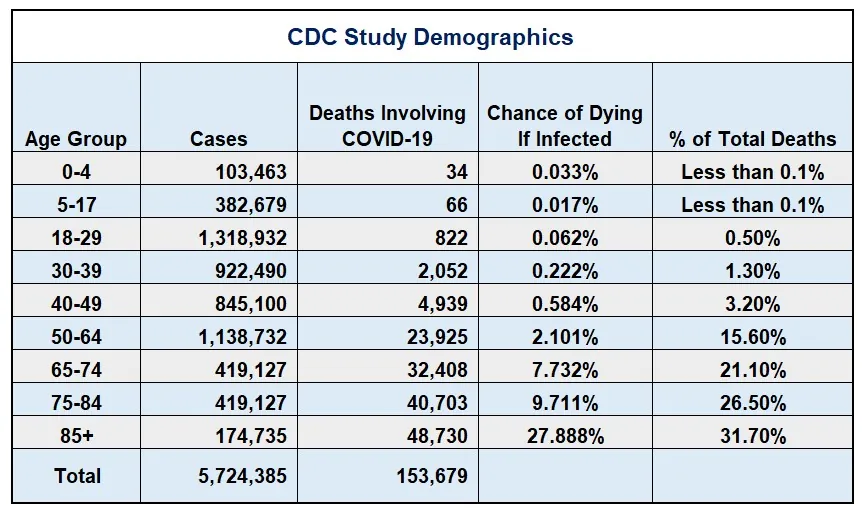
Fear-mongering such as the text I received reinforce fears that may be completely unfounded. So, in order to understand the risk of dying from COVID-19, I looked for the COVID-19 facts that were analyzed.
I first noticed that their chart says: “Deaths Involving COVID-19.”
The chart DOES NOT say “Deaths From COVID-19”
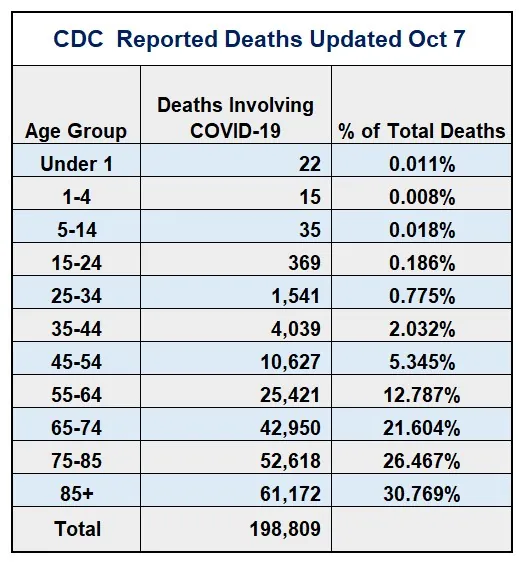
This suggests that COVID-19 was in many cases the final overloading cause of death (the final straw), not the stand-alone cause. (Important distinction) We also notice that there is a jump in deaths beginning with people in their mid-fifties. For most of us this is when our health issues become apparent and begin to require care or intervention.
Like the study, the chart also shows that about 79% of deaths occur in people over 65 with 30% of the deaths coming from people over the age of 85.
So from the Science, Data, Facts and Analysis should we be fearful of getting COVID-19?
Well that depends on your age group and maybe more importantly your health.
The analysis helps us know where we should place our concern. It also helps us stop creating unfounded fear. But more importantly, it prevents us from being fear-mongered by those who an agenda and want to use fear to manipulate us.
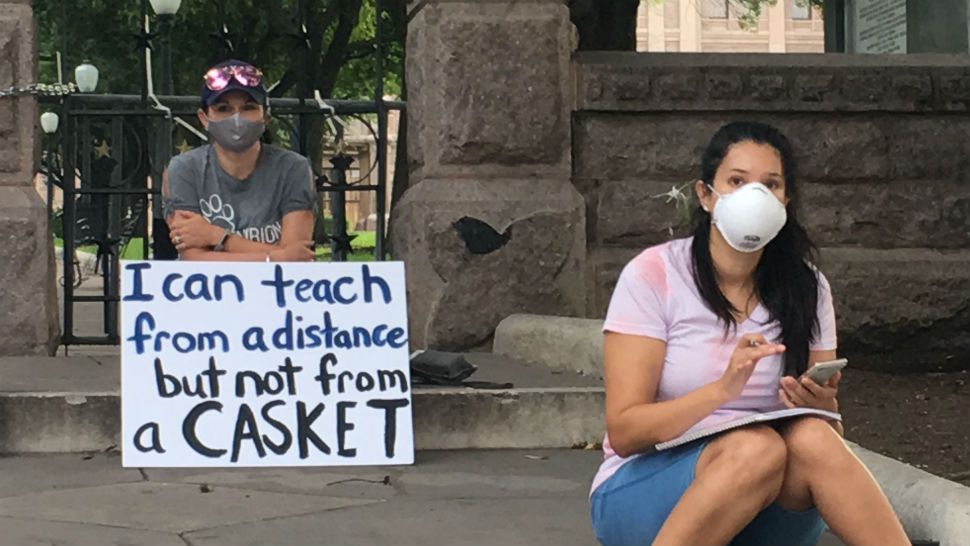
The average age of teachers is 41. Older teachers have reason for concern if they have health issues. Young, healthy teachers have little to fear.
Women are conditioned to defer to others. In school we were praised for raising our hand before we were called on to speak. We won favoritism and were rewarded with special privileges for being “good girls.”
We also watched boys speak out of turn, disrupt class and disregard the rules. Some boys were scolded. But others learned how to get around the rules with charm and humor. And even though their behavior was “bad,” they got attention which became its own form of reward.
So, boys learned that breaking the rules doesn’t necessarily result in negative consequences.
This difference in how boys and girls are conditioned became apparent during the COVID-19 era. At first, all non-essential personnel worked from home. But slowly that began to change.
I live adjacent to a major road. In late March and early April of 2020, I could pull out of my street onto the major road without even stopping. There wasn’t a car in sight.
But then, the week after Easter traffic began to change. Work trucks were back on the road. Then by the end of April there were several cars which I noticed were driven by men.
Even as the news media reported that people were working from home traffic steadily increased each week.
Who wasn’t working from home anymore?
My unofficial surveys indicated they were predominantly men.
To me this made sense.
From my decades of working with men, I knew many men who always showed up to work no matter what. They came to work because they thought of themselves as “essential.”
When COVID-19 broke out, we understood this was an emergency situation. Therefore, the only people who went to work were people who dealt directly with the emergency (doctors and nurses) and those who provided critical services in support of the emergency (grocery store workers).
But then we stopped calling these people “emergency workers” and began calling them “essential workers.” This opened the door for more people to return to work because to men “essential employees” means something very different from “emergency employees.”
Having spent my career working with the trades, I know plumbers, roofers, HVAC mechanics and electricians respond to emergency situations and provide “essential” services. This is why they were the first ones out on the road after Easter 2020.
I also know that when “routine” trade services such as maintenance are delayed, bad things happen. Things break and can quickly escalate into “urgent” and even “emergency” situations. Consequently, crises were created across many industries and workplaces.
Most men understand this natural progression in their work.
They know authorities can’t command “shelter in place” and expect everything in existence to freeze. They know the forces of physics, biology, nature and weather certainly won’t listen. And these forces will create a growing ripple effect. More and more of us will need to resume normal activities to prevent the escalation and spread of “urgent and emergency” situations.
Men are also acutely aware that the faster someone is required to return to work, the more essential (important) they are.
So, men began their progression back to their workplace in the order of their real or perceived importance.
Men don’t want to be seen as one of those people who can disappear and not be missed. Because, if no one misses them, then their job isn’t important…and can be eliminated.
This is why once back in the workplace men quietly note who is and isn’t in the office. They assess the pecking order. They note who sees their job as important and who doesn’t.
Now as women, our good girl conditioning tells us to listen to “the experts” who tell us to keep working from home. If we raise our hand to ask if we should come into the office, our workplace’s “official statement” is that we should continue to work from home. So, we wait for permission to return to our workplace.
But are we the only ones waiting??
How many of our male colleagues have gone back to the office either full time or part time?
Do we know? (They certainly know we are still “at home.”)
We need to know. We need to know if we are foolishly waiting to be praised for being a “good girl” who follows all of the rules but also sending the message that neither we nor our job is essential.
So, if you haven’t done so yet, drive by your workplace during work hours. See how many and whose cars are in the parking lot.
Go into your workplace, even if you have to go in at night. Take a look around and gauge the daytime activity. You will be able to tell who does and doesn’t come into the office.
This information will tell you whether you are leaving yourself out and ultimately leaving yourself behind.
Only you can know when the right time to return is. Just make sure you aren’t the last, unessential worker to return.
During the Covid pandemic, I was listening to my local news when a teaser for the national news came on broadcasting:
“Teachers and school nurses quit rather than return to school.”
The next commercial that came on was from my local power company showing men going to work and taking safety precautions for Covid-19 because they have to be out there. Their work is essential. They have to get it done.
The contrast between the two commercials was stark.
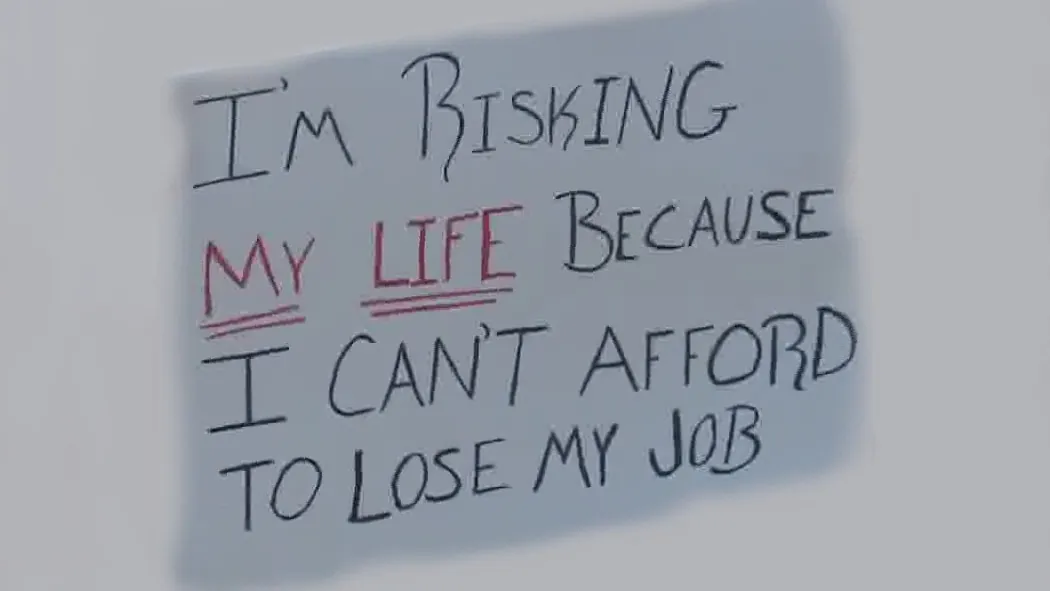
Women saying, “We can’t, we can’t” accompanied by signs saying, “I don’t want to die.”
While men whose work is inherently dangerous and where they can die just from doing their tasks say, “We can and we will.”
The contrast is an immediate reminder of the stereotypes.
Men are brave, daring, risk takers who get things done. While women who are caring and compassionate are driven by emotion. Our emotions make us weak and fearful, leading us to become irrational and hysterical.
The media then reinforces the stereotype of women being overly dramatic with stories of mothers who are afraid to send their children back to school for fear they might “get sick” (with no symptoms) or become “transmitters” (nice way of saying “silent killers.”)
Now of course there is science, data and facts to help alleviate women’s fears but mathematical, rational, analytical thinking is just too much for women’s brains. This is why we defer to “the Experts” who happen to be men to tell us what we need to do. Right?
No.
This is just what we’re conditioned to believe about ourselves.
Now this may be breaking new to some – especially those in the media industry – but women are quite capable of thinking and solving problems. I would venture to say that women are even far, far, far better than men at solving complex problems because we think about how this has to work with that, and that has to fit into this but then there is also this other thing we have to consider.
In other words, women are really good at thinking about all of the pieces and parts that are needed to solve a problem, and we are also really good at fitting all of them together to create a complete solution.
However, women aren’t taught to recognize this ability. Instead we are taught that men and their brains are superior to ours in problem solving. So, when women see men and especially “the Experts” get stumped by a complex problem, we believe that of course our poor little emotionally driven brains can’t handle it either.
This belief is what conditions us to respond to complex problems with “I can’t, I can’t, I can’t.”
But we can.
Throughout my career I’ve seen women – irrespective of their education or role – “help men” figure out how to assemble all the pieces and parts of a complex problem to come up with a solution. And it made me question, “Who is the real leader in this situation? Who is the more valuable person?”
So, it’s time for women to break free of our conditioning and recognize our abilities for the leadership qualities they are. But first, we also have to adopt the same attitude as men.
When women adopt this attitude then we will stop saying “No, I can’t” and begin saying “Bring it on….Because…Yes, I can!”
But more importantly, we will experience the joy and challenge of problem-solving and the sense of achievement that comes from creating a solution that works.
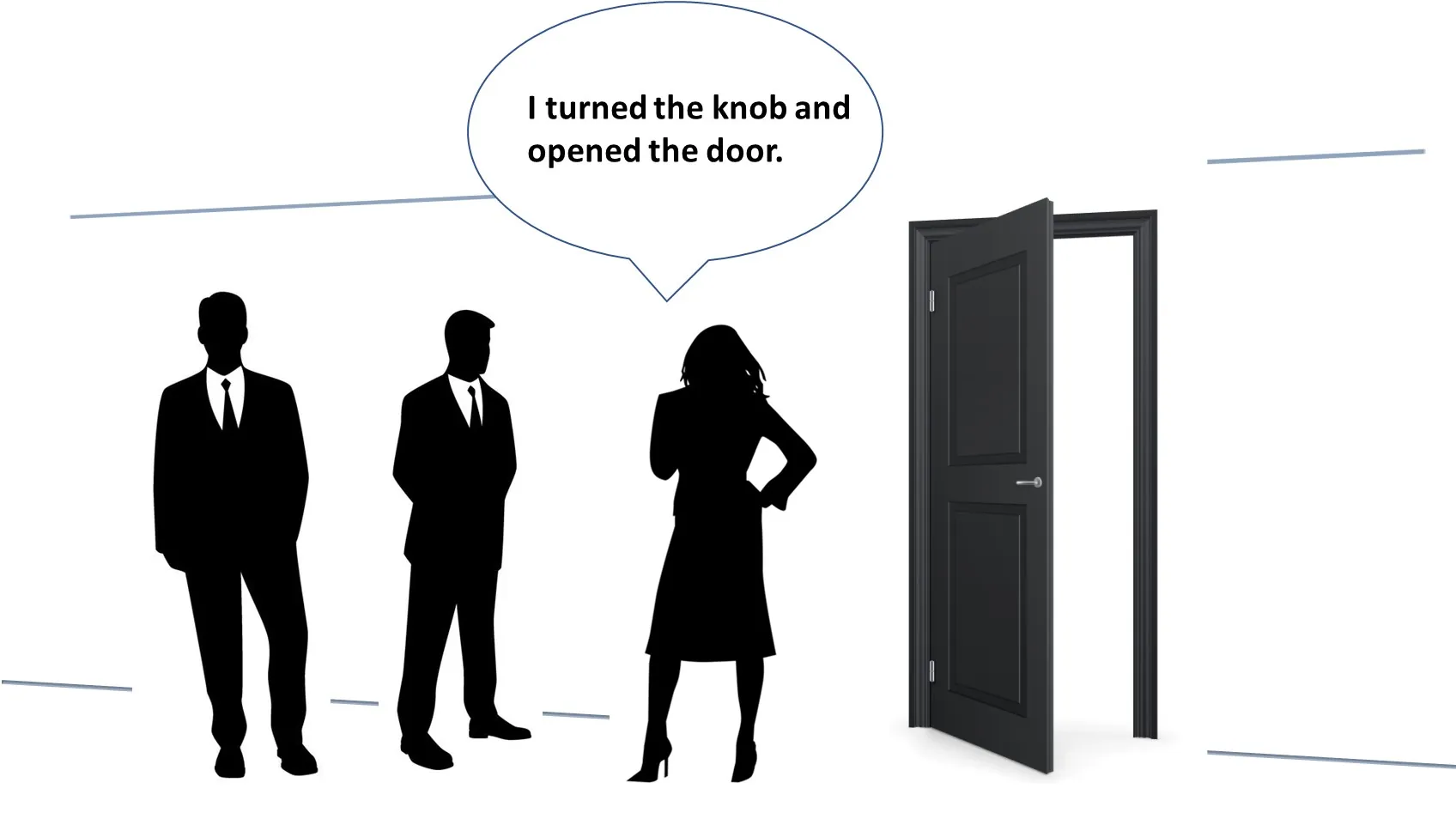
All through my career I faced closed doors. On the other side of the doors were the All-Boys Clubs. I could have let each closed door stop me but as I looked at the door, I also saw knob.
So, I turned the knob, opened the door and walked in.
It was easy.
Of course, men were surprised to see me. but I knew I had just as much right to be there as any man. I knew my credentials, experience and achievements actually gave me more right to be there than many of the men.
And this may shock many women – the vast majority of men accepted me and made me part of their group.
Remember closed doors have knobs. So, turn the knob and walk in.
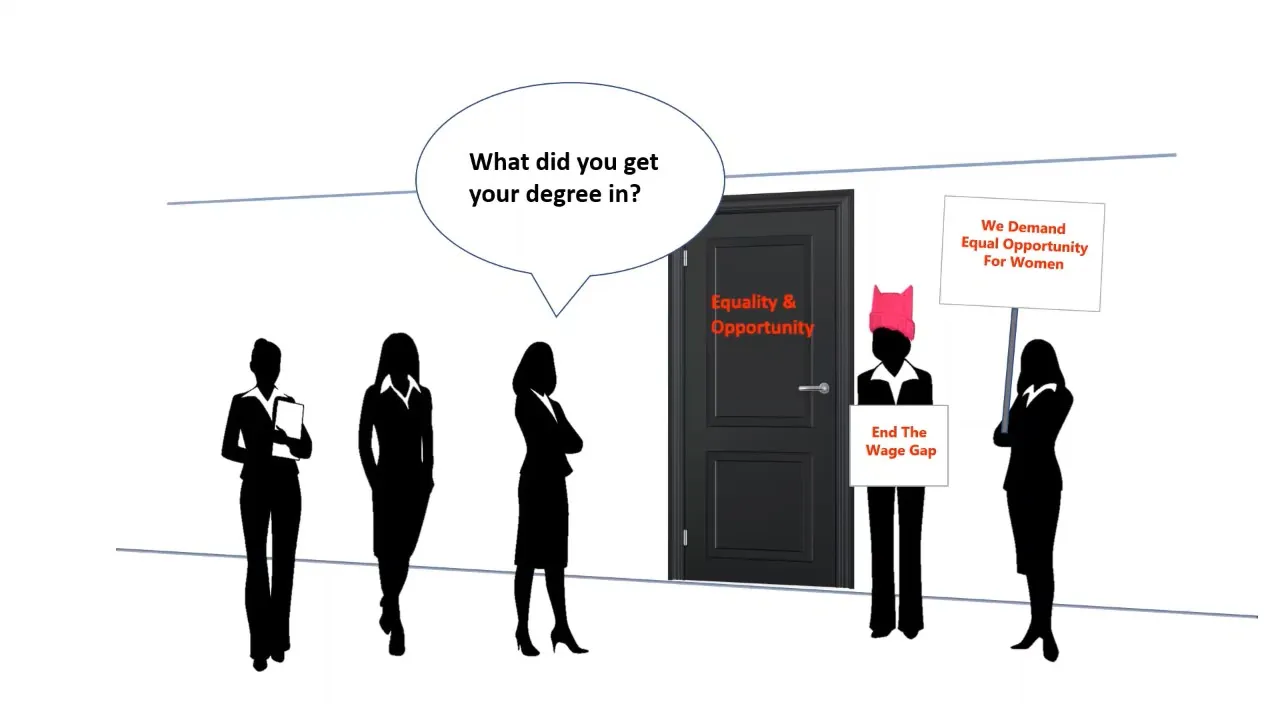
Women are told to go to college because a college degree is essential to a higher paying job and career success. We are told that people with college degrees will earn significantly more than people without.
So, we go to college. We get the degree. We acquire debt. We get a job – a low level job working alongside people who don’t have degrees.
Where did we go wrong?
For many women we make the mistake of getting a degree that doesn’t give us any employable skills. We ignore the fact that employers hire people with skills, people who can do things and people who can accomplish things. And our paycheck depends on the value of our skills and accomplishments.
So a degree that doesn’t give you employable skills won’t translate into a high paying job no matter how prestigious a university it comes from.
As women we also have to recognize that knowledge on a subject isn’t good enough either. In the workplace no one cares that you had a 4.0 GPA. In the workplace your employer cares that you can apply that knowledge to varying situations and achieve their objective.
Closing the wage gap will require more than women getting college degrees. It will require women going into the workplace with the same employable skills as men and accomplishing as much as men.
Watch this YouTube video:
And pay attention to the ending…you may be surprised who has the greatest potential to become a self-made multi-millionaire.
“Toxic Masculinity” makes women concerned about working with men. However, since I spent my career in environments where women expect to find lots of toxic men and toxic masculinity to run rampant, I want to share what I learned about toxic behavior and how to control it.
Watch this YouTube video:
Working in a hard-core male industry I found that out of every 10-15 men, I could expect to find 1 toxic man.
I usually identified him because he spent a lot of time trying to make himself sound important or tough. He was usually the man I found to be the most obnoxious.
As women we frequently think their aggressive behavior makes a toxic man the Alpha male – and that is exactly what he wants us to think.
But, in reality, the toxic man is just an Alpha Wannabe.
As women, since we don’t understand relationship dynamics of our male colleagues, we get a lot of things about them wrong. For example, we’re taught that the Alpha male is horrible, toxic, oppressive, epitomizing every male behavior we hate.
That is NOT true!
In reality, the Real Alpha Male is our best and most powerful ally.
So, watch this video and learn how the male dynamic really works.
And by the way, my feedback from men has been that I got this right!
I’ve been anticipating it and it finally happened. Someone, (Ed Rollins) called Alexandria Ocasio Cortez “little girl.”
Of course, AOC thought the comment was pure misogyny. And her response probably caused lots of old guys to chuckle and shake their heads saying, “Oh little girl, you have so much to learn.”
Obviously, there is a huge generation gap at play but in this case the “little girl” moniker is something AOC shouldn’t dismiss. It’s a warning she should heed.
Remember when Trump called Marco Rubio “Little Marco?” It wasn’t a reference to his hand size or the size of anything else. The slam meant that Rubio was still wet behind his ears. He didn’t have the breadth of experience to be President. Sure, Rubio had a lot of political policy positions, but he lacked real-world experience. He was never responsible for executing his policy positions or accountable for their results.
Rubio didn’t experience the hard knocks, leaving him green and untried. Trump picked up on this created the “Little Marco” nickname.
But Trump also gave him some respect. He didn’t call him “Little Boy Marco.”
Being called “little boy” or “little girl” means you don’t have the basic the knowledge to come up with good ideas. It means you still need to learn how the world and your workplace function before you open your mouth and express your ideas.
We are all “little boys” and “little girls” in the beginning of our careers. Even though we have a college or technical degree, we haven’t applied our education out in the real world. Therefore, we haven’t discovered the many ways our book learning fails against the realities of the world.
We need to spend our early years wisely because what we learn in these years sets the path for the rest of our career. We need to tackle challenging assignments and experience the hard knocks. This is how we us learn and grow. But most importantly, it’s how we earn respect.
AOC needs that experience. When she answers questions, her gaffs reveal how much she still has to learn. So, she needs to spend the next few years quietly learning, challenging herself and growing.
But unfortunately, she is in the social media spotlight. And she may be confusing media popularity with respect. She needs some old school mentors to pull her out of the spotlight, take her under their wing and challenge her.
If she expects to be taken seriously, her ideas have to do more than sound and feel good. She must make them complete and feasible. She needs to figure out how to make them work in the real world. Then she must have the courage to present them and be held accountable for their execution and their outcome.
This is how it works in the real world for anyone, man or woman, who wants to be a leader.
As women we like to distinguish ourselves from men based on our emotions – women are more empathetic, nurturing and compassionate.
But we have to ask ourselves:
How do our emotions benefit us in the workplace?
Years ago, when women tried to assert the value of our emotions, men just looked at us and mocked:
What are you going to make us do?
Sit around holding candles and sing?”
Touting our emotions didn’t get us anywhere.
After that we got lost. We didn’t know what unique value women brought to the workplace. We didn’t know what would make a workplace say, “We need to hire and promote more women!”
So, we fell back to the stereotypes and that is where we have been stuck for decades.
It’s actually gotten worse. The media loves dramatic, emotional women fighting over insignificant issues. Women in politics love to yell at each other and call each other names. Everywhere we look we see emotional, yelling, fighting women.
This is why one of the first videos I made is:
THINK – Women Are More Than Emotions
So watch my video on YouTube:
It’s way past time for women to stop believing we are driven by emotions. We have a miraculous, powerful, wonderful brain.
And once we start applying it, we will change the world.
We often hear about “White Privilege”, “Male Privilege” and of course “White Male Privilege.” where these privileges give you an advantage or opportunity others who don’t have those characteristics don’t get. And, if you follow intersectional feminism, you learn there are an endless list of privileges.
As a female engineer in the military and the construction industry, I had many opportunities to see many “privileges” in action. And while feminists and liberals want to make a big deal out of “White Male Privilege”, it’s really just plain old “Male Privilege” at work.
Even early in my career, I knew many successful “men of color” who became successful at a time when racism was rampant. The reason for their success is something feminism doesn’t understand – the merit system. The old male-dominated workplace valued people who got things done. Period.
I knew many crotchety old white guys who today we would take one look at and think “racist.” However, they respected and were even best friends with nonwhite men who shared their value of working hard and getting things done.
As a young woman, when I asked my first mentor what I needed to do in order to be successful as a woman, he replied:
“Be someone who gets things done.”
I listened to that advise and it served me well. As a 31-year-old woman, I worked on par and with equal pay to men who were old enough to be my father…because I was getting done the same job as them. Actually, I was doing it better.
However, that was not always the case. One of my workplaces was very patriarchal. And even though I was one of the top 3 project managers in the company, I was held back in every way. I was kicked off projects and sent to sit at my desk to twiddle my thumbs while men I trained, mentored and whose work I was expected to correct, replaced me. And of course, they got higher pay.
It was pure male privilege which doesn’t care about the race or ethnicity of a man. It only cares that he is a man and as such he is preferable to even the most qualified, intelligent, competent woman.
I know many women would have given up faced with my circumstances. However, growing up I learned that there are many types of disadvantages and privileges. I faced two lesser-known forms of privilege which should have scarred me for life but instead taught me how to overcome my lack of privilege.
Hair Color Privilege
The first is what I call Hair Color Privilege. When I grew up having blond, brunette and black hair (in that descending order) was the preference. The style of the times also said that your hair was parted in the middle, long and straight.
I didn’t have Hair Color Privilege or any kind of Hair Privilege. You see I grew up with short, curly RED hair.
In the days before Prince Harry made being ginger was cool, my first-grade teacher informed me that my red hair was the mark of “the Devil’s child.” I spent the year dealing with her abuse.
In middle school my math teacher called me “a witch” and routinely marked my correct answers wrong in order to sabotage my grades. In high school one teacher refused to teach me. And I can’t even count how many assignments, tests, reports and homework was marked as turned in but mysteriously was the only one that was lost and not graded.
And of course, being the different girl with red hair (and lots of freckles) was a calling card to all bullies.
On the positive side, my lack of Hair Color Privilege taught me how to stand up for myself. And for other people too.
It made me comfortable being different and being “the only.”
It prepared me for being the woman in the room. So, I am very thankful for my lack of Hair Color Privilege and the strength it gave me.
My second lack of privilege didn’t occur to me until I went to college. It was even more pervasive in it’s conspiracy to hold me back and it was based on my last name.
A-B-C privilege
When I grew up, schools loved alphabetical order. Alphabetical order ensured the kids with A-B-C-D last names were in the front of the line and in the front rows of the classroom. Everyone knew who these kids were. They got lots of attention.
So, with a maiden last name that started with STI, I was very close to the back of the line, perfectly placed to be invisible. Even my bright red hair couldn’t overcome how my lack of A-B-C privilege cast me into obscurity.
When I was in middle school, two schools had to combine for a year, creating overcrowding and I suffered consequences of A-B-C privilege. The most advanced classes were filled in alphabetical order, and by the time they got down to my name, those classes were full. Consequently, another boy (SUT) and I, weren’t placed in our proper class, even though we were more qualified than most of those who were.
This then affected our high school class placement. The math teacher who called me a “witch” used his influence to keep me out of the “honors program” high school. The SUT boy overcame this through his acceptance to a highly accredited private all-boys high school (male privilege). Without a similar female option, it took several months for my high school guidance counselor to realize I was badly misplaced and put me in the “honors program.” Without this correction, it would have been much harder for me to get into the best engineering colleges.
In college, ABC privilege was still prevalent. However, I got married after my junior year and changed my last name to CAL.
That is when I realized the enormity of “A-B-C Privilege“!
With a CAL last name, I was transformed from obscurity to visibility. I was in the front of the line. In the front row. Part of the first group.
It was like a whole new world opened up!!
When I got divorced people asked if I was going back to my maiden name. My answer was:
“Hell no!” I’m not giving up my A-B-C privilege!
(Sorry Mom and Dad.)
Creativity To Overcome
My experience with these two lacks of privilege taught me a lot. Yes, a lack of a privilege is unfair however, it doesn’t make you permanently disadvantaged.
I learned a lack of privilege could be overcome.
In elementary school I watched the boys who were last in line “act up.” By being disruptively funny, these boys got a lot of attention. Every adult in the school knew who they were. In elementary school these boys (and I) learned a very powerful lesson about how a change in attitude and a little creativity can go a long way to overcome a disadvantage.
The high school teacher who refused to teach me, was my teacher again my senior year. However, this time I really got into the subject and remembered those elementary school boys at the back of the line. So, from the back of the classroom, I sat on the back of my chair, or stood up and walked around as I voiced my ideas. I hijacked discussions and amazingly, the teacher and I really clicked. She loved having a student who was as much into the subject as she was. As for me, I learned a lot about taking command of a room, a lesson that came in handy when dealing with a room full of loud, opinionated men.
In my professional life I put these early lessons about Privilege and Opportunity to use.
Many people assume that being the Woman In The Room created a huge disadvantage for me because my colleagues all had Male Privilege. However, I quickly discovered my uniqueness overcame their privilege.
When my male colleagues and I were introduced to senior leadership, or a new client, who stood out?
I did.
I was the person people remembered. I was the one they talked about. I was the one they let approach and talk to them because they were curious about me, my story and most importantly, how I was going to measure up against my male colleagues.
Even if people questioned my capabilities, they all knew who I was. I learned how to leverage that. Then when I was the one who could be counted on to get things done, I was a force to be reckoned with.
Be Positive and Be Your Own Privilege
Life isn’t fair. There will always be people who have some kind of advantage or privilege over you. So, use your lack of Privilege to find creative and different paths to give you opportunity.
And since life isn’t fair, not every situation creates an opportunity. It creates other lessons.
My middle school math teacher who held me back, well, he went to prison for embezzlement. He taught me the joy of Karma.
And speaking of Karma, that very patriarchal company I worked for that kept replacing me with younger, less qualified men all in an effort to prove that “whatever a woman can do, any man can do better.” Well, the project they did it the most on, became the worst project in their history. It is forever, a huge blemish on their previously perfect record. And I never have a problem reminding them of exactly why the project was a total failure.
Then because Karma truly is a bitch (and feminist) she wasn’t done.
In the weeks prior to me leaving the good ole boys were all congratulating themselves for being awarded the biggest project in company history. And since in construction, size matters, they were really stroking their “egos”.
But with my resignation, I also proudly announced:
“By the way guys, my new project is 20% bigger than yours! I have the biggest. I WIN!”
(Yes, that felt really good.)
However, I “won” because I stayed positive. I didn’t let my lack of privilege and all the disadvantages cast on me, stop me from looking for new opportunities. I chose not to stay in places that didn’t let me be all I could be.
As it turns out, Privilege turns out not be all that privileging. It stunts your development opportunities in the things that really matter in life.
Truth be told, from a young age I never wanted to be the kid with all the popular privileges. Their life seemed so boring, so in the box, so safe, so stagnant. I felt like so many of the privileged kids were afraid to take risks or express who they really are because they were afraid of diminishing the arbitrary status their privileges supposedly gave them.
I felt sorry for them. And I guess that’s why I like the people who are different, who stand out, who are quirky and eclectic.
These are the people who learn to be themselves, to express themselves and like themselves.
During my career the first issue I dealt with in every workplace was that my male colleagues never worked with a woman as a peer and certainly not as their boss. Therefore, they didn’t know what to expect.
Their concerns immediately went to the stereotypes:
Is she competent?
Can she function in her role as well as a man?
Is she a man-hating feminist?
Some men were concerned with my mental state:
Will she cry?
Will she be too girlie?
Will she talk too much?
The women in traditional roles who never worked with a nontraditional woman had their own concerns:
Will she manipulate the men into doing her work for her?
Will the guys fawn all over her?
Is she going to make me feel inferior?
Everyone was concerned about how my presence would affect them and the work environment.
How will her presence change the long-established power structure between men and women?
These concerns caused many of my supervisors “to advise” my male colleagues of my hiring. My pending arrival sparked lots of conversation, especially as I rose higher in the workplace hierarchy. The discussions centered on how:
“How are we going to quickly assess what she is like?”
In other words:
“What TEST are we going to give her, so we can see how she reacts?”
Prior to my arrival or shortly thereafter, my male colleagues conspired to create or use an upcoming situation they thought would make me uncomfortable, put me off balance or challenge/intimidate me to see how I handled it. My reaction would then form their opinion of me and my suitability for my job; an opinion that would forever stay with me and be shared with every man.
When I was young and just beginning my career, I was warned to expect these tests. However, several months into my tenure as an Air Force officer, I was surprised I wasn’t tested and I asked my male colleagues about it. Their response was:
“You were tested and all the Senior NCO’s were really impressed.”
Really? When? What was the test?
As it turned out the test came during a training exercise when we practiced our convoy being ambushed. We had to jump off the back of a truck, hit the ground and roll. When my turn came, I jumped, hit the ground and rolled…through a watery mud puddle. I remember observing at the time that I was the only one who had to roll through a mud puddle.
That was the test. Was I afraid to get dirty?
I passed my test because I rolled through the mud without hesitation and then spent the entire day covered in mud from head to toe without complaining about being dirty.
That test taught me a valuable lesson:
If I face every situation in front of me and choose to take it on, I will prove the strength of my character.
I learned that when tested, the best reaction is no reaction. I should just continue moving forward through the situation until I saw it though.
In time I learned this is what distinguished me as someone who can lead an organization through any adverse situation.
Was I ever upset that I was continually tested and needing to prove myself?
No.
I considered each test as an opportunity to distinguish myself above my male colleagues and set a higher standard. I knew that each test was a shortcut to:
RESPECT
In their careers, my male colleagues faced their own tests – though probably only once and it was an easier test.
But by facing a harder test (according to male standards but not necessarily female standards) I earned the right to carry an attitude: