“I had a candidate, female, who we wanted to hire. Her salary ask was significantly lower than her worth – especially considering location. The hiring manager came to me. He said he was uncomfortable with her salary ask, and wanted her to get paid the same as the other people (basically men) in this position. We sent her the offer she deserved.
I didn’t need to champion equity. I didn’t have to advocate or advise, though I would have stepped in if he hadn’t first. The right thing to do is second nature with good leadership.
She took the offer.
Candidates don’t always know what’s going on in the background. But when you find a company that leads with integrity, they have your back before you walk through the door.
Cheers to the men in leadership who are true allies for the women in their industry. I can’t say this enough.”
Are you also cheering for great men in leadership who are true allies for women?
You might want to rethink that.
My immediate response to this post was:
Why would the hiring manager need to ask to pay her more? That doesn’t make sense.
He’s the hiring manager – the person with the authority to determine who gets hired and how much they get paid…unless…he was considering taking her offer…even though he knew it was unfair. So, his so-called discomfort was really him wondering: Should I do it? Can I get away with it?
Faced with a controversial decision, he decided to follow the male-dominated workplace rule: Get a buddy.
So, he relayed the story as a way to bounce the idea off someone else.
It probably took less than a minute for him to figure out that he didn’t have a buddy in this and he needed to pay her fairly.
This manager wasn’t a great example of a true ally of women. He is an example of a cheapskate manager who frequently suffers from bouts of questionable integrity. (I know these guys well.)
On the other hand, a man who is a great ally of women and a true leader would have already determined a salary range for the position that was fair and equitable to other employees. He wouldn’t have been silent after her unfair salary request (as he quietly pondered it.)
Instead, he would have replied with “Good news, this position pays more than that so if we offer you this position, I suspect you will be very happy with our offer.” (Yes, these guys do exist.)
Remember, if your offer isn’t countered, it is probably well below what they are willing to pay. So, when you are asked what salary you want, don’t give a number. Instead ask for the pay range or the “banding” for the position. Once you know this, you can negotiate based on your experience and skills.
It’s important for women to understand how things really work otherwise we can misread a situation.
Confidence is a quality that seems to distinguish between men and women. Men seem to naturally have it.
However, after working with so many men I know this isn’t true. The truth is men are just better at covering up their lack of confidence. This is because the male-dominated workplace expects men to know what to do and how to get things done. It rewards men on this premise. Therefore, men are afraid to admit it when they don’t know what to do.
As a woman working with and supervising men, I had to become very good at detecting when men were giving me a line of BS in order to hide the fact that they really didn’t know what to do.
I also had to be very assertive in calling them out on it whenever my BS detector went off. However, I had to be careful in how I did it. I couldn’t criticize or make them feel incompetent because that alienated them. It was learned dance that began with me just saying “No, that’s not going to work” and holding my ground when faced with (sometimes intense) challenges.
As women, we need to understand that most men derive their sense of self and their value from their professional expertise. If their expertise is questioned, then so is their right to be in their job. In response, men can pout, disappear and avoid you for a very long time.
Consider this.
Do you expect your boss to have all the answers?
Have you ever asked your boss what to do in a particular situation and have him just throw out an answer – sometimes accompanied with anger and yelling. We feel like he just wants to get rid of us and we question if we just hurt our career.
So we go and do what we were told to do. However, often it doesn’t quite work and we don’t know what to do. We know we certainly can’t go back and ask our boss again. We get frustrated and especially frustrated with our boss. But the truth is, we should be looking in the mirror instead.
Our fundamental problem is that we were conditioned to take direction from above and not conditioned to problem solve for ourselves.
We like this conditioning because it makes our life easy. It gets us off the hook. It keeps us from being responsible and accountable.
This is the attitude we need to change!
Problem-solving is one of the greatest challenges our workplaces face. Because our workplaces are made up of people, many workplaces don’t want to admit it when they don’t know what to do. Instead of admitting they don’t have a solution, they would rather fumble around making mistakes, wasting time and money.
Admitting we (as in ourselves) don’t know what to do is the first step in problem solving. However, too many women have been conditioned to be afraid to admit they don’t know what to do. This is a cycle we have to break – and as women, we best suited to do it.
Unlike men, women will naturally ask other women for help. And most of our female colleagues will voluntarily jump in and offer their expertise. It’s common to see several women working together to solve a problem or complete a task because women naturally collaborate!
Our collaboration is what makes us a gazillion times better at problem solving than men. And it is why women must assume a leadership role in teaching our workplace to problem solve.
Throughout my career I used women to lead the men in our workplace to collaborate and problem solve.
No matter how many women are in the workplace, or their role, we start by choosing a problem to solve on our own. We don’t need to ask the boss’s permission. We just do it.
To draw men into solving the problem solving we ask them questions within their own area of expertise. (Men love to share their expertise.) They’ll want to know what we are trying to fix so we tell them. They will gladly chime in with their knowledge, experience and opinion. Once other men see all of us talking, they will chime in too. Before you know it, men are engaged in the collaboration process.
Women lead in collaboration because men will naturally talk to women about things they would never discuss with other men.
In my experience, the workplace dynamic changes quickly. Men voluntarily begin bringing their problems to women to help them solve. (Yes, Hell does freeze over.) By bringing the problem to women, men can initially hide their problems from their male colleagues however, their discussions don’t go unnoticed. When men see other men talking to women, they come over and chime in. Before you know it, discussions, collaboration and problem solving happens organically. Our workplace changes.
I’ve successfully done this in many of my workplaces…even when I was the only woman in my workplace, I still did it.
As a woman, I didn’t adopt the male fear of hiding my weaknesses in order to protect my status and ego. Instead, I freely admitted what I didn’t know because I knew my male colleagues would gladly share their expertise. And since I was the only woman, men came to me with their problems. Consequently, I was drawn into many discussions, and my professional knowledge grew very quickly across many disciplines. More importantly, I learned how the various disciplines had to work together to get our projects done. This gave me a HUGE advantage over my male colleagues who preferred to increase their expertise in one or two disciplines because I could lead my workplace in solving complex problems.
Of course, I ran into a few jerks who mocked me for asking a question in order to belittle me. My response however was to call their bluff, “Well, why don’t you just step up and tell us all what to do…and then we’ll see how well it turns out.”
I learned this was a very powerful challenge because confidence and mockery are easy to project when you aren’t held accountable for the outcome. However, when the finger is pointing at you, it’s a whole different story.
As women we must remember our power won’t ever come from projecting fake confidence or expertise. It will always come from acknowledging what we don’t know, not being ashamed to ask questions and then allowing our natural ability to collaborate to make us our workplace leader in problem-solving.
We live in a society that doesn’t value our female or feminine perspective. It’s thought to be too emotional, not intellectual enough. So, for decades, women were told to think and act more like men.
Today, this thinking is so engrained in us that we don’t even recognize itand certainly don’t question it.
Our most influential women thought leaders reinforce these ideas. We assume they are right because…. look at them! They are so successful!
We want to copy them, but we find it hard. Something is off. Something is wrong. Something doesn’t feel right. But we don’t know what.
So instead of questioning all the advice we’ve been given, we question ourselves. Our conditioning tells us the problem is us. We just don’t have what it takes.
In reality the problem is that we aren’t connecting with our true selves. We aren’t asserting our female and feminine perspective.
In this video I discuss a quote by Sheryl Sandberg which initially sounds good. It’s supposed to sound right…but something inside us tells us something is off.
Watch this YouTube video.
Then, start thinking about how often you push aside your female perspective believing it is inferior.
Additional Note:
Sheryl was what I call a “Blue Zone Woman.” She fully believed that male traits were the key to a successful career. Her concept of “Lean In” screams Blue Zone and male thinking.
Unfortunately, she was completely blind to how she was conditioned because she was well-rewarded for it. Lean In got so much great press because it encouraged women to become “Blue Zone Women” – women who fit into the male-dominated workplace and who would NEVER question how it functioned.
(Did Sheryl stand up against Facebook and Instagram for what they were doing to women and girls?)
I noticed however, that after Sheryl’s husband died, her perspective changed dramatically. I think for the first time she was forced to confront her female perspective. And I hope that she like all of us, find, embrace and assert our feminine selves to the benefit of all.
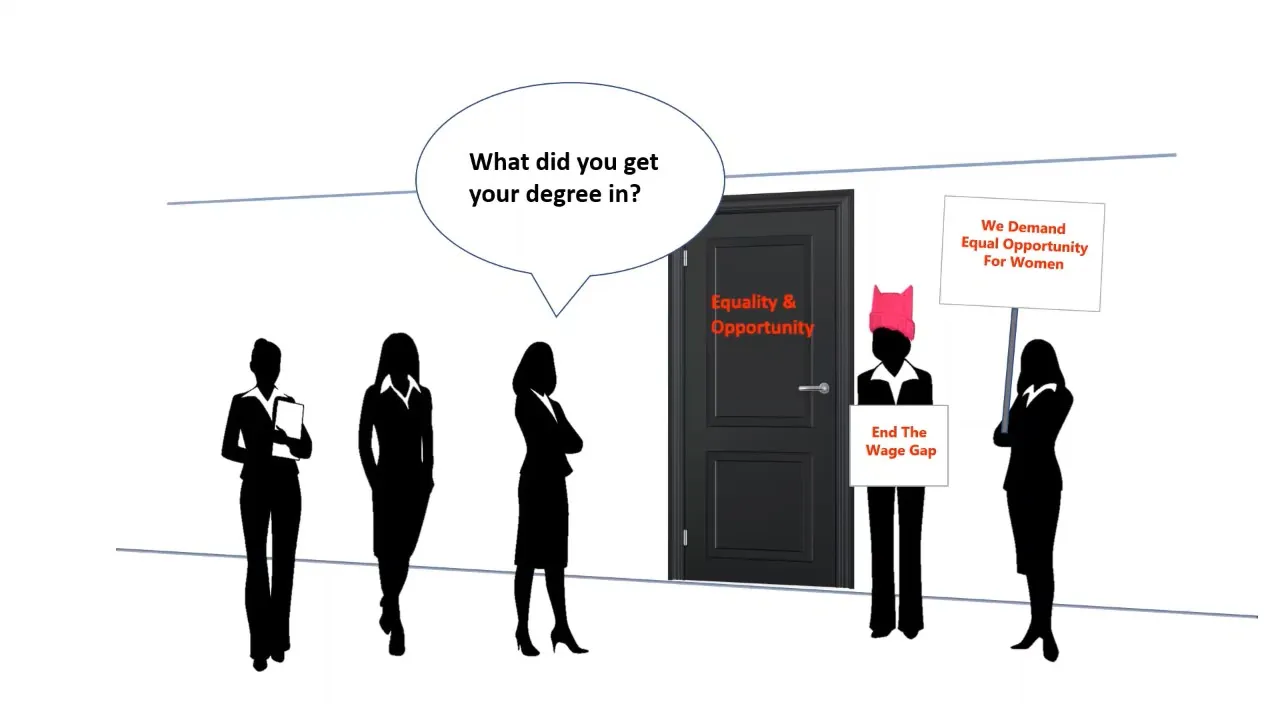
Women are told to go to college because a college degree is essential to a higher paying job and career success. We are told that people with college degrees will earn significantly more than people without.
So, we go to college. We get the degree. We acquire debt. We get a job – a low level job working alongside people who don’t have degrees.
Where did we go wrong?
For many women we make the mistake of getting a degree that doesn’t give us any employable skills. We ignore the fact that employers hire people with skills, people who can do things and people who can accomplish things. And our paycheck depends on the value of our skills and accomplishments.
So a degree that doesn’t give you employable skills won’t translate into a high paying job no matter how prestigious a university it comes from.
As women we also have to recognize that knowledge on a subject isn’t good enough either. In the workplace no one cares that you had a 4.0 GPA. In the workplace your employer cares that you can apply that knowledge to varying situations and achieve their objective.
Closing the wage gap will require more than women getting college degrees. It will require women going into the workplace with the same employable skills as men and accomplishing as much as men.
Watch this YouTube video:
And pay attention to the ending…you may be surprised who has the greatest potential to become a self-made multi-millionaire.