
Tag: career advancement

  • Finding Solutions to Advance Women

    Finding Solutions to Advance Women

    In order to advance women in the workplace, women need solutions for the unique issues and challenges we face.  That is why I started this website.

    When I began, the women who had worked deep in the male-dominated workplace weren’t sharing the lessons they learned. So, through this website my original intent was to share a lot of “How To’s” such as:

    • How to get your voice heard and take command of the conference room when you are the only woman in a meeting with 25 loud, opinioned men who all want to be in charge.
    • How to prevent sexual harassment and what to do when it occurs.
    • How to get a lot of recognition for your achievements without being an obnoxious braggart.
    • How to recognize and seize the hidden opportunities in your workplace that will propel your career forward
    • How to deal with women in traditional roles when you are the first female manager and upset the decades old informal power structure.
    • How to be a leader as a woman.
    • How to be confident when you don’t have all the answers.
    • How to approach any job so you always out-perform your male colleagues
    • How to deal with very competitive male peers.

    These are the solutions women need.  However, as soon I began putting these solutions out there, I met resistance.  I quickly discovered that women had a larger, more fundamental problem:

    Our perceptions about the male-dominated workplace are based on narratives written over 40 years ago.  And these narratives have been repeated decade after decade. Consequently, young women today think they are facts. They aren’t.

    What women don’t know is:

    Even now when I speak to a group of women, I sometimes get lambasted by women who want to protect these old narratives.  Meanwhile the women who have been “the woman in the room” as computer programmers, mathematicians, procurement specialists and statisticians are quietly sitting, nodding their head in agreement with what I am saying.
    It seems many women are focused more on protecting the narratives, than on advancing women. They don’t want to hear how their bad workplace experiences come from the bogus narratives. They don’t want to know how the male-dominated workplace really functions.

    We know that if we want to succeed in an environment, then we have to understand that environment. 

    Therefore, if women want to advance in the workplace, one of the first solutions we have to put in place is and understanding of how the male-dominated workplace functions.

    Here are some basics:

    • Men and the male-dominated workplace are driven by a quest for Autonomy, independence and self-determination. (Women’s narratives say they are driven by a quest for power and domination over others.)
    • Trust and respect are paramount in the male-dominated workplace. (Women’s narratives eradicate men’s trust.)
    • Men fear blame. In some men that fear is intense. (Women’s narratives blame men.)
    • A good sense of humor is critical. (If you have never LMFAO at a Trump tweet, you will have problems working with men.)

    The result of not understanding of how the male-dominated workplace really functions is having a devastating effect on advancing women.  Too many women see themselves as powerless.
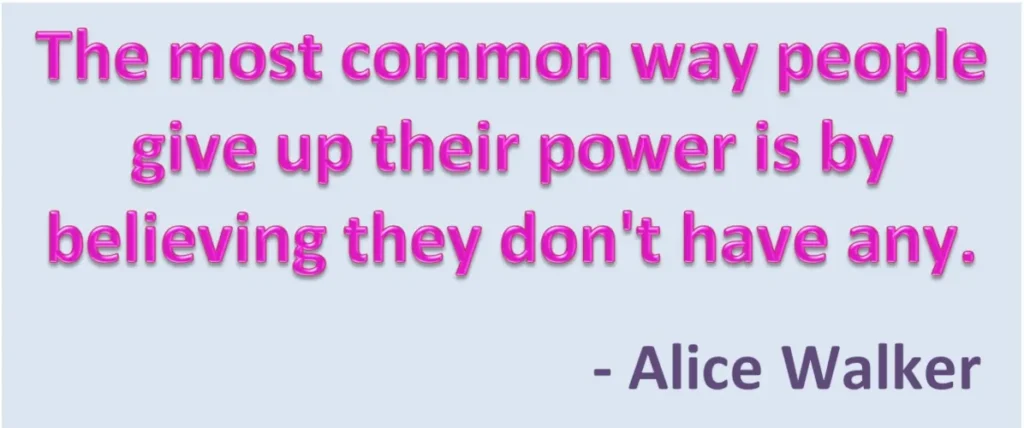
    Quote by Alice Walker saying: The most common way people give up their power is by believing they don't have any.

    Consequently, too many young women accept that the only way women can become empowered, and advance is when men decide to give up some of their power and give it to women.  Since this idea follows the dictionary definition of empowerment, women accept it as a real-world truth. We accept that this is the way the world works.

    Out of all of the narratives this definition of empowerment is the most devastating to women.  To remedy this woman must adopt men’s attitude towards empowerment:

    Women need to understand that our full empowerment and equality already exist.  They are just sitting there waiting for each of us to pick them up and do something with them.  We just have to choose to do so.

    Cartoon of a girl sitting in a chair saying "It's fine. I'll wait."

    As women we should never accept that we aren’t fully empowered.  And when someone says we aren’t we should do what men do – challenge them.

    But many women resist accepting this perspective on empowerment and equality. Why?

    I found one answer when I first began talking about my career. I wasn’t cheered for my success. Instead, I was slammed with comments that I was lying or making it up. Women didn’t want to hear that a woman was successful in a male-dominated job.

    Why not?

    Because I could then turn to them and ask:

    The truth is that the old narratives give women an excuse not to try. They give us an excuse to play it safe and stay in our traditional roles and protect our feminine privilege.

    The fundamental, underlying reason women don’t want me speaking out is because I was willing to give up my feminine privilege in order to achieve equality and advance my career.

    Feminine privilege says women can assume less responsibility in the workplace but still have the same pay and promotion opportunities as men who take on more work, responsibility and accountability.

    But that is not how the workplace functions. Ultimately the workplace is merit based. So, we need to prove we merit the same opportunities, pay and promotions as men because we take on the same work, responsibility and accountability as men.

    I know that the male-dominated workplace is a goldmine of opportunity for women. My blogs, videos and book can help women advance and achieve their full potential.

    We just have to choose to do it.

    Empowered Women Give Up Their Feminine Privilege To Achieve Their Equality.

  • Women Need Solutions, Not More Studies

    Women Need Solutions, Not More Studies

    When women need career advice our first instinct is to look on the internet.  This is what I did a few years ago. 

    After a few hours of reading and skimming through internet articles, I stopped.  I was horrified by what I read.  My only thought was:

    I forgot about looking for my own career advice and dove into this new problem.  I kept reading and realized the articles could be divided into four groups.

    The first group and by far the largest, was what I called:

    The Feel-Good Group.   

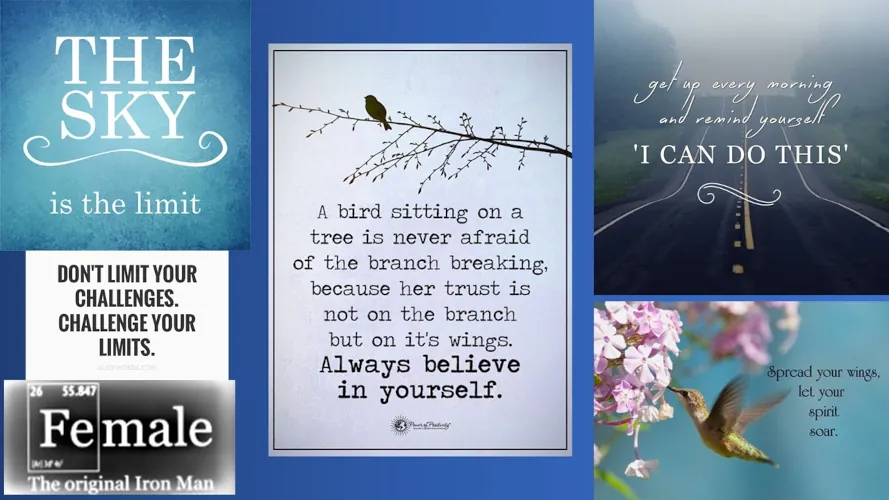
    These articles, blogs, pictures and quotes offered an abundance of inspiration and empathy.  They let me know I wasn’t alone and other women were dealing with the same issues as me.  I felt like my frustrations were heard and shared with the world.  This group made me feel better as it inspired and motivated me.

    But then, after reading what seemed like hundreds of these articles, I still wondered what behaviors I was supposed to adopt or change in order to advance my career.  As an engineer and a business woman, I wanted actionable solutions.  However, The Feel-Good Group offered only inspiration.

    A collage of inspirational messages for women

    The second group had the opposite effect so I called it:

    The Feel Bad Group.  

    These articles and blogs made me feel like women are doomed.  It didn’t matter what I did, how I acted, or what I achieved, the male-dominated workplace was inherently unfair and would always hold me back simply because I was a woman.  According to them, it didn’t even matter if I worked for a female manager because they often treated women worse than men.  Reading these articles I felt more victimized and powerless than I actually ever experienced my hard-core male-dominated the workplaces.  From these articles I concluded that I should stop looking for solutions because my situation was hopeless.

    The third group of articles was summaries of research papers, so I called them:

    The Studies Group. 

    Written by various institutions and organizations these articles were basically long problem statements loaded with lots of facts and figures documenting all the ways women aren’t advancing and achieving parity with men.  I also noticed that the way the facts were sliced and diced led women to conclusions that were inconsistent with my real-world experiences.  I decided that many of these studies were worthless, not only because they didn’t offer solutions, but because they didn’t give me credible information I could use to derive my own solutions.

    For 11 months, I searched and read.  Then finally I was sent an HBR article that I was told belonged to the elusive fourth group:

    Solutions for Advancing Women. 

    I read the article with great anticipation, expecting the wisdom of the ages to spill off the page.  After reading it though, I wasn’t excited.  There was something about it that bugged me.  And I mean it really, really bugged me. Something about it wasn’t right but I couldn’t figure out what.

    Then, it hit me.

    Wow!  What does that advice tell women about their value in the workplace?!

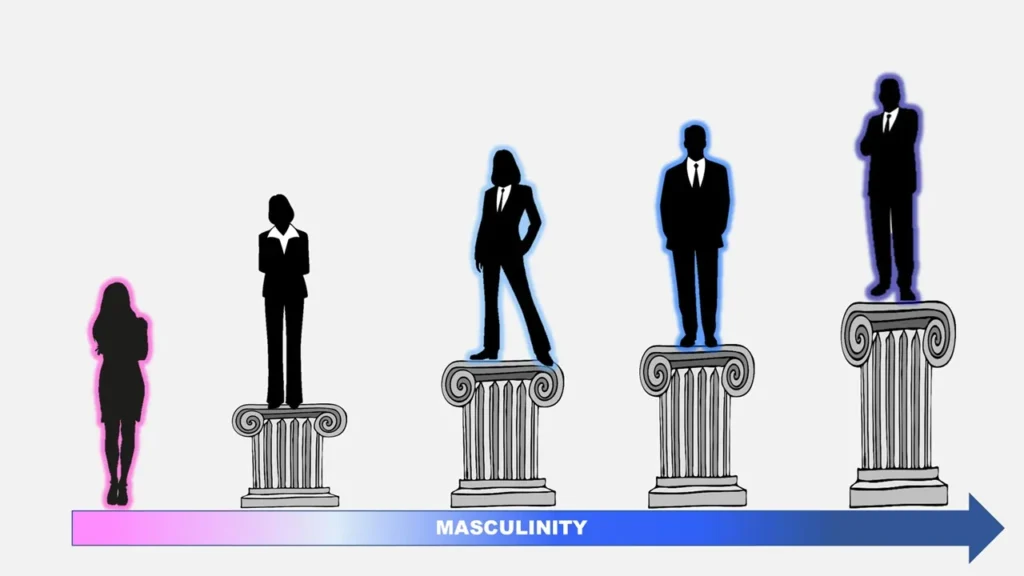
    Graph showing how society favors masculinity. On the right is a woman with a pink glow standing on the ground, then a woman with no glow standing on a pedestal, then a woman with a blue glow standing on a higher pedestal, then a man with a blue glow standing on a higher pedestal and finally a man with a dark blue glow representing his deep masculinity standing on the highest pedestal

    I was disappointed that a year of researching and reading countless articles yielded no feasible and actionable solutions to advance women in the workplace.   However, there were a few things that stuck me.

    The first was that society’s perception of women hasn’t evolved. 

    So, when women have problem, just make us feel better, and – *POOF* – all of our problems magically go away.  In the old days we gave women Valium. Today we are given dopamine through social media feel good posts and bias confirmation.

    The second thing that struck me was that it seems we still believe that female traits are inherently inconsistent with workplace success.  

    Is this why women aren’t given actionable solutions? 

    Do we still believe femininity and workplace success are mutually exclusive?

    This made me question how many people, organizations, institutions and workplaces truly believe men and women are equal and of equal value in the workplace.  This goes well beyond just a gender bias:

    After thinking about all that, I was struck by another alarming thought: 

     Women are being played.

    It seems that many of the organizations, institutions and media aren’t as interested in advancing women in the workplace and society as they advertise.

    Why not?

    Because there is so much $$MONEY$$ to be made off of maintaining the status quo!

    It’s actually very simple.

    We know women are the largest consumer group.  And, if you read any article or book on marketing to women, it will tell you that to sell to women, appeal to their emotions. (Stereotype)

    The product the media and social media sells to women is:

    Emotional Responses. 

    A woman holding a picture of herself crying on her right and a picture of herself smiling on her right.

    If women feel bad, give them an inspirational message, so they feel better.  Then the next time they feel bad, they will return to the site again so they can feel better.

    To generate even more revenue, start generating negative messages so women will seek out the posts, images, a class, a training program or coaching that make them feel good.  By manipulating the cycle and women’s emotions they can generate tremendous revenue. 

    (Take an internet marketing course and this is what they teach.)

    In the years since I began monitoring how the internet uses women, there have been some changes. 

    Women caught onto The Feel-Good Group and want more than just empathy and inspiration.  We want to feel like we are intelligent too. 

    In response, the technique changed and the floodgates opened producing articles and posts that fall into The Studies Group.  There is a reason this is so effective. 

     You probably read a study that says women get more college degrees than men.  Therefore, the media knows it can make women feel good by reminding women that we are academically superior to men.   

    Now, most real studies are long, dry and boring. So, to appeal to women, there has to be an emotional element.  The facts must be sliced and diced to create an emotional reaction. 

    And the chosen the emotional reaction is outrage and an intense feeling of unfairness reminiscent of The Feel Bad Group.

    A prime example of this is the wage gap.

    We’ve all read many studies that cite that women earn 78 or 80 cents to every 1 dollar men earn.  Seeing these numbers, women are outraged! Our workplaces are discriminating against women! We are led to believe women that women earn 20% less than men for doing the exact same job.

    However, that’s NOT what the facts say.

    But to the media that doesn’t matter. It achieved its goal:

    It successfully sold Intellectual Outrage to women.

    The media could now produce countless programs, books, articles, videos and podcasts about the “unfair” wage gap WITHOUT providing any solutions. (Solutions would kill the revenue source.)

    www.123rf.com 24390717

    As women we need to get wise to all the ways we are being sold Intellectual Outrage without any solutions to the problem. 

    It’s everywhere! 

    Emotional manipulation then gives people power over us.

    It’s all a cycle to take advantage of women, not advance women.

    Don’t believe me?

    Conduct your own study.  Read through posts on social media.  Watch any “news” show that discusses politics. Listen to a podcast.

    Monitor your own response.  Is it emotional?  Then ask yourself:

    Empowered Women Aren’t Emotionally Manipulated

    They Seek Solutions