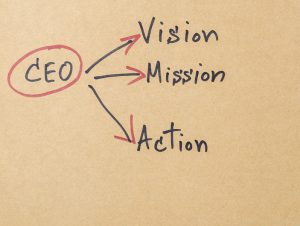
There is an old fallacy that change happens from the top down.
It says that in order for a company to institute a new initiative the first must-do step is: Get CEO buy-in! The CEO then gets the buy-in of senior management. Senior management then directs the initiative down to middle management who carries it out through the workforce.
But if you’ve ever worked for a medium or large company you probably learned a different response to any big announcement of a new initiative: “Yay, I’ll believe it when I see it.”
Many initiatives never make it down to the workforce level. And the few that do often fade out with few if any lasting remnants of their existence. The common excuse, “We didn’t have enough buy-in.”
But the real reason they fade is because they are clumsily tacked onto existing work. They aren’t integrated into the existing operating, managing and reporting systems. Therefore, they don’t feel natural and easy. When we become over-worked or stressed the best solution is to lob off the work that doesn’t fit.
When it comes to advancing women in the workplace, we’ve been trying to use this same top-down approach for 40 years. A women’s organization approaches a CEO and in the tradition of all new initiatives, has him sign a document or make a video declaring the company will now work towards gender equality. It’s great PR – for both parties – but the results are minimal – just like they were with every previous management initiative.
So why do women still use the top-down approach to advance women?
Because we still believe too much in the myth of the hierarchal power and not enough in our own inherent power.
In reality change happens from within and amongst people. It comes from interaction and open and honest communication. So, any woman in any role has more power to affect changes in attitude, behavior and culture than the CEO.
As women we can create change by positively asserting ourselves and making change safe. People are often afraid of change because they fear they will be negatively impacted. When we negate their fears and replace them with positive experiences, the change is embraced.
This is why in my efforts to advance women I focus on the positive changes and meaningful outcomes any woman can create in her workplace:
Improved performance, efficiency and profitability
Achievement and pride in daily accomplishments
Less stress, frustration, chaos and health issues
These changes happen because when women assert themselves, we transform the workplace. We make our workplace Whole.
We’ve all heard narratives about how women “bring balance” to male-dominated workplace. But balance is an incomplete portrayal of the power of women. It still implies that men take more initiative and drive performance while women only curb and prevent them from being total bulls in the china shop.
Balance doesn’t imply full equality.
Wholeness does.
To understand Wholeness, we only have to look at the Yin-Yang concept we are all familiar with.
Yin and Yang are equal halves of the whole. They are dynamic. They continually interact and influence each other in an easy and natural manner, making their interaction feel right. Neither is superior or inferior, each controls the other and both need the other to create a harmonious Whole.
If we think about Yang working all by itself as it does in many of our workplaces, we realize its performance limitations. Working by itself Yang can’t roll all the way over and revolve. Not even the CEO with all of his mighty hierarchal power can make Yang to revolve on his own.
Nor can the CEO make Yin to assert herself and influence Yang. Yin has to decide to do that on her own. That is the power of her equality – she must be the one who recognizes and accepts that she is one half of the whole. She must be the one who steps into and exercises her full equal power.
The changes women want have always been women’s to make. We just haven’t seen our power to do so because we have always been misled into believing in the power of the hierarchy. And even though the male-dominated workplace knows this is a myth it keeps quiet because it wants to hide the fact that the hierarchy can’t create change and doesn’t even know how.
Changes in the workplace and the advancement of women will happen, but only when women accept that men and women really are equal and choose to exercise their equality.
Construction sites have a reputation for crude behavior and the women who work on them can face behavior seldom found in other workplaces. This situation keeps most women away from the industry and those that do enter it often opt for support jobs in the office. Those of us who do venture out onto the construction site enter an extreme male-dominated workplace where it is essential that we know how to handle situations correctly so we don’t ruin our career.
To understand what I am talking about let’s examine a situation I’ve encountered a couple of times – the crude and denigrating drawing of me in a porta-pottie.
If someone made a derogatory drawing of a female colleague in the men’s room at the main office we know what would happen. HR would get involved, a company-wide email would go out denouncing the drawing, there would be mandatory training and the culprit if identified would be fired. In short there would be expressed outrage.
However if a woman took this same approach out on the construction site, it would back fire on her – big time!
Why?
Our first instinct may be to blame construction site culture full of sexism, discrimination and a good ole boy’s club that doesn’t want women intruding into their territory. However, that is wrong and reveals our inherent misunderstanding of the situation. The reality is that any man who used expressed outrage to deal with a site situation would face the same consequences as us. However, most men already understand it back-fires is because it goes against the reasons men enjoy working on a construction site.
As women we are taught to use expressed outrage as our go-to solution. We are taught that men want to have power over us and we have to fight back in order to have our own power. But again, that is wrong and reveals our fundamental misunderstanding of the male-dominated workplace.
In reality, the vast majority of men don’t aspire to have power over others – they aspire to preventing others from having power over them. They want to be independent and autonomous.
The construction site epitomizes a work environment where men get to be independent autonomous. Since it is away from all of the office rules, policies and structure, the construction site has a freedom most workplaces never experience. That is why men (and women) like working there.
When a woman expresses her outrage at the crude comment, men interpret it as her dragging the office rules out to site with her and trying to control them. She and her rules are trying to have power over them. In response they rebel. They they no longer work with her and even sabotage her so she fails at her job and leaves the site.
From a discrimination standpoint, that is extremely unfair. But it is reality.
No one can come onto the site, dictate behavior and be successful. (Every good Safety Manager knows that.) To change site behavior requires coaching, building relationships, earning respect and a healthy sense of humor. These are behaviors women excel at.
A woman who works out on the site must understand these fundamentals and apply them in her response. This should be easy because they align with the culture she wants. Therefore, unacceptable behavior becomes an opportunity to lead and establish a rapport that propels our career forward. That is the approach I took in responding to my porta-pottie drawing:
Many years ago when I worked on a construction site, I could tell something was up. As I walked around site, the guys all looked at me and whispered to each other as if they were expecting me to react to something. After a couple of days I asked a man I had a good relationship with what was going on. He refused to tell me. That made me really curious. As the situation continued and I got more looks, I kept pestering him and a few others to tell me what was going on. Eventually, the man I first asked told me that there was a drawing of me in a crude position on the wall of a porta-pottie. He wouldn’t tell me which one.
News spread fast that I knew. The titillating drama on site sky-rocketed as everyone wondered – What is she going to do?
I didn’t react at all. For the next two days I went about doing my job as normal, all the while chuckling to myself at the men who were obviously waiting with anticipation for my reaction. The waiting fed the titillating drama.
By not reacting right away, I put the ball in my court, I was in control. I also gave myself a couple of days to think about my reaction and figure out how I would use it to my advantage.
Eventually, I went around to different port-potties and just looked at them. This got everyone’s attention and heightened the drama some more. Is she going to open the porta-pottie and see the drawing? How was she going to react?
Again by not reacting, I remained in control. I created an image of strength for myself which began earning me respect.
The next afternoon as I made my rounds on site I stopped in front of a porta-pottie and said “Is this the one with the drawing of me?” No one answered. So I asked, using a tone appropriate for opening a big gift-wrapped present, “Which one is it? I want to see my drawing!”
I never opened up a porta-pottie door which again fed the drama.
Over the next day or two as I made my rounds, the guys brought up the drawing themselves. They wanted me to know they didn’t do it. Of course they all knew who did and with a little prodding eventually gave me enough information for me to figure out which porta-pottie and who drew it. The man was no longer on site.
By waiting a couple of days and playing off construction site drama, I completely changed the situation. No one wanted to be associated with the drawing and how it denigrated me. This was the sign I was looking for – they respected me and wanted me to respect them in return.
However, I still needed to resolve the situation and do it in a way that earned me even more respect.
When I felt the time was right, I went to see the drawing for myself. As I approached the porta-pottie, every eye on site was on me and some men approached. When I looked at the drawing I used my planned reaction “Dang I didn’t know my butt looked that good!”
I wanted to give a humorous reaction to show I wasn’t offended. The crude drawing didn’t have power over me – it couldn’t diminish me, my role or my authority on site. My reaction showed I was strong and confident. It also showed that I understood and valued how the construction site doesn’t conform to office rules.
The ball was still in my court and I needed to pass it to someone else so we could play ball and build teamwork. So, right after my joke reaction I said “Johnny I heard you drew this.”
I purposely accused Johnny because everyone knew Johnny already respected me and followed me to this project so he could continue working with me. I also knew Johnny had a good sense of humor and he would banter back with me as he proclaimed his innocence.
As women we need to appreciate and take advantage of how much men like to banter with each other. Banter and humor are more effective in making a point than outrage or blame. However, we have to be extremely careful. Too often when women banter with men we stay engaged too long and wind up getting hurt. To be effective our banter has to be short and direct.
After Johnny denied the drawing, I bantered back with “I don’t know, I kept hearing you did.” Then I looked at the other guys as if to say “Aren’t you the one who told me he did?” This brought everyone into the joke on Johnny. (No one was thinking about the drawing anymore.)
Johnny of course responded with his own banter back, asserting himself. He drew a good line for the banter to end. If I continued to banter back he could feel like I was unfairly blaming him, trying to make him the scape-goat and trying to assert power over him.
To exit the banter I needed to shift everyone’s attention again so I replied “Johnny, you may be a good artist but is unit 18 ready for inspection tomorrow?”
I already knew it wasn’t. There was a problem Johnny was having trouble resolving. So before Johnny could give his excuse I interrupted him with “Show me what the problem is.”
That simple statement showed I cared about and respected the men who worked on site. It distinguished me from a lot of my peers who avoided getting involved with the problems until they absolutely had to.
As I walked away with Johnny, another man took a marker and covered over the drawing. That proved that I earned the respect of the men on site. From that point on, any time a new man came on site and wanted to denigrate me, the guys stood up for me. It didn’t take long for me to have a great reputation and be the project the guys requested to work on.
When we are disrespected and even denigrated, the easy response is to express outrage. But we have to think about what that really accomplishes and if it is the best response. Does it change the culture? Does it earn us the respect we want?
As I’ve said many times before, our goal isn’t to accumulate notches in our “How women have been treated unfairly belt.” Those notches won’t advance us or our careers. They won’t create culture change. They will however discourage us.
This is why we have to think beyond our expressed outrage, blame and shame responses. To do so requires understanding how your male-dominated workplace really thinks and acts. We then have to think outside the box and be creative. We want to work with our colleagues; encourage and coach them; ease their fears and insecurities; broaden their perspective so they realize they just may enjoy working with us a lot more than working with another man. If we can do that then we’ve led men through the culture change we want.


 Find this article helpful?