When women experience inappropriate behavior, sexual harassment, bullying or discrimination in the workplace, we have a lot of reactions – shock, anger, resentment, fear. Our mix of emotions creates confusion as we try to figure out what we should do about it.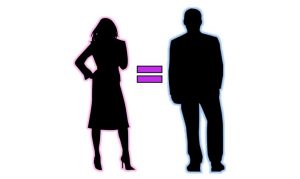
We want to hit the right and appropriate response but we aren’t always sure what it is. We don’t want to come off as a trouble-maker by blowing the incident out of proportion. But we also don’t want to downplay the incident and feel like we let ourselves be diminished. All we really want is stand up for ourselves and be treated with respect for doing so.
I found that finding the right response begins with having the right attitude. The right attitude says that no one has the right to diminish anyone else. This attitude also infers that no one is superior to or better than anyone else. Being higher in the organizational structure, having more education, more job experience, more authority or more anything doesn’t make a difference. As human beings we are all equal and deserve to be treated as such.
When you apply this attitude you come to terms with how diminished the incident really made you feel. Too often women are taught to go right into victimization, no matter who the man is or what the comment or behavior was. However I don’t like victimization because it automatically assumes the offender has power over you and the ability to diminish you. It assumes a natural or inherent inequality.
The right attitude however makes you ask one simple question: Who is this guy that he thinks he has the right to diminish me?
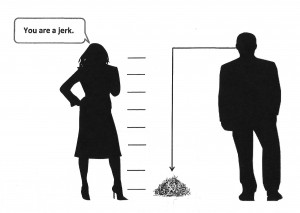
That is an empowering question. It makes you think about why you elevated this guy’s opinion and subjugated yourself to it. Why does his opinion matter to you?
It reminds you that no matter who he is, or thinks he is, he still puts on his pants one leg at a time. Therefore, he is just an ordinary human being and not part of a superior alien species. He may have more power and authority in our workplace but again that doesn’t give him the right to diminish others. It simply means he has a different role and responsibilities. And his responsibilities often dictate that he ensures everyone be treated fairly and equally.
When you recognize your inherent equality, your perspective changes and a new question quickly comes to my mind: What the heck is wrong with this guy?
This question helps you recognize that the incident says nothing about you and only makes a statement about your offender. It allows you to refocus on your offender and why he acted the way he did.
Armed with the right attitude, we can then come up with effective, empowering and appropriate responses to incidents. Personally, I divide incidents and my response into three categories based upon the severity of the incident. In the first two categories, the offender doesn’t have or isn’t using his organizational power to impact to you. This makes it easier to see him simply as a jerk and the incident as representing that something is off with him.
My first response category is the Eye Rolling Response. These incidents are very minor and not worthy of any concerted response on your part. The eye rolling, smirk or “what is wrong with you” expression conveys the message that you aren’t impacted, diminished or subjugated. It is the “I’m rubber, you’re glue, what you say bounces off of me and sticks to you” response.
You want to be careful not to over-respond to these incidents because your offender can be feeling you out, interpret your over-reaction as a sign of weakness and continue to target you.
My second response category is where most incidents fall. You want to stand up for yourself and make a point but, you are afraid it will be blown out of proportion and backfire on you. All too often we let these offenses go without a response. Then we feel bad about that too. We feel trapped in a no-win scenario.
When you think about what you really want, you realize you want culture change. You want your response to help the offender(s) to grow out of their behavior.
The reason we struggle with this category so much is because we’ve been taught to be limited in our responses. We are taught the only acceptable response is to file a complaint and take the issue to management to resolve. But there are two problems with this.
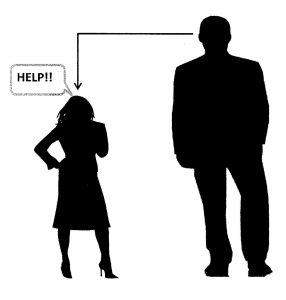
The first is that when we take the problem to HR or management we feel like we are acknowledging being diminished, and that we aren’t capable of standing up for ourselves. It is disempowering. It doesn’t make us feel strong or equal.
The second problem is that the offender will be blamed then possibly punished. In either case he will see himself as being diminished. He will want to restore his equality and respect. And that means you probably just made an enemy in your workplace.
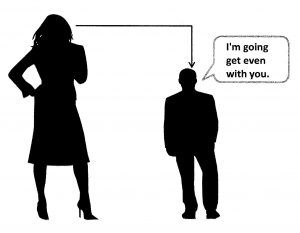
The problem with the standard file a complaint response to these types of incidents is that the solution usually raises one person up and diminishes the other. It doesn’t maintain the equality and the balance of personal power. It is further complicated by the fact that men and women perceive the situation from two very different perspectives.
Women are fighting for their respect and self-esteem. We assume men are too but they aren’t.
Once men are diminished they see themselves as fighting for survival. At this level they fight back more fiercely than women who see this situation from their perspective think is warranted. This leads women to conclude that men are fighting back because they believe in the subjugation of women. So women then fight back harder.
This misunderstanding of perceptions throws the situation way out of wack. Each party feels diminished and blames the other without understanding the other party feels diminished too. The conflict goes round and round with no happy kumbaya ending. It teaches all us that standing up for yourself just creates a bigger mess and isn’t worth it.
This is why in this category we need to think beyond the file a complaint response and be more creative.
Over the years I’ve written several articles about being creative and the effectiveness of using humor to stand up for yourself, address an incident and create culture change. Contrary to what we are taught, humor doesn’t diminish the seriousness of our response or suggest we are merely laughing it off. Instead humor creates a positive environment where no one is diminished so the offender can grow and change their attitude without blame or shame. (super-important to men)
Creative and humorous responses demonstrate that you are equal, strong and confident without conflict. This earns you the respect you wanted all along.
My third category of responses is for the really egregious and ugly stuff. It is where I make a firm stand and take formal action because the offender’s comment, action or behavior successfully impacts me and I can’t stop it. The impact can be:
- Monetary affecting my role, promotion, raise, bonus or lay off.
- Invasive physical contact
- Unwanted attention from a Creeper so I longer feel comfortable or safe in the workplace and/or away from it.
- Bullying
Out of all of these issues, the monetary ones are actually the easiest and most clear cut to resolve. However they are often an indicator of a larger culture that will tolerate the other issues.
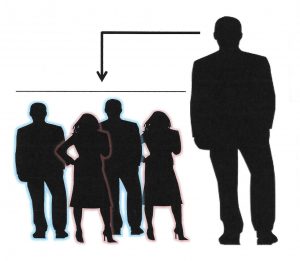 So, whenever you face incidents in this category take a good look around your workplace. You will probably discover that you are not alone in your situation. This includes your male colleagues who often silently endure degrading behavior.
In this category the offender is more emboldened. He’s gotten away with his actions before and that made him feel powerful. He began spinning a flywheel and created a cycle where he abused and intimidated people to make himself feel more powerful. As he abused more people his flywheel spun faster, produced more energy and making him seem invincible. Consequently, no one stood up to him. It is an intimidating one-on-one situation that makes many of us back down and then feel guilty about it. We know the offender is counting on us backing down just like everyone else did and this makes us angry. We want to stand up for ourselves. We want what’s right.
Again this is where your attitude reminds you that he is just a man who created an image and you aren’t totally powerless against him. This fact gives you the determination to stand up for what is right and see it through to the end.
It also forces you into a reality check and recognize that dismantling his intimidating flywheel may take time – there may not be that satisfying swift and dramatic victory. So, check your attitude – are you really trying to diminish and punish him? Or, are you trying to neutralize him, hold him accountable and get justice? There is a big difference between the two and only the latter will be successful.
When you are dealing with an offender especially those with a long list of victims you are not engaging in a battle of wills or power. You are engaging in a battle of flywheels. Therefore, your objective is to put a new flywheel into motion that counters his. You take a stand in order to create momentum against the offender that allows just a few more people come forward. They then increase the momentum of your flywheel. As word spreads, more people come forward and your flywheel is further energized. Your offender becomes less intimidating and his flywheel loses momentum. Eventually the offender is neutralized by the momentum of the forces against him.
It is a scary to be the first person to take a stand and be the one who starts the second flywheel into motion. But if you really believe that all people are equal and no one has the right to diminish anyone else, then you have a duty to stand up. And remember you won’t be in this alone – you will recruit others to increase the momentum of your flywheel.
I’ve found that finding other people to join you is easier when they know you are committed and will not back down. I then present them with a binary choice: Do they want to be on the side that stands up for what is right? Or, do they want to be on the side that supports this bad behavior?
I keep their decision black and white. They can choose to go on the record as a good guy or a bad guy.
Most people want to be the good guys and want to do what is right.
Your “good guys” help recruit the other “good guys” they know and trust. Together you increase the momentum of our flywheel and spread its influence across the workplace. Sometimes you will be fortunate and the right good guys get on board and immediately stop the behavior. Sometimes it takes a while. In these cases, I find that there is an irony. The offender keeps up his behavior to energize his flywheel but in reality he is adding momentum to my flywheel. In the end he destroys himself – and I never had to go negative or get ugly. I just had to stand up for what is right.
I lost count of how many times I’ve successfully put the second flywheel into motion on behalf of myself or others. While it is scary to do the first couple of times, you realize that when we exercise our inherent equality we can restore power and respect to everyone. This energizes a new flywheel within yourself that strengthens your attitude that no one has the right to diminish anyone else. The next time you have the opportunity to take a stand, you do so but with even more confidence.
Empowered Women Have the Right Attitude to Stand Up For What is Right
For more articles on harassment and discrimination go to The Ugly Stuff article category
Empower Yourself – Subscribe to my articles – Contact Me
Assert and Express Yourself – Leave a Comment & Share this article
Follow The Woman In The Room on Facebook for more empowering ideas and solutions!