
Tag: equality

  • Why Women Say “I Can’t”

    Why Women Say “I Can’t”

    During the Covid pandemic, I was listening to my local news when a teaser for the national news came on broadcasting:

    “Teachers and school nurses quit rather than return to school.”

    The next commercial that came on was from my local power company showing men going to work and taking safety precautions for Covid-19 because they have to be out there.  Their work is essential.  They have to get it done.

    The contrast between the two commercials was stark.

    Women saying, “We can’t, we can’t” accompanied by signs saying, “I don’t want to die.”

    While men whose work is inherently dangerous and where they can die just from doing their tasks say, “We can and we will.”

    The contrast is an immediate reminder of the stereotypes.

    Men are brave, daring, risk takers who get things done.  While women who are caring and compassionate are driven by emotion.  Our emotions make us weak and fearful, leading us to become irrational and hysterical. 

    The media then reinforces the stereotype of women being overly dramatic with stories of mothers who are afraid to send their children back to school for fear they might “get sick” (with no symptoms) or become “transmitters” (nice way of saying “silent killers.”)

    Now of course there is science, data and facts to help alleviate women’s fears but mathematical, rational, analytical thinking is just too much for women’s brains.  This is why we defer to “the Experts” who happen to be men to tell us what we need to do.  Right?

    No.

    This is just what we’re conditioned to believe about ourselves. 

    Now this may be breaking new to some – especially those in the media industry – but women are quite capable of thinking and solving problems.  I would venture to say that women are even far, far, far better than men at solving complex problems because we think about how this has to work with that, and that has to fit into this but then there is also this other thing we have to consider.

    In other words, women are really good at thinking about all of the pieces and parts that are needed to solve a problem, and we are also really good at fitting all of them together to create a complete solution.

    woman putting two puzzle pieces together as part of a larger puzzle

    However, women aren’t taught to recognize this ability.  Instead we are taught that men and their brains are superior to ours in problem solving.  So, when women see men and especially “the Experts” get stumped by a complex problem, we believe that of course our poor little emotionally driven brains can’t handle it either. 

    This belief is what conditions us to respond to complex problems with “I can’t, I can’t, I can’t.”

    But we can.   

    Throughout my career I’ve seen women – irrespective of their education or role – “help men” figure out how to assemble all the pieces and parts of a complex problem to come up with a solution.  And it made me question, “Who is the real leader in this situation?  Who is the more valuable person?”

    So, it’s time for women to break free of our conditioning and recognize our abilities for the leadership qualities they are.  But first, we also have to adopt the same attitude as men. 

    When women adopt this attitude then we will stop saying “No, I can’t” and begin saying “Bring it on….Because…Yes, I can!” 

    But more importantly, we will experience the joy and challenge of problem-solving and the sense of achievement that comes from creating a solution that works. 

    Empowered Women Say, “Yes I Can!”

  • Turn The Knob

    Turn The Knob

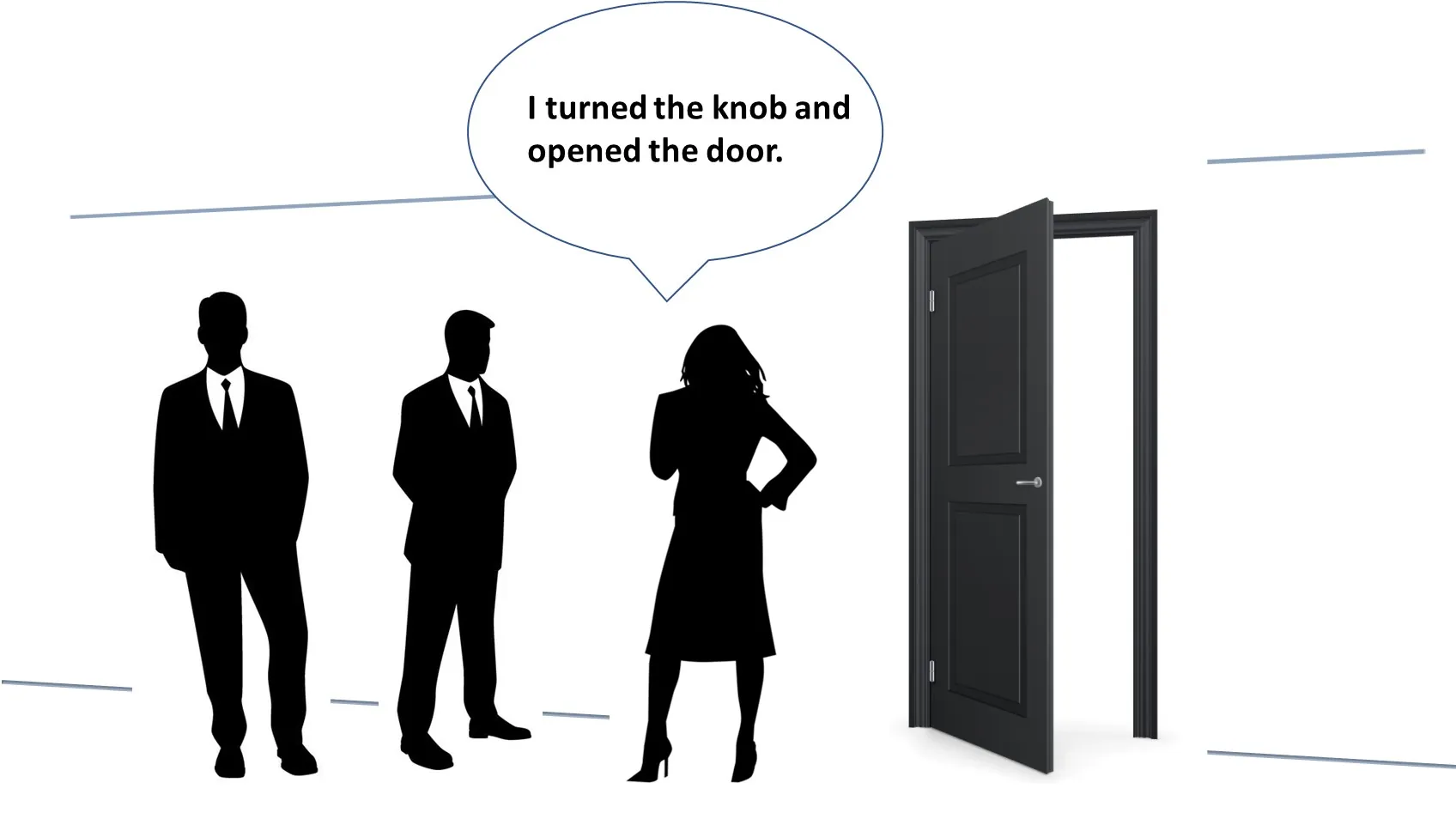
    All through my career I faced closed doors.   On the other side of the doors were the All-Boys Clubs.  I could have let each closed door stop me but as I looked at the door, I also saw knob.

    So, I turned the knob, opened the door and walked in.

    It was easy.

    Of course, men were surprised to see me. but I knew I had just as much right to be there as any man.  I knew my credentials, experience and achievements actually gave me more right to be there than many of the men.

    And this may shock many women – the vast majority of men accepted me and made me part of their group.

    Remember closed doors have knobs.  So, turn the knob and walk in.

    Empowered Women Don’t Let Closed Doors Stop Them

  • Seeing and Believing In the Equality of Women

    What value do women, bring to the workplace?

    For centuries the accepted answer was “None.”  Even today most of us can still only give a vague answer.  We hear that companies with more women perform better but we can’t specifically state why that is.  Without a clear answer, women don’t know how to leverage themselves at work and companies don’t have an incentive to proclaim “We need to hire and promote more women!”

    The reason we can’t define the value of women is because we are still influenced by old ideas.  Most notably is the Doctrine of Two Spheres, which most of us probably never heard of even though we know its effects.

    The Doctrine of Two Spheres states that men and women, due to their biological makeup naturally inhabit two distinct and separate spheres.  According to the doctrine men naturally have traits suited for the public sphere (politics, law, business, commerce, academia and finance) while women naturally have traits suited for the private sphere (domesticity, child rearing and religious and charitable work).  This doctrine determined that male traits set a superior standard in the workplace and female traits are of little to no value.

    Back in the 20th century when women first went into the workplace to work on par with men, we didn’t question the validity of the doctrine.  We didn’t declare women’s equality by saying “Female traits are just as important to workplace success as male traits!”  Instead we sought women’s equality on the basis of equal rights and equal opportunity – giving women the right and the opportunity to go into the workplace and achieve the superior standard set by men.

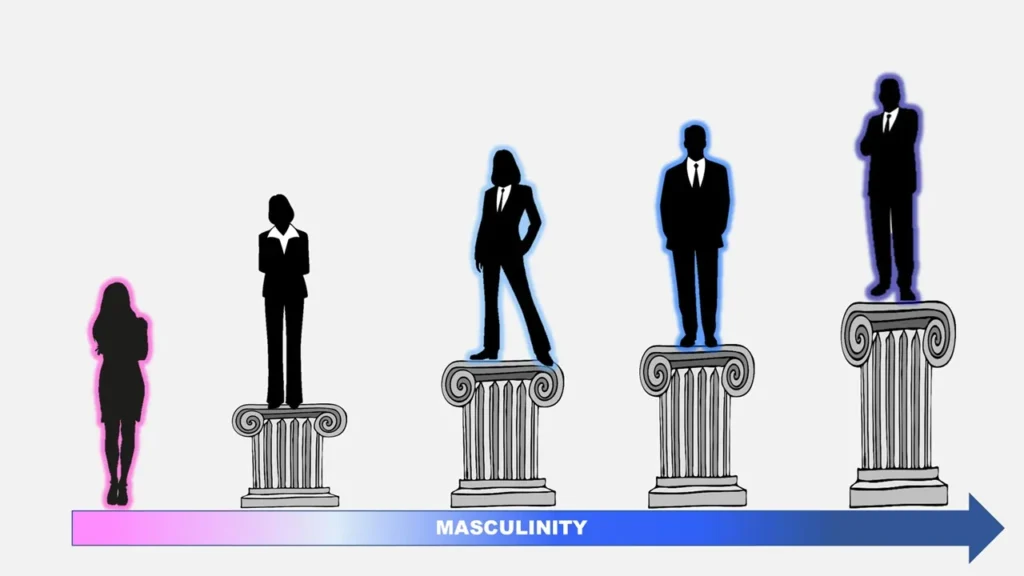
    Without the declaration that female traits are just as valuable as male traits, a woman couldn’t work on par with men by acting like a woman.  To be equal she had to be perceived as being the same as a man.  She had to leave her female traits behind in the private sphere and adopt male traits for the workplace.  She could have the body of a woman but she had to think and act like a man.

    Many, many women still think this way.

    The consequences of this have been enormous for women.  We perpetuated the perception that men are superior and women inferior in the workplace.  We made women choose between their femininity and having a career and financial security on par with men.

    This choice keeps women out of many industries, jobs and professions, especially the highest paying.  It is a major contributor to the wage gap.  It leads women to conclude that they can have a career but they can never go as far or achieve as much as their male colleagues.  It is a significant reason why women aren’t advancing in the workplace.

    This is why any effort to advance women has to start with throwing the Doctrine of Two Spheres in the trash can.  We have to stop comparing women to men, stop telling women to copy men and stop believing that the way men do things in the workplace is the best and right way.  We have to stop believing women will obtain equality when we measure up to the standards set by men.

    This is how I began my engineering career.  Like many women, when I started my career I had high expectations of my all-male workplace.  However, it took me only a few days to say, “What the Hell?  I thought you guys knew what you were doing!”

    All around me I saw was chaos, crisis management, stress and lots of inefficiency.  Any concerns I had about measuring up to my male colleagues immediately vanished.  I saw lots of things that I needed to fix if my workplace was to meet my standards.

    I quickly realized that the way my male colleagues worked always felt incomplete – it was as if there were a lot of “things missing” in everything they did.  At the time I couldn’t quite articulate what was “missing” so I began using the term “Swiss cheese” to describe how they “functioned” and “completed” tasks.

    To fix my workplaces I didn’t copy my male colleagues or compete in their discussions.  Instead I listened for and looked for what they weren’t saying or doing.  I looked for the Swiss cheese holes.  Then I asserted myself and filled in the holes.  Filling in the holes felt obvious and completely natural.

    It also made our performance soar.  It made me wonder why millions and millions of men armed with their superior traits never figured out how to fill in the holes like I did.  We had the same education and experience.  There was only one difference between us – I was a woman.

    Could it be that as a woman I brought unique and valuable traits to the workplace that men couldn’t?

    After many years and many workplaces I concluded the answer was – Yes!

    I discovered that it was the combination and interaction of male and female traits that made workplace performance soar.

    To understand how this works we only have to look to the Yin and Yang concept we are already familiar with.

    Unlike the Doctrine of Two Spheres which divides male and female into two static and separate spheres, Yin and Yang are connected opposites.

    Yin and Yang continually interact and influence each other.  Neither is superior or inferior.  Each controls the other and both need the other to create a harmonious whole. 

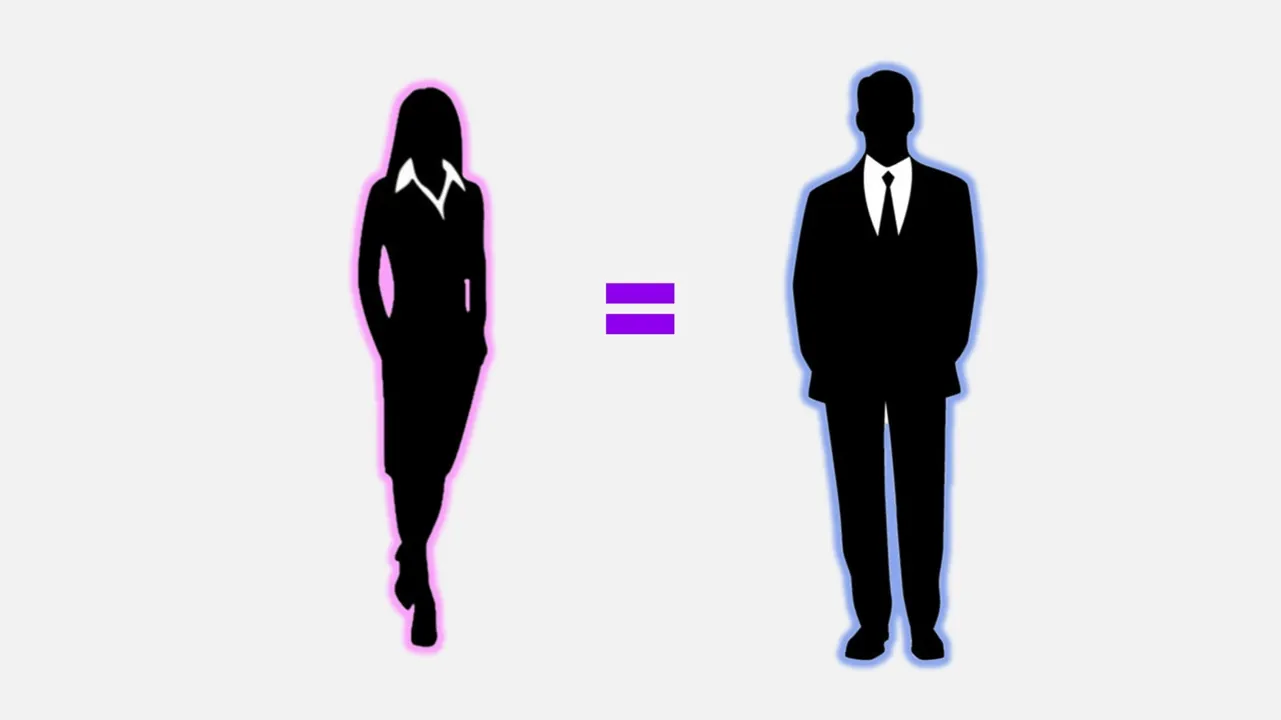
    Yin and Yang allows men and women to be different but still remain full equals. 

    But it is really the concept that men and women together create wholeness  that is really important.

    This is what I picked up on when I began working.

    My male-dominated workplaces weren’t whole.  They were full of Swiss cheese holes because they didn’t have any women.

    I came along and provided the missing other half.  By asserting my female ways of thinking and doing things I made my workplaces whole.

    The significance of this is enormous to all workplaces and companies.

    It  means they are all under-performing.

    This is especially true for all those heavily male-dominated STEM industries who work from the premise that male traits are the right traits for their industry.  But watch the movie Steve Jobs: The Man in the Machine.  Listen to how many times the word “chaos” is used and how often the men talk about their stress and frustration.  This occurred because they were working with only one half of the whole.

    Workplace that function in wholeness, achieve greater performance while also reducing stress, frustration, chaos and inefficiency.  That is the beauty of working in wholeness.

    So let’s answer the original question: What value do women, bring to the workplace?

    Women make the workplace WHOLE. 

    This is why  workplaces with more women  perform better.

    Empowered Women Understand They are One Half of the Whole and Essential to Every Workplace


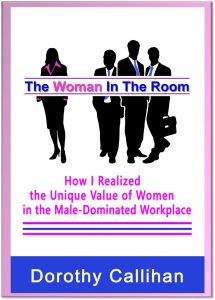
    To learn more about the value of women in the workplace and how we create wholeness, checkout my book. 


  • Do Women Self-Discriminate?

    Recently I read a comment in a post:18692973_m

    “Women want to be treated the same as men except when they want to be treated differently.”

    Then I did a double take – the comment was written by a woman and had over 10,000 Likes.  Wow!

    I couldn’t help but wonder what experiences 10,000 people had to make them all find more than a grain of truth in that statement.  Do women really want to pick and choose when they want to be treated as equal to men?

    I will admit I’ve known some women like that.

    Gender equality means men and women have equal value and equal treatment.  So to understand the comment, I Googled gender inequality issues, reasons, causes, etc.  Most of the articles discussed income inequality and the wage gap.  There were also a lot of general discussions about glass ceilings and gender biases.  The articles all came from the perspective of how society is constructed to hold women back or make it difficult for women to have economic parity with men.

    However the comment and the experiences of 10,000 people say that it isn’t just society holding women back.  Women aren’t doing all they can to advance themselves either.

    After many hours of searching I still couldn’t find any articles that discussed why women pick and choose their moments of equality.  Then buried in one article I found the term “diminished responsibilities.”  The example it cited was men dismissing a woman who wanted to help unload a truck.  “Don’t worry sweetheart, we got this.  You go on back to the office.”

    According to the article if she wants to unload the truck then the men should let her.  That sounds good.  That sounds like equality.

    But wait!

    What about the other 2 women who work in the office?

    Shouldn’t they be out helping to unload the truck too?  Isn’t that equality?  Or do they get to decide that unloading the truck is man’s work so this is one of those situations they don’t want to be treated as equals?

    In the past we’ve excused women from this type of work because it was physical.  However, current workplace safety rules have pretty much negated this excuse.  Equipment must be used to lift heavy objects, even by men who are strong enough to lift the object without equipment.  So there is no reason why women can’t help unload the truck.

    Today there is no reason why women can’t do the overwhelming vast majority of things once considered a man’s job, even physical work.

    So I see diminished responsibilities expanded with four applications:

    1. It is men saying women can’t  do something because it is a man’s job
    2. It is women excusing themselves from doing something because it is a man’s job

    (We can all come up with examples to fit these applications.)

    1. It is women saying men can’t do something because it is a woman’s job.

    (Sorry, I am having a hard time coming up with an example of this except for giving birth, breast feeding and helicopter mothers who never cut the apron strings to their sons.  I can think of a lot of things we let men do but then aren’t satisfied with the results.  So, if you have an example, leave a comment.)

    1. It is men excusing themselves from something because it is a woman’s job

    (We can come up with a long list of examples but they are all considered politically incorrect.)

    If women will stop themselves from doing a man’s job but won’t stop a man from doing a woman’s job, we can conclude that women pick and choose when we want to be equals.

    That makes women sound like hypocrites.

    If we are going to have true equality then we need to eliminate all four applications of diminished responsibilities.  We need to set a new standard where we see most jobs, tasks, responsibilities and accountabilities in terms of being an adult, not in terms of being a man or a woman.

    Actually this isn’t even an equality issue – it is just a fact of modern life.  Today, there are a lot of single people in all age groups who have to carry life’s responsibilities solo.  Men have to cook, clean the bathroom and do laundry.  Women have to take care of their cars, earn a living and manage their finances.   This is just the way it is.

    And yet, we are still using a mid-20th century perspective of inequality.  Too often we are solely focused on others oppressing or discriminating against women.

    We ignore that many women are still sitting back, letting men take the lead and in a secondary role by their own choosing.  Our society still allows women to choose #2 – to see tasks and jobs as men’s jobs and opt out.

    Even though this still perpetuates the idea that women are weaker or inferior to men, we don’t call this politically incorrect, discrimination or inequality.  But it is self-inflicted discrimination.

    As women we have to look in the mirror and see if we are choosing to hold ourselves back – if we only want to assume the perks of equality and not the less pleasant responsibilities and accountabilities that come with it.


    As a society we have to apply equality evenly – between men and women and amongst women.  This means we see men and women as adults who share a common list of responsibilities and accountabilities and have an equal expectation of living up to them.  If we don’t then we all wind up confused and with 10,000 people liking the comment above.  And that’s not good for anyone.

    Empowered Women Don’t Self-Discriminate


    Leave a comment and don’t forget to share!

    To subscribe to my articles Contact Me


  • Run to the Ball!

    A few weeks ago while walking my dog in the park I watched a father hit baseballs to his young son.  The boy standing in place missed several balls as they hit the ground all around him.  His father finally said “You have to run to the ball.  Don’t wait for it to come to you.”  The boy started moving to meet the ball and even though he didn’t catch the fly balls, he got many of them on the bounce.
    I found myself thinking that the father taught his son a great lesson that went well beyond baseball.  Don’t wait for things to come to you, you have to run to them and meet them where they are.

    I could understand the boy’s hesitation.  Running to the ball is scary.  It can hit you in the face and give you a black eye.  Or you can embarrass yourself if you slip on the grass and fall flat on our face.

    Thinking about my trips to the park and watching all the activities boys and men engage in there, it made me wonder how many girls are taught to run to the ball.

    Too many girls are still never told they have to run to the ball.  Too many aren’t even encouraged to get out there on the field and play.  And if they do play and find out they don’t like it, they can quit and go sit on the sidelines.  Girls are allowed to play it safe.

    Boys aren’t allowed to play it safe.  If they don’t like the game or don’t play well, they change positions or find a different game to play.  They have to keep playing so they learn how to make things happen for themselves so they keep advancing themselves.

    When my girls were growing up they didn’t play ball, they rode horses.  At the barn, parents who brought their daughters out for the first time would ask me if riding horses was worthwhile.  I would laugh and say “Be prepared for tears.  Lots and lots of tears.”  Learning to ride a horse and make it go over jumps is hard and sometimes frustrating work.  And of course parents were concerned about their daughters falling off and getting hurt.  “They will fall off.  They may get hurt.  But they will have to get back up on that horse again and keep trying.”    That is the real lesson.

    But are we so afraid of our girls getting hurt – physically or emotionally – that we give them permission to sit on the sidelines?

    What would happen if all girls were told like boys are that they had to play and they cannot quit?

    What if we taught all girls they have to run to the ball and they have to make things happen for themselves?

    Isn’t that real equality?

    Or is our thinking about equality limited to:  If you want to play, then equality says the boys have to let you play.  But if you don’t want to play that’s okay.

    If we allow girls to sit on the sidelines, then shouldn’t be surprised that they are more vulnerable as women.

    We shouldn’t be surprised that women aren’t equally represented in high positions in government and business.

    We shouldn’t be surprised that there are very few self-made female billionaires.

    We shouldn’t be surprised that women earn $0.78 to every $1.00 men earn.

    We shouldn’t be surprised that women stay in a bad situation at home or at work.

    We shouldn’t be surprised about the number of single mothers that are trapped in poverty.

    And we shouldn’t be surprised that society hasn’t fully benefitted from the gifts and talents of women.

    It seems to me that all girls should be taught to run to the ball.  They should be out in the field experiencing what it is like to miss the ball, get hit by the ball and to be laughed at when they slip and fall on their face.

    Only when they are out on the field do they build the character to keep trying.

    And it only when they keep trying that they learn the exhilaration of running and catching the ball they didn’t expect to catch.  It is only then they will hear the crowd cheering “You go girl!”

    What girls choose to do with their ability to go for the ball once they are women is up to them.  But with the character instilled in them as girls, they know as women they can get out on the field and play.  And they know that as they play they will get better and better to the benefit of themselves, their workplace and society.

    Megan Martin getting through an obstacle:  https://www.youtube.com/watch?v=51V-cY414qg

    (Karen O’Connor refusing to fall off her horse: https://www.youtube.com/watch?v=Du3496C7WwE


    Empowered Women:

    Run to the Ball,

    Get Back on the Horse,

    Keep Trying Until They Make it Through the Obstacle

    Keep Going


    To learn more about the empowerment and value of women in the workplace check out my new book.

    Don’t forget to leave and comment and share!