One reason I started my website and blogging was to help women be proud of who they naturally are. Too often we are afraid to say that men and women have different traits because we assume all traits identified as female will be labeled inferior. Our society has historically favored male traits and used men to set the standard. 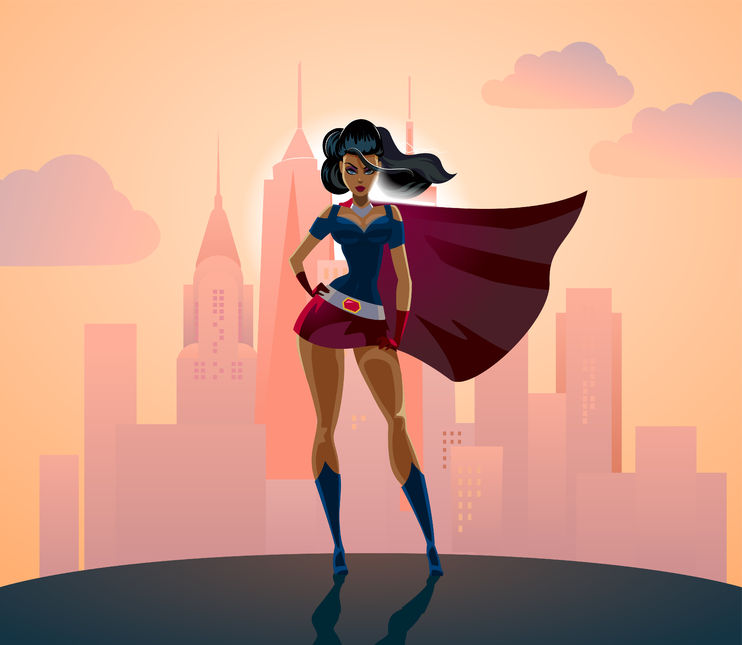
As women we are conditioned and taught to think like men and often don’t even realize it. We just feel those subtle little differences where we don’t align with the standard. And we are trained to interpret them as not measuring up or fitting in.
Using men as the standard, women are portrayed as a subset of men. We are part of man-kind, created from Adam’s rib. We are wo-men. We are fe-male. We don’t have our own unique characterization that doesn’t reference us back to men.
This is why I like the words feminine and heroine. Feminine is distinctly different sounding from masculine. Heroine is distinctly different sounding from hero even though it has hero is in its spelling. Saying heroine doesn’t conjure an image of a man. We visualize a noble, courageous woman who is admired for her own achievements. She is the equal of a hero and fully capable of acting on her own. When she teams up with a hero, they are full side-by-side partners. A hero doesn’t overshadow a heroine.
As a word that creates an image of womanhood, heroine is great because it portrays an image of a woman that is unique and independent from a man.
However, heroine is now being replaced by the word “shero.” As soon as we say shero, we think of the word hero. Men come into the picture. It is as if we can’t think of a strong woman without also being reminded that men are heroes too – we can’t talk about Wonder Woman without talking about Superman.
Shero gives us the subtle message that men set the standard and women are attached to men. S-HERO It doesn’t support an image that women can be unique and independent from men.
I looked up the definition of shero. It is used interchangeably with heroine. More correctly it is used to describe a woman who stands up for women’s right and equality. Okay. But why can’t we still use heroine to describe a woman who stands up for women’s rights?
Is it because when we think of a heroine, we think of Wonder Woman with her Amazonian body, tiny outfit and golden lasso? Does Wonder Woman over sexualize a heroine so we are using shero to tone it down?
THIS IS WHERE IT GETS REALLY INTERESTING:
Completely unrelated to this article, I was doing some research on New Womanhood when I came across an article in The New Yorker by Jill Lepore about Wonder Woman called “The Last Amazon.” It seems odd that researching early feminism would pull up an article on Wonder Woman.
http://www.newyorker.com/magazine/2014/09/22/last-amazon
Here are some quotes from the article:
“Superman débuted in 1938, Batman in 1939, Wonder Woman in 1941. She was created by William Moulton Marston, a psychologist with a Ph.D. from Harvard. A press release explained, “ ‘Wonder Woman’ was conceived by Dr. Marston to set up a standard among children and young people of strong, free, courageous womanhood; to combat the idea that women are inferior to men, and to inspire girls to self-confidence and achievement in athletics, occupations and professions monopolized by men” because “the only hope for civilization is the greater freedom, development and equality of women in all fields of human activity.” Marston put it this way: “Frankly, Wonder Woman is psychological propaganda for the new type of woman who should, I believe, rule the world.”
“But more of the mystery lies in the fact that Wonder Woman’s origins have been, for so long, so unknown. It isn’t only that Wonder Woman’s backstory is taken from feminist utopian fiction. It’s that, in creating Wonder Woman, William Moulton Marston was profoundly influenced by early-twentieth-century suffragists, feminists, and birth-control advocates and that, shockingly, Wonder Woman was inspired by Margaret Sanger, who, hidden from the world, was a member of Marston’s family.”
“Her “undermeaning,” Marston explained, concerned “a great movement now under way—the growth in power of women.” Drawn by an artist named Harry G. Peter, who, in the nineteen-tens, had drawn suffrage cartoons, she looked like a pinup girl. She’s Eleanor Roosevelt; she’s Betty Grable. Mostly, she’s Margaret Sanger.”
Margret Sanger is Wonder Woman!
I like this! We have a new image of heroines as confident, intelligent, athletic, courageous and sexy feminists.
So, we don’t need sheros. We have heroines like Wonder Woman!
Empowered Women are Heroines