
Recently I read an article about how to be an effective Change Agent. The article listed the characteristics of a Change Agent as Positive, Visionary, Likeable, Open and Strategic. It is through these qualities that the Change Agent has the ability to alter the deeply held beliefs of others simply by being authentic.
Whoa.
The person who wrote this has never been a Change Agent!
I hate to burst anyone’s bubble but being positive, open, likeable or even collaborative isn’t enough to alter deeply held beliefs. These positive characteristics aren’t a magic wand or magic fairy dust that makes Change easy. Sorry. That’s not how it works.
I’ve been a Change Agent in all of my workplaces and learned that the most important quality of a Change Agent is the ability to deal with Conflict. If you can’t deal with Conflict, then you can’t make Change happen.
When we create a Change, we are asking our team to go beyond their current comfort zone. Each team member has their own personal response. For some the Change is non-threatening. Others will be reluctant. Using the positive qualities mentioned above helps get most people on board.
But not everyone. In most organizations there is one hold out.
You know who I am talking about.
This is the person who only wants to do things their way. They have a history of resisting and derailing any attempt to Change the status quo. The team, having been through this before, knows that unless this person buys-in. the Change won’t happen. So they take a wait-and-see attitude. They want to see how you, the Change Agent is going to deal with the Difficult Person.
The Difficult Person resists Change as if their life depended on it. Change threatens how they perceive themselves. We all want to think that we are doing things right and working as hard as we can. But, to a Difficult Person Change is like a megaphone publicly announcing: “You’ve been doing it WRONG! You don’t know how to do your job because you are incompetent.”
Change triggers something from their past that causes their response. They see themselves losing status and fight back the way they were unable to do in their past.
Being good people, we recognize they feel threatened and immediately try to ease their concerns. We try to be nice, get to know them, be their friend, talk to them, hear them out etc. etc. But none of this works. Their negativity continues. We become worn down and exhausted. We are too drained to push forward with the Change and give up.
Change is just too hard.
The Difficult Person got exactly what they wanted.
The rest of the team is discouraged. They feel trapped and held hostage by the Difficult Person. They view management as weak because they can’t deal with the Difficult Person.
How do we create Change when there is a Difficult Person?
First as the Change Agent you have to get your head screwed on straight. You must accept that you aren’t a psychologist and aren’t paid to be one. It isn’t your job to resolve the Difficult Person’s personal issues. Your job is, to implement Changes, that improve your organization’ performance.
Your colleagues are also responsible to implement Changes that improve the organization’s performance. No one has the right to place their personal issues above organizational performance. Each team member can either go along with the Change or face the consequences or find employment elsewhere. It is their choice.
Sound cold?
Think of it this way: Is it fair to everyone else to be held hostage by the Difficult Person’s issues? Should their livelihood or family suffer because we want to be nice to the Difficult Person who has already demonstrated that they don’t care about the rest of the team?
The Difficult Person isn’t interested in creating a win-win scenario. They want a win-lose scenario where they are the victor.
This creates the conflict the Change Agent must overcome. Therefore Change requires a strategy.
I take a positive approach. I don’t dictate changes. Instead I present a proposed Change as a workplace problem that we need to solve as a team. I schedule a meeting where we can all sit down and work on the problem together. Since most people in my organizations hate meetings but like free food, I have these meetings over lunch. People bond when they share a meal so this increases the positive atmosphere.
Most changes in the workplace are procedural – how to accomplish something. This requires mapping out the new procedure. My job is to act as the facilitator and let my team figure out the best procedure. I stand at the white board to write out the procedure and ask simple questions such as:
- What’s next?”
- “Who does that?”
- “Why?”
- “When does that need to happen?”
- “What about…”
- “What else is there?”
When we are done, the Change is mapped out and the team has buy-in.
Except for the Difficult Person. They had a last minute crisis so they couldn’t attend the meeting.
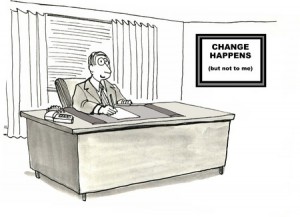
If you doubt that you have a Difficult Person amongst your team, hold the meeting and see who has the last minute crisis. They will make it sound legitimate but it was contrived in order to avoid Change.
Because I have dealt with so many difficult people, I am no longer amazed by the lengths they will go to avoid the meeting. I personally tell them face to face about the meeting. I personally remind them multiple times by email and in person about the meeting. I deny them the ability to use the “I didn’t know about the meeting” or the infamous “I forgot” excuse.
With experience I got good at anticipating their next excuse so I block it. Yes it is a game. They try to get out of the meeting and I block their attempt. As the Change Agent, my job is to force them to be very creative in their excuses.
When a Difficult Person has no way out, then what typically happens is they become sick. Genuinely sick. My best explanation is that they are coming face-to-face with their own issues.
When this happens it is important to once again to have your head screwed on straight.
You have to remember you are engaged a win-lose scenario. Not with the Difficult Person, but with their personal issues.
I recognize that the Difficult Person is also held hostage by their issues. Their issues are stronger than them, their colleagues and their managers. Their issues always win. The Difficult Person needs to know someone is stronger than their issues by not giving in.
That is the real Conflict a Change Agent takes on.
On the day I put the Change into effect I clear my calendar to deal with nothing else. I know this is the day when the Difficult Person will make their last ditch effort to stop the Change. As the Change Agent it is my responsibility to handle the grenades the Difficult Person launches. It is my responsibility to work with my team to make sure the Change happens.
Standing up to the Difficult Person’s issues simply requires calling upon my super-stubborn inner 3 year old child who only knows the word “No.”
I’m not aggressive. I just refuse to budge. The Change is going to happen. It doesn’t matter what the Difficult Person says, how many threats they make or how they try to intimidate me, the Change is going to happen.
It doesn’t matter how many alternative ways they come up with, the answer is “No.” I am not budging. The change is going to happen the way the team worked it out.
I know from personal experience how far a Difficult Person will go to convince you that your proposed Change will have cataclysmic consequences. They will do their best to make you question yourself and feel incompetent. (How they are feeling inside.) But you have to remember, that the Change wasn’t 100% your idea. It was a collaborative effort, using the collective knowledge and experience of the team.
The team knows what they are doing. If any problems arise the team will figure it out. The team wants to move forward. And as the Change Agent your responsibility is to the team.
How does this all play out in the end?
Sometimes the Difficult Person breaks and suddenly everything is sunshine and roses. The Difficult Person becomes a great team player. It truly is magical.
Sometime the Difficult Person quits and finds a job elsewhere.
Sometimes you have to take disciplinary action and fire the Difficult Person.
And sometimes, senior management steps in and sides with the Difficult Person. The changes never happen and the organization never moves forward. The workplace becomes deeply dysfunctional and you leave to find a job elsewhere where your Change Agent skills can make a real difference.
However it turns out, you know you have what it takes to make your organization better. And it feels really good to know you CAN make a difference!
Empowered Women Aren’t Afraid To Be Change Agents
To subscribe to my articles Contact Me
