
Many women don’t understand the real and tangible value women bring to the workplace. For centuries we were led to believe that the all-male workplace functioned just fine without us. The proof is in all of its accomplishments.
Thanks to men, civilization has advanced technologically, industrially and philosophically. All the tangible things in our lives and all the principles we live by are due to men!

That sounds wonderful…until we look a little deeper.
Behind the scenes is a messy, chaotic, frustrating and often destructive process. The truth is that the male-dominated workplace doesn’t function very well.
Throughout my career, I discovered over and over again, the value of being a woman working with men. My male colleagues needed my female ways of thinking and doing things. Over the years I came up with a few analogies to remind myself of the value and power of my female ways.
Analogy 1: Swiss Cheese
My first analogy describes how men really work.
Men want us to believe all their work is solid and complete.

But it isn’t.
In reality their work is Swiss cheese. There are holes in everything they do.

These holes are what create chaos, incomplete work, rework and unintended consequences.
Men are taught to be the one who brings the Big Cheese. As women, we’re told to compete with men to bring the Big Cheese. However, it’s very hard to compete with our male colleagues’ boldness and brashness. To them losing to a woman is unacceptable so they gang up on us.
Early in my career I learned not to compete with them, even though I knew I had a better plan or could do the job better.
I took a different strategy.
I looked at their plan or job and compared it to mine. I was looking for all of their holes; all the things that wouldn’t work out right. I then focused on figuring out how to fill in their holes.
So, when their work didn’t produce the expected results, I could stand up and be the one with all the solutions. I was the one who could fix things. This got me recognition. And when our performance soared, I got the credit.
No one cared who started the project.
They only cared about who delivered the results.
Over time I discovered that men couldn’t fill in the holes themselves, no matter what they did or how hard they tried. I witnessed all my workplaces adopt management initiatives to improve performance.
Eventually all of them failed.
The holes could only be filled in by women’s Pink Zone traits – the way women think and work.

When women fill the holes, we create wholeness. And wholeness is the only way to achieve the sustained superior results our workplace wants.
Looking for and filling in Swiss cheese holes proved to be the most powerful tool I used in my workplaces. I transformed so many ideas, plans and practices and made enormous impacts. My male colleagues kept asking, “How does she do that?”
My answer was, “I think like a woman.”
Analogy 2: Cupcakes and Cake Slices
Since my work was always project-based, teamwork was very important. But in men’s concept of teamwork, all parties aren’t of equal value. There has to be an MVP.
There are men who want to prove, “I can deliver this project!” They give the rest of the team permission to back off and ride his coattails. Team members willingly sit back either because they’re relieved to escape responsibility or they believe they aren’t as valuable. So, they wait for the MVP to deliver that big, beautiful chocolate cake that they can all get a slice of.

But in the end, all he delivers is a cupcake that celebrates him.
As women, we need to think of teamwork as a dessert bar where there are many different kinds of cake slices. As women, we find it hard for us to choose just one cake. We want to bring a slice of every cake back to our table to sample. We want to appreciate each of them for their unique qualities.
That is what teamwork is.

It requires everyone to come to the table, everyone to participate and everyone to emphasize their unique characteristics.
Analogy 3: Women Hold Up Half the Sky

Atlas holds up the world all by himself. He doesn’t need the help of anyone, especially a woman. We’re taught that the workplace is the same. Superior men accomplish great things and don’t need the help of women.
The foundation for this belief is the Doctrine of Two Spheres. It says men naturally inhabit the Public Sphere and women the Private Sphere. This of course, harkens back to the old stereotypes that see male traits as superior to female traits.

Consequently, for women to have any value in the workplace, we must adopt male traits and compete with men. Women must take a piece of work away from men or men have to surrender it to us. This is how we will achieve equality.
However, there is another concept:
Duality
Duality refers to two contrasting elements that coexist. They don’t exist in competition or in conflict but rather in a complementary relationship. I think of the value of women in duality with men through the Chinese proverb that says:
Women hold up half the sky.
But given our indoctrination as to the nature of men and women, we still see them as distinct and separate. We also want an empirical measurement to ensure there is equality.

However, that isn’t Duality.
In Duality, men and women aren’t separate.
They are opposing forces who interact and work together in harmony.

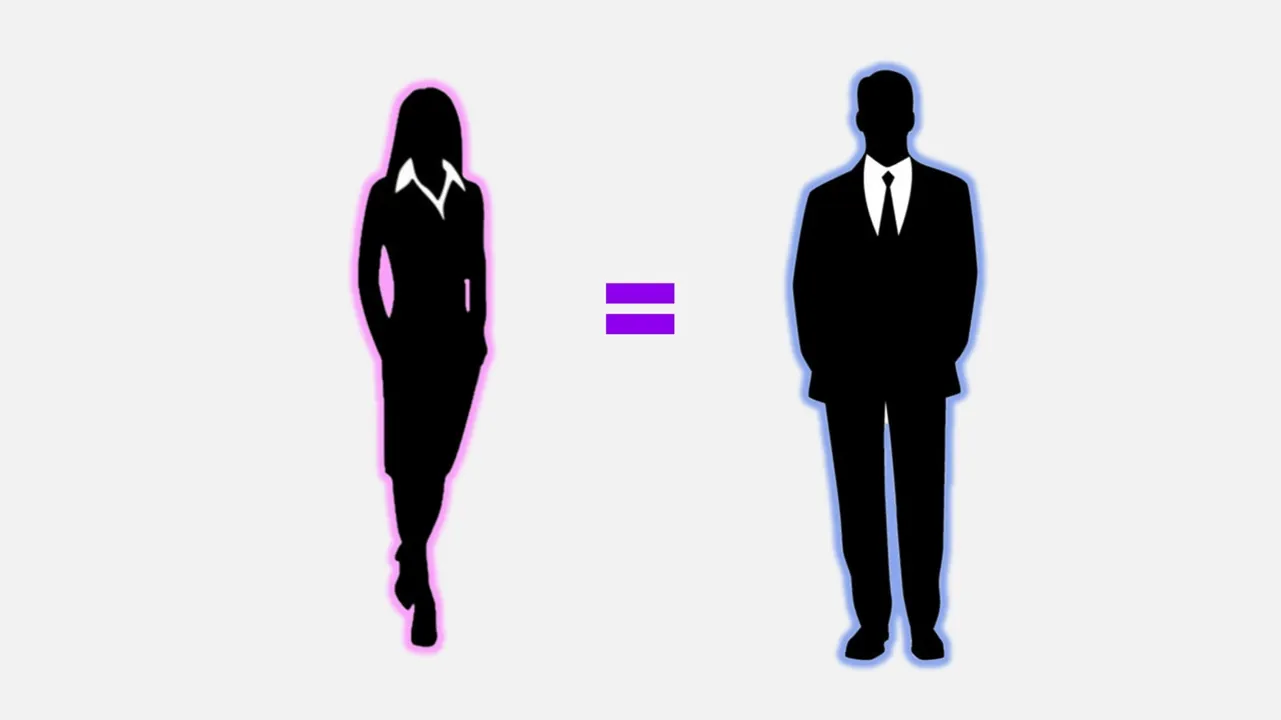
This means women don’t have to compete with men. We don’t have to take from men and men can’t take from us. We are inherently equal.
We each have our own half of the sky – our own way of thinking and acting. We need each other to perform our duty of holding up the sky. Most importantly, the sky isn’t complete and whole unless we lift up our half.
This brings me to my final analogy.
Analogy 4: Yin and Yang.
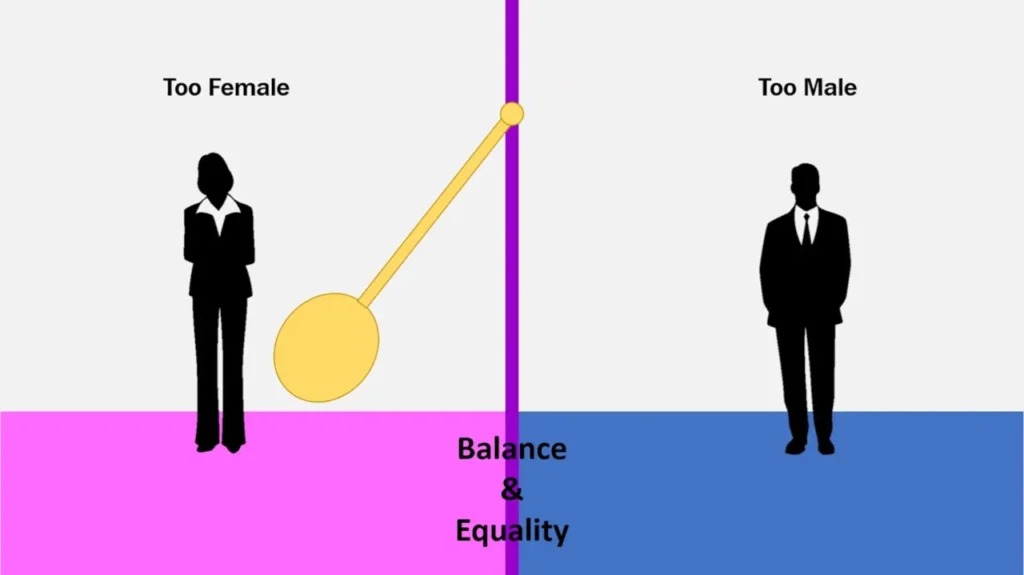
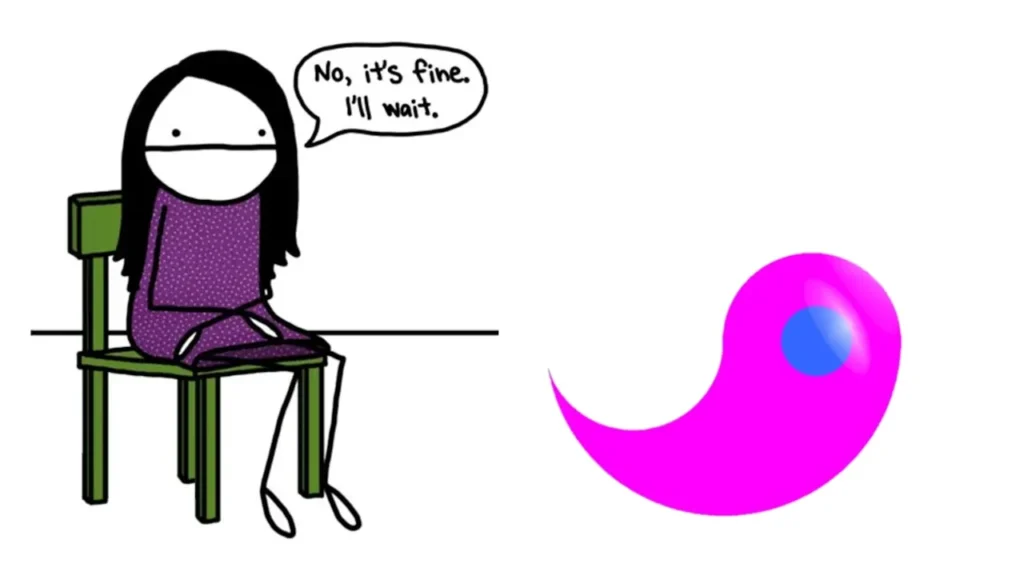
I use Yin (pink)and Yang (blue)to represent women and men as two complementary halves of the whole. They are connected opposites who continually interact and influence each other, creating a dynamic environment.

In this symbol we often miss noticing Yin and Yang are not represented as a solid color. Yin has Yang’s blue qualities and Yang has Yin’s pink qualities. This is because women and men aren’t different species. We share human qualities.
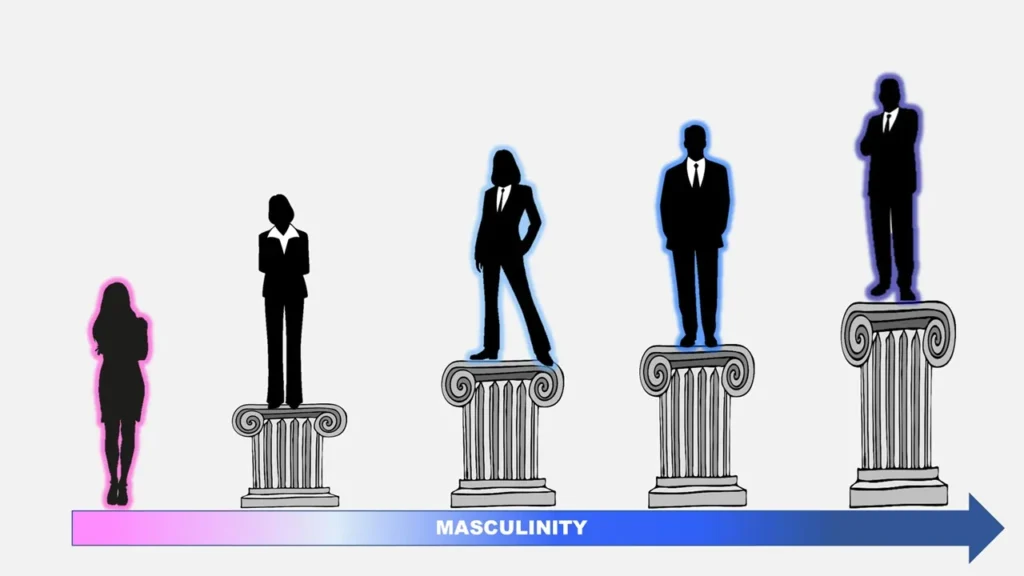
As individual men and women, the size of our complementary qualities can vary. Some of us have more, some of us less. How much we express also varies by our situation and environment.
Yin and Yang are not static within themselves or together.
As connected opposites they both influence and respond to each other. They work in harmony where neither is stronger or weaker than the other. In their dynamic relationship, they continuously balance each other and create balance within their environment.
More importantly, their harmonious, balanced interaction creates Wholeness.
Wholeness is where we find sustained, superior performance.
When men and women interact, work together and influence each other, we become comfortable expressing our complementary traits. We change each other, so we are no longer solidly Pink and Blue.
Even though we remain predominantly Yin or Yang, we transform into our own unique shade of Purple.
We find, balance, harmony and Wholeness within ourselves.

Empowered Women Know They Are One Half Of The Whole
To learn more, watch these YouTube videoes: