
Tag: communication

  • Do Men Hate Conflict More Than Women?

    Do Men Hate Conflict More Than Women?

    Women are taught to think of men as tough and aggressive.  But then we work with men and discover just how many of them really hate conflict.  They literally run away from it.

    In the workplace, personnel issues can be the biggest source of conflict. The manager may try to hide behind coldness or bravado, but it doesn’t protect him from the raw, honest emotional reaction coming directly at him.

    As women our empathy makes us dread firing someone. But in my experience, our discomfort is nothing compared to men. I’ve seen several men get physically ill at the thought of firing or disciplining someone.  I’ve known several men who had to fire someone, not show up to work that day.

    In one of my workplaces, I watched three senior managers have a secret off-site meeting to develop a plan on how they were going to fire a superintendent on my project. I was shocked by how whimpy these otherwise big manly men were.  When the time came to meet with man being fired, the most senior manager was nowhere to be found. Another suddenly had an important phone call.  And the one manager who was left, as he was sweating bullets, he tried to get me to do it.

    I would say it was the most bungled firing I ever witnessed, but it wasn’t. Even President Trump with his “You’re fired!” television persona, can’t seem to fire people in person.

    Many men have counseled me that the construction site is the domain of the macho men and is managed through intimidation. So why then, am I always going out on site to deal with issues and conflicts the guys avoid???

    Dealing with conflicts and I faced many men who got very aggressive. Early in my career, these men were imposing. But by the end of my career all I saw were overwhelmed little boys crying for help.

    I learned that many men get very aggressive in conflict because they fear it, dread it and hate it so much that they only way they can get themselves through it is by being aggressive. (Men have admitted this to me.)

    When you figure these men out, you discover that the guys who come across as the biggest grizzly bears, are actually the biggest teddy bears.

    Men aspire to be Autonomous.  They want to believe their actions produce the result they want and that is it. They don’t want any other consequences and certainly don’t want consequences not in their control.

    Man standing next to the word "Action" with an arrow pointing to the words 'Desired Result."
    Men want to take an action, get their desired result and be done.

    In conflict, men know they aren’t autonomous. They know their action will threaten another man’s autonomy and cause him to react. Not knowing what the reaction will be, leaves them unprepared to deal with it. And since they have no control over the reaction, they feel vulnerable.
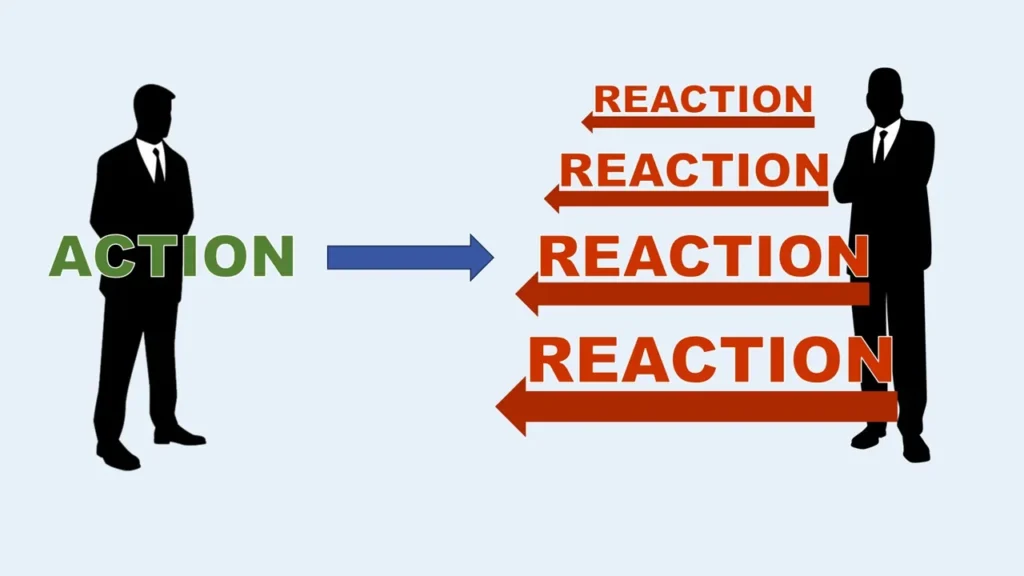
    Men don’t know how another man will react to his action. Will it be a small reaction or a big one?

    When men feel vulnerable, they know they have lost their autonomy. In order to regain their autonomy, they must react to the reaction.

    The need to react goes back and forth and suddenly things go off the rails and a simple issue gets really twisted and complicated. 

    Men don’t deal with complicated well.

    But women do.

    Women aren’t afraid of the reaction, feedback or pushback.  We expect it.  It is a natural part of our group dynamic.

    Before the 21st century and before women were taught to act like men and be aggressive, women didn’t feel the need to react. Our emotions such as empathy and understanding told us we should consider the reaction and what it means.

    Therefore, we aren’t afraid of conflict.  Heck we don’t even consider it conflict.  To us, we’re just talking things out.  We’re figuring out how to make things work for everyone within the group.

    As women in a male-dominated workplace, this is one of the most important transformations we can help our workplace make.

    In today’s workplace, no one is autonomous. Each person’s work impacts other people. If we don’t work in coordination with each other, there will be a lot of conflict.

    As women we can help men (and aggressive women) learn to talk to each other and become comfortable with reactions from other people. Since we all have responsibilities and objectives, we all feel some pressure to get our work done and don’t want to be negatively impacted by other people.

    This is why we need to teach each other to RESPECT each other’s jobs. With respect we can then work together to optimize how we each do our job so we all get the best possible outcome.

    As women we’ve historically been credited with bringing communication and teamwork to our workplaces. However, today too many women believe they must be as aggressive and selfish as the stereotyped man. But by following stereotypes that don’t represent the vast majority of men, women are hurting both themselves and our workplaces.

    As a manager, I always liked conflict because it showed me a problem or issue that needed to be resolved. I saw conflict as an opportunity to facilitate communication and coordination, so we made positive changes in how we did our work.

    This made everyone happier!

    Resolving conflict creates a better work environment.

    Ignoring or being scared of conflict achieves nothing.

    As a woman and team member we are the ones who are best equipped to step forward and resolve conflicts.  We are far better than men at facilitating and coordinating communication to resolve conflicts. Men know this about us, and many hope we will step up and help them.

    However, I don’t want you to think of yourself just as a facilitator or communications specialist.  Those are soft skills that put you in a support role.

    Recognize that you are stepping up and leading your team through its coordination issues.

    Empowered Women Lead Their Workplace Through Conflict

  • Don’t Let a Skill Become a Trap

    www.123rf.com 61070833

    When I began my career my male colleagues didn’t know how a female engineer would be different from a male engineer.  They soon discovered the difference – “She can write!”

    At first I laughed because engineers are notoriously bad writers so it wasn’t difficult to do better.  But then I saw the danger in this acclaim.

    Instead of being seen as engineer, I could be seen as a woman only and get pushed into a traditional female role.

    One year later my fears became a reality.  I was moved to a new job where my overwhelmed boss discharged me to help write performance reviews and award packages.  I sat in the back corner of the small room occupied by the two secretaries with a typewriter on my desk.

    I knew I had to change my situation.

    I soon discovered an upside to my new location – everyone talked to the secretaries.  I soon learned about every issue and problem in our department.  I realized there was a big beautiful world of opportunity out there – I just had to figure out how to get out from behind my desk.

    Opportunity soon knocked when a supervisor came to the secretaries begging for their help in rewriting the Wastewater Treatment Plan.  The secretaries quickly volunteered me.

    Eureka!!!

    I had a perfect excuse to get out from behind the desk.  I told the supervisor I needed to understand how things worked so off we went to the shops and the wastewater treatment plant where I talked to the men about operational issues.  I gladly took over rewriting the plan.

    The next thing I knew I had the Snow Removal Plan, the Vegetation Removal Plan, the Flood Control Plan and the Traffic Control Plan sitting on my desk to update and rewrite.

    Writing these plans took me all over the Air Force base I worked on and exposed me to the larger base mission.  I met and talked to everyone.  I learned how my department was supposed to support the mission and where it was falling short.  By the time I left that assignment I had more operational knowledge than any of my male peers.

    At my next assignment I sold my knowledge to my Commander and landed a new job normally given to someone with at least 6 more years of experience.

    About a month into my new job, my supervisor was pulled away to handle a crisis.  He gladly dumped some of his responsibilities onto me, especially the monthly presentation to the Wing Commander, which we called “the monthly bloodbath.”

    I should have been terrified but my earlier experience taught me how Wing Commanders and senior officers wanted information presented to them.  I changed up the presentation and to everyone’s shock I survived my first presentation.  Over time those monthly presentations made me very comfortable in public speaking.  I had a new and valuable skill.

    I also I realized technical knowledge coupled with strong communication skills is very powerful.  Too often the person giving a presentation is just a speaker – they aren’t the person with operational authority.  I however had operational authority – I could present issues, answer technical questions, implement the decisions and then discuss the results at the next presentation.  I eliminated the middle man (my supervisors) and established direct communication to higher level decision-makers.

    I became the person they came to, to get things done.

    After leaving the Air Force I continued to combine technical knowledge and communication skills.  I got a job conducting an operational audit for a government contractor where I uncovered a serious problem.   My report went right up the chain to senior management.  They loved my report and I was soon offered a new job writing proposals.

    My writing skills were once again front and center and giving me the opportunity to develop more  professional skills – proposal writing, marketing and contract negotiations.

    I took the job.  However, I remained leery of being seen more as a writer than engineer.

    Many years later I proved to myself that I was correct to be leery.  I had two job offers on the table – one to write proposals and one to run an operational department.  The job running the department paid 33% more.

    I realized I always had my priorities right – operational and technical skills were more important.  They were the key to better pay and advancement.  Communication skills were supplemental – useful to distinguish and leverage myself, but they should never be my primary workplace skill.

    All through my career I used both my skills.  If I established myself with technical skills, I then used communication skills to distinguish myself.  Likewise, if communication skills could get my foot in the door, I used them and then found an opportunity to apply my technical expertise.

    Many men have a hard time understanding how I could do this because the male-dominated workplace believes you can only excel at one skill.  Consequently I’ve been asked countless times: “Are you an operations person or a proposal writer?”

    I answer: “I do both” and watch their heads explode!

    For women it is easy to fall into the trap of having to choose between our skills.  These choices often maneuver and trap us into more conventionally female jobs that pay less and deter our advancement. 

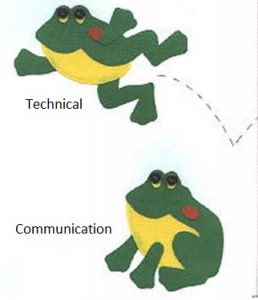
    This is why we should never conform and never choose.  Instead we should learn new skills, leap frog them over each other and leverage our skills to distinguish and advance ourselves.

    Empowered Women Use All of Their Skills


    Find this article helpful?

    Sign up to receive more and check out my New Book!
    Follow The Woman In The Room on Facebook
    Take a quick moment to share


  • Open and Honest Communication Advances Women

    www.123rf.com 23735932

    I remember when it was rare to be a woman in the workplace who wasn’t a secretary or in HR.  I began my engineering career in the Air Force on a base with 5,000 airmen.  When I arrived you could count the number of female officers on one hand and the senior ranking woman was a 1st Lt.

    Using today’s popular narratives, you would expect that we faced horrible conditions – discrimination, sexual harassment, subjugation etc.

    Not true.

    Instead there was a lot of curiosity.  That curiosity led to questions.  The questions led to countless conversations about the role of men and women in the workplace and in the home.

    Those conversations happened informally in offices and in shops.  They also happened formally through a committee of women the base leadership established.  Anyone could bring their questions and concerns about working with the opposite sex to the committee.

    The example I remember is a NCO in aircraft maintenance who came to us about his one female aircraft mechanic.  While working  in the hanger it got hot so he told everyone they could take off their fatigue top and just work in their t-shirts.  Back in those days, we wore white t-shirts so when the woman took off her fatigue top you could see her bra through it…and it was leopard print.  The NCO had her put her fatigue top back on but then he was worried about her working in the heat.  He reassigned her to a different task which wasn’t fair to her or the men.

    Our solution was simple.  The female aircraft mechanic should wear a white or beige bra with her uniform and save the leopard print for her civilian clothes.  We also told the NCO that her bra will still be visible under her t-shirt (we all knew this from personal experience) but he and the other male mechanics just had to deal with it.  (Yes, we were still a bit prudish back then.)

    Later we followed up with the female mechanic and she said everything worked out fine.

    What was drastically different between those days and today is that back then we had open honest direct communication where anyone could honestly express their point of view, fears or vulnerabilities.  No subject was off limits.  And no one was told their ideas and opinions were wrong.

    We recognized that we were all in new territory.  We recognized that most men had no experience working with a woman as a peer just like we had no experience working with men.  Therefore our objective was to broaden everyone’s perspective and comfort zone without incrimination.

    Through our very politically incorrect conversations men and women got to know each other and build the relationships necessary for women to realize our equality.

    That is how it was for about 20 years.  Then everything changed.  Suddenly we were all being called into training seminars where we were “educated” about each other.  We were told what we could and could not say.

    www.123rf.com 31134098

    As the woman in the room, the spotlight was on me.  “Diversity” singled me out and labeled me as “different.”  I was told in front of my male colleagues that I could bring my issues to HR or the Diversity office and they would help me, confidentially.

    My response was “I don’t have any issues.”

    The trainer however looked at me as if to say, “You can tell us what’s really going on later.”

    I could feel the walls going up in all of my male colleagues.

    After the training I talked to my boss.  He asked me if there were any issues I never voiced and I told him there weren’t.  But the trust was damaged.  We could no longer talk openly and honestly as we always had.  For several months the guys and I walked around on eggshells with each other as I slowly re-built their trust.

    I was furious.

    I was furious at the arrogance of a training seminar swooping in and damaging both my relationships and my career.

    I was furious that these supposed experts were ignorant of the one rule that helped women like me – open and honest communication.

    I was beyond furious that they didn’t talk to me before the training.  They just assumed that I was a timid, insecure woman who couldn’t stand up for herself.  I felt more insulted and degraded by something meant to empower me than I had ever felt by an incident in my career.

    And I wasn’t the only woman who felt that way.  I knew many women who broke through all kinds of barriers without any outside help who felt like our strength and confidence were no longer politically correct.  We were supposed to sit around and talk about how we were “victimized” evn though we didn’t feel like victims.  We wanted to talk about how we tackled issues, kicked butt and distinguished ourselves.

    After years of diversity training classes, it was one of the last ones I attended that finally gave me some satisfaction.  My diverse team and I sat through 2 hours of being told how to be politically correct with each other.  Immediately afterwards, we all looked at each other and said “We’re going to keep doing what we’ve been doing.”  And we all walked out.

    Very concerned, the trainer came to see me.  I unloaded on her.  I told her she didn’t know the first thing about being a woman like me and she sure as heck didn’t know the men I worked with and supervised.  I told her we were a tight team and we weren’t going to allow her or anyone else to divide us.  We all experienced that before and this time we decided to take a stand and say “No.”

    I realize that what I resented all those years was that someone who never walked in my shoes and never talked to me about my experiences thought they had the credentials to tell me how to deal with being the woman in the room.

    But more so than that, I felt like my voice and the voice of other experienced women didn’t count.  More accurately, we were supposed to remain silent because what we had to say may contradict the popular or media-driven narratives.   

    That has to change.  We need to bring back open and honest conversation so more women with real-world experience can lead in advancing women in the workplace.  We after all,  are the ones who can say “Been there, dealt with that, let me tell what works.”

    Empowered Women Know Open and Honest Conversations Work Wonders

    Find this article helpful?

    Sign up to receive more and check out my New Book!
    Follow The Woman In The Room on Facebook
    Take a quick moment to share