I received a fear laced text about COVID-19 and climate change from a political party. My gut reaction was:
“OMG!!!! I’m going to die!!!”
I decided to reply to the text which began an exchange with an unknown person. Our exchange was frustrating, so I ended it by saying:
“Get freaking real! Stop fear-mongering me and stop trying to manipulate me. Treat women as if we have a brain.”
Politics and COVID-19 proved a powerful combination to fear-monger and emotionally manipulate women. We’re susceptible because:
We mistakenly identify with our emotions, not our ability to think.
We aren’t as technically savvy, so we rely on “the experts.”
We rely on other people (news media and politicians) who also aren’t technically savvy to interpret and analyze for us what the experts are saying.
These media personalities and politicians also conditioned us to believe that anyone who utters those three magical words,
‘Science, Data, Facts”
must know what they are talking about.
However, that’s not true. Those of us who are trained to work with numbers know “Science, Data and Facts” are completely meaningless until they are analyzed.
Too often people don’t analyze the data.
Instead, they hear big numbers such as 214,917 COVID-19 deaths and believe they are at high risk of dying if they get COVID-19.
Fear-mongering such as the text I received reinforce fears that may be completely unfounded. So, in order to understand the risk of dying from COVID-19, I looked for the COVID-19 facts that were analyzed.
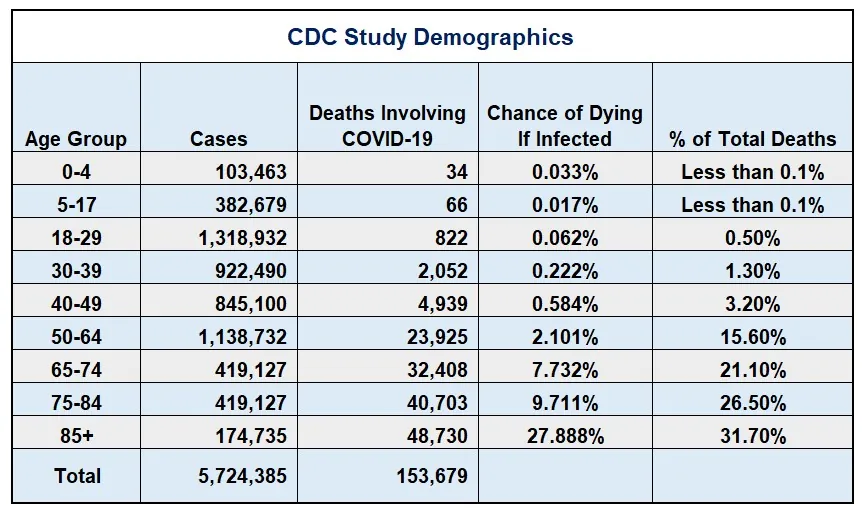
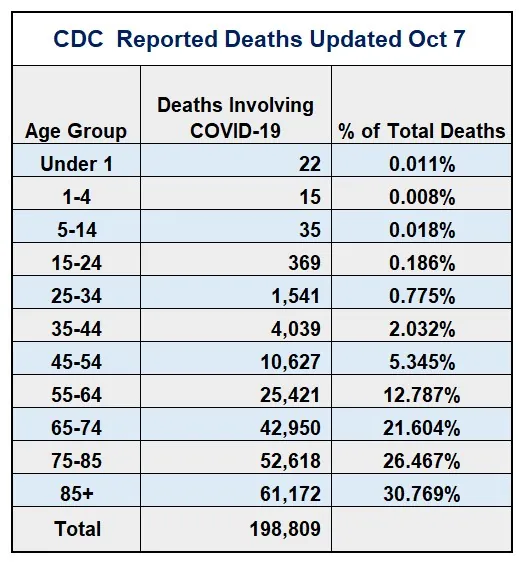
I first noticed that their chart says: “Deaths Involving COVID-19.”
The chart DOES NOT say “Deaths From COVID-19”
This suggests that COVID-19 was in many cases the final overloading cause of death (the final straw), not the stand-alone cause. (Important distinction) We also notice that there is a jump in deaths beginning with people in their mid-fifties. For most of us this is when our health issues become apparent and begin to require care or intervention.
Like the study, the chart also shows that about 79% of deaths occur in people over 65 with 30% of the deaths coming from people over the age of 85.
So from the Science, Data, Facts and Analysis should we be fearful of getting COVID-19?
Well that depends on your age group and maybe more importantly your health.
The analysis helps us know where we should place our concern. It also helps us stop creating unfounded fear. But more importantly, it prevents us from being fear-mongered by those who an agenda and want to use fear to manipulate us.
The average age of teachers is 41. Older teachers have reason for concern if they have health issues. Young, healthy teachers have little to fear.
Women are conditioned to defer to others. In school we were praised for raising our hand before we were called on to speak. We won favoritism and were rewarded with special privileges for being “good girls.”
We also watched boys speak out of turn, disrupt class and disregard the rules. Some boys were scolded. But others learned how to get around the rules with charm and humor. And even though their behavior was “bad,” they got attention which became its own form of reward.
So, boys learned that breaking the rules doesn’t necessarily result in negative consequences.
This difference in how boys and girls are conditioned became apparent during the COVID-19 era. At first, all non-essential personnel worked from home. But slowly that began to change.
I live adjacent to a major road. In late March and early April of 2020, I could pull out of my street onto the major road without even stopping. There wasn’t a car in sight.
But then, the week after Easter traffic began to change. Work trucks were back on the road. Then by the end of April there were several cars which I noticed were driven by men.
Even as the news media reported that people were working from home traffic steadily increased each week.
Who wasn’t working from home anymore?
My unofficial surveys indicated they were predominantly men.
To me this made sense.
From my decades of working with men, I knew many men who always showed up to work no matter what. They came to work because they thought of themselves as “essential.”
When COVID-19 broke out, we understood this was an emergency situation. Therefore, the only people who went to work were people who dealt directly with the emergency (doctors and nurses) and those who provided critical services in support of the emergency (grocery store workers).
But then we stopped calling these people “emergency workers” and began calling them “essential workers.” This opened the door for more people to return to work because to men “essential employees” means something very different from “emergency employees.”
Having spent my career working with the trades, I know plumbers, roofers, HVAC mechanics and electricians respond to emergency situations and provide “essential” services. This is why they were the first ones out on the road after Easter 2020.
I also know that when “routine” trade services such as maintenance are delayed, bad things happen. Things break and can quickly escalate into “urgent” and even “emergency” situations. Consequently, crises were created across many industries and workplaces.
Most men understand this natural progression in their work.
They know authorities can’t command “shelter in place” and expect everything in existence to freeze. They know the forces of physics, biology, nature and weather certainly won’t listen. And these forces will create a growing ripple effect. More and more of us will need to resume normal activities to prevent the escalation and spread of “urgent and emergency” situations.
Men are also acutely aware that the faster someone is required to return to work, the more essential (important) they are.
So, men began their progression back to their workplace in the order of their real or perceived importance.
Men don’t want to be seen as one of those people who can disappear and not be missed. Because, if no one misses them, then their job isn’t important…and can be eliminated.
This is why once back in the workplace men quietly note who is and isn’t in the office. They assess the pecking order. They note who sees their job as important and who doesn’t.
Now as women, our good girl conditioning tells us to listen to “the experts” who tell us to keep working from home. If we raise our hand to ask if we should come into the office, our workplace’s “official statement” is that we should continue to work from home. So, we wait for permission to return to our workplace.
But are we the only ones waiting??
How many of our male colleagues have gone back to the office either full time or part time?
Do we know? (They certainly know we are still “at home.”)
We need to know. We need to know if we are foolishly waiting to be praised for being a “good girl” who follows all of the rules but also sending the message that neither we nor our job is essential.
So, if you haven’t done so yet, drive by your workplace during work hours. See how many and whose cars are in the parking lot.
Go into your workplace, even if you have to go in at night. Take a look around and gauge the daytime activity. You will be able to tell who does and doesn’t come into the office.
This information will tell you whether you are leaving yourself out and ultimately leaving yourself behind.
Only you can know when the right time to return is. Just make sure you aren’t the last, unessential worker to return.
During the Covid pandemic, I was listening to my local news when a teaser for the national news came on broadcasting:
“Teachers and school nurses quit rather than return to school.”
The next commercial that came on was from my local power company showing men going to work and taking safety precautions for Covid-19 because they have to be out there. Their work is essential. They have to get it done.
The contrast between the two commercials was stark.
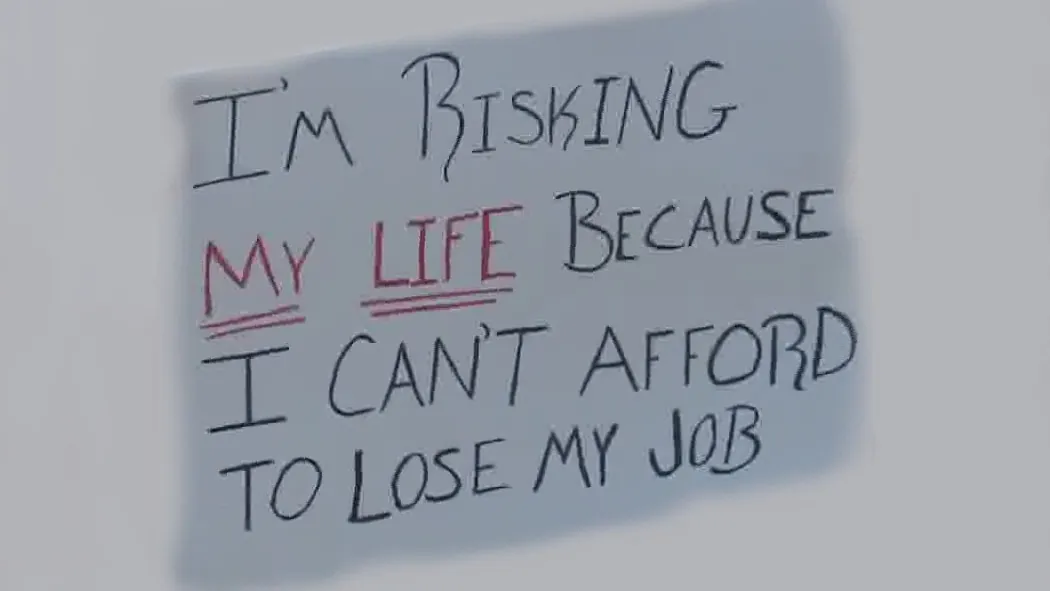
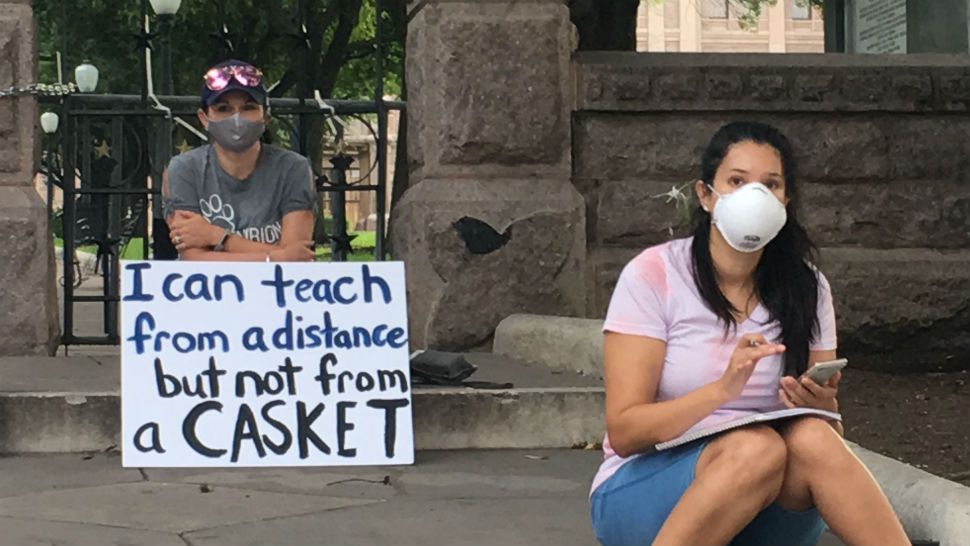
Women saying, “We can’t, we can’t” accompanied by signs saying, “I don’t want to die.”
While men whose work is inherently dangerous and where they can die just from doing their tasks say, “We can and we will.”
The contrast is an immediate reminder of the stereotypes.
Men are brave, daring, risk takers who get things done. While women who are caring and compassionate are driven by emotion. Our emotions make us weak and fearful, leading us to become irrational and hysterical.
The media then reinforces the stereotype of women being overly dramatic with stories of mothers who are afraid to send their children back to school for fear they might “get sick” (with no symptoms) or become “transmitters” (nice way of saying “silent killers.”)
Now of course there is science, data and facts to help alleviate women’s fears but mathematical, rational, analytical thinking is just too much for women’s brains. This is why we defer to “the Experts” who happen to be men to tell us what we need to do. Right?
No.
This is just what we’re conditioned to believe about ourselves.
Now this may be breaking new to some – especially those in the media industry – but women are quite capable of thinking and solving problems. I would venture to say that women are even far, far, far better than men at solving complex problems because we think about how this has to work with that, and that has to fit into this but then there is also this other thing we have to consider.
In other words, women are really good at thinking about all of the pieces and parts that are needed to solve a problem, and we are also really good at fitting all of them together to create a complete solution.
However, women aren’t taught to recognize this ability. Instead we are taught that men and their brains are superior to ours in problem solving. So, when women see men and especially “the Experts” get stumped by a complex problem, we believe that of course our poor little emotionally driven brains can’t handle it either.
This belief is what conditions us to respond to complex problems with “I can’t, I can’t, I can’t.”
But we can.
Throughout my career I’ve seen women – irrespective of their education or role – “help men” figure out how to assemble all the pieces and parts of a complex problem to come up with a solution. And it made me question, “Who is the real leader in this situation? Who is the more valuable person?”
So, it’s time for women to break free of our conditioning and recognize our abilities for the leadership qualities they are. But first, we also have to adopt the same attitude as men.
When women adopt this attitude then we will stop saying “No, I can’t” and begin saying “Bring it on….Because…Yes, I can!”
But more importantly, we will experience the joy and challenge of problem-solving and the sense of achievement that comes from creating a solution that works.
“Toxic Masculinity” makes women concerned about working with men. However, since I spent my career in environments where women expect to find lots of toxic men and toxic masculinity to run rampant, I want to share what I learned about toxic behavior and how to control it.
Watch this YouTube video:
Working in a hard-core male industry I found that out of every 10-15 men, I could expect to find 1 toxic man.
I usually identified him because he spent a lot of time trying to make himself sound important or tough. He was usually the man I found to be the most obnoxious.
As women we frequently think their aggressive behavior makes a toxic man the Alpha male – and that is exactly what he wants us to think.
But, in reality, the toxic man is just an Alpha Wannabe.
As women, since we don’t understand relationship dynamics of our male colleagues, we get a lot of things about them wrong. For example, we’re taught that the Alpha male is horrible, toxic, oppressive, epitomizing every male behavior we hate.
That is NOT true!
In reality, the Real Alpha Male is our best and most powerful ally.
So, watch this video and learn how the male dynamic really works.
And by the way, my feedback from men has been that I got this right!
During my career the first issue I dealt with in every workplace was that my male colleagues never worked with a woman as a peer and certainly not as their boss. Therefore, they didn’t know what to expect.
Their concerns immediately went to the stereotypes:
Is she competent?
Can she function in her role as well as a man?
Is she a man-hating feminist?
Some men were concerned with my mental state:
Will she cry?
Will she be too girlie?
Will she talk too much?
The women in traditional roles who never worked with a nontraditional woman had their own concerns:
Will she manipulate the men into doing her work for her?
Will the guys fawn all over her?
Is she going to make me feel inferior?
Everyone was concerned about how my presence would affect them and the work environment.
How will her presence change the long-established power structure between men and women?
These concerns caused many of my supervisors “to advise” my male colleagues of my hiring. My pending arrival sparked lots of conversation, especially as I rose higher in the workplace hierarchy. The discussions centered on how:
“How are we going to quickly assess what she is like?”
In other words:
“What TEST are we going to give her, so we can see how she reacts?”
Prior to my arrival or shortly thereafter, my male colleagues conspired to create or use an upcoming situation they thought would make me uncomfortable, put me off balance or challenge/intimidate me to see how I handled it. My reaction would then form their opinion of me and my suitability for my job; an opinion that would forever stay with me and be shared with every man.
When I was young and just beginning my career, I was warned to expect these tests. However, several months into my tenure as an Air Force officer, I was surprised I wasn’t tested and I asked my male colleagues about it. Their response was:
“You were tested and all the Senior NCO’s were really impressed.”
Really? When? What was the test?
As it turned out the test came during a training exercise when we practiced our convoy being ambushed. We had to jump off the back of a truck, hit the ground and roll. When my turn came, I jumped, hit the ground and rolled…through a watery mud puddle. I remember observing at the time that I was the only one who had to roll through a mud puddle.
That was the test. Was I afraid to get dirty?
I passed my test because I rolled through the mud without hesitation and then spent the entire day covered in mud from head to toe without complaining about being dirty.
That test taught me a valuable lesson:
If I face every situation in front of me and choose to take it on, I will prove the strength of my character.
I learned that when tested, the best reaction is no reaction. I should just continue moving forward through the situation until I saw it though.
In time I learned this is what distinguished me as someone who can lead an organization through any adverse situation.
Was I ever upset that I was continually tested and needing to prove myself?
No.
I considered each test as an opportunity to distinguish myself above my male colleagues and set a higher standard. I knew that each test was a shortcut to:
RESPECT
In their careers, my male colleagues faced their own tests – though probably only once and it was an easier test.
But by facing a harder test (according to male standards but not necessarily female standards) I earned the right to carry an attitude:
All of our workplaces have goals and objectives they want to achieve. The standard approach is to ask the best and brightest employees to generate ideas, work through the planning process and develop a plan to achieve the objective. But, no matter how “well-planned,” our workplaces still experience problems achieving the objective.
Why is that?
It is because the planning process is too entrenched in male-thinking.
Don’t believe me?
Google “Planning Process” and read some of the results. They leave little doubt that the planning process requires a lot of stereotyped male traits – intellectual, analytical, rational etc. They also use a lot of jargon leading us to believe that Planning is what the smart and highly educated people do.
The not-so-smart and not-so-well-educated execute the plans that are handed-down to them. I read “Plans must be communicated and explained to those responsible for putting them into practice. The participation and cooperation of subordinates is necessary for successful implementation of plans.”
Sounds a bit elitist and snobbish.
I could let that pass if the feelings of superiority were deserved – but they aren’t. In my experience very few, if any, plans can be handed-down and implemented without revamping. I’ve seen many plans designed by the so-called planning experts get thrown in the trash because they simply don’t work.
The fundamental problem is that the male-dominated workplace believes in the separation of planning and implementation. This idea goes back to the 19th century and Frederick Taylor’s scientific management theory. Even though we have moved away from a manufacturing economy into a more service and technology based economy, we still dragged a lot of his management theory into the 21st century.
Why?
Dr. Myron Tribus of MIT explained it this way:
“It suits the self-image of managers [and planners] that they were superior, the brains for others who could only supply the brawn.”
So even though the management theory doesn’t produce the best results, the male-dominated workplace hangs onto it because it feeds ego, status and a feeling of superiority for some.
We see this distinction carried out in many of our workplaces (and society) – there is a separation of the educated personnel who “work with their heads” from the “uneducated” personnel who work with their hands.
The Suits
As a young female engineer, this class distinction was readily apparent in my first workplaces. Engineers worked over here and craftsmen worked over there. The only engineers who worked with the craftsmen were there as the managers.
I often thought that if I were a man, I probably wouldn’t question this arrangement. But as a woman the separation and distinction seemed contrived. I questioned it.
When I was assigned several plans to write, I could have sat at my desk and developed them all by myself like my male colleagues were doing. However, I decided to “cross over,” interact with the craftsmen and ask for their input. I found that they were incredibly knowledgeable. I learned that if I wanted to know HOW things worked and HOW to get things done, I should ask them. Working with them, I wrote plans that they later implemented. The plans actually worked and achieved the objective.
About a year later the engineering staff was floundering for 2 years trying to solve a recurring design problem. Many engineering consultants from top firms were brought in. No one could come up with a solution.
Then I had an idea:
Let’s ask the craftsmen who were sent out every week to fix the problem.
I took the initiative to gather them together and asked them if they could come up with a solution. Working together it took them 1 hour to figure it out.
1 freaking hour!!!
That was a pivotal moment.
I realized that all of the separations and the distinctions in the workplace by function and education was a detriment to effective planning and implementation. If everyone worked together through the planning and implementation processes, we would meet and potentially exceed our objectives.
When I became a manager, this became my management philosophy:
Work Together
At first it was difficult because the various factions had rivalries they enjoyed. So, I forced the issue. I scheduled planning meetings between the planners and craftsmen and literally sat in the meetings as the babysitter. Eventually they began building relationships and collaborating. I almost died of shock the first time I walked into the Planning office and found craftsmen in there voluntarily collaborating with the planners.
Within a few months the change in our performance was noticeable. Within a year our performance was exponentially better.
Throughout my career I continued to make the various workplace functions work together in both the planning and execution of work. I believed everyone needed to park their egos at the door and that no one is so smart and so superior that they have all the answers.
I ran into opposition, especially in the last 15 years or so. There seems to be more and more men who believe their education distinquishes them and it is beneath them to interact with the workforce. They believe they get to pontificate from the on-high of their cubicle and create dictates for the minions to follow.
Of course, their dictates don’t work because they don’t understand how things work in the real world. But don’t tell them they are wrong – they get angry and ugly.
However, I NEVER had a problem telling them they needed to get off their perch and participate in the real world if they wanted to be of any value. If they still didn’t listen, I cut them out.
I didn’t involve them. I let them sit in their cubicle by themselves and pout. When they got upset because “they aren’t consulted in their area of expertise, my response was, “We’re all working together over here. You may join us any time you like. That decision is up to you.”
A few men never joined.
For most men, it is a challenge to undo the old learned ways of how the male-dominated workplace should function because their ego and self-identity are tied to their function and place in the organizational hierarchy. I found that women are essential to creating the change.
Women are much more comfortable working together with other people. Women aren’t as ashamed of what they don’t know so they are more willing to ask questions and collaborate. I laughed many times when men witnessed how women work together for the first time. They were amazed by women’s interaction, collaboration, problem-solving and the volume of work women produce.
As a manager I used women to draw men into collaboration. There are always a few men who are easily drawn in by the energy women create when they work together. These men and women form the core of the collaboration group. Once the core is established it is easier to invite more men to join in. Before long men are telling other men they have to join in.
That’s when you know you are successful.
The collaboration group creates a lot of positive energy in the workplace. That positive energy is a natural attraction since so many of our workplaces drain us of energy. As people work together to produce results, achieve the objectives and improve performance, the positive energy grows and the group becomes powerful. It isn’t afraid to take on the bad actors, the people who use the workplace for selfish gain and the workplace bullies.
It is this positive energy that transforms the male-dominated workplace and creates the genuine teamwork we want.
Empowered Women Put Teamwork First By Respecting Everyone, In Every Role
My first boss died of a heart attack 4 months after I began working.
A year later a male co-worker died of complications following quadruple by-pass surgery.
Six months later a man I frequently worked out with died of a massive heart attack following a run.
One month later, a male co-worker standing 20 feet from me, dropped dead of a massive stroke.
I went to retirement parties and then attended funerals where we sadly sighed, “He never got to enjoy his golden years.”
Many of my male colleagues were alcoholics. It was common to be warned, “Don’t light a match near him today.”
I lost track of how many male colleagues suffered breakdowns from stress. And how many times I wondered if any of my male colleagues would show up for work because they were too stressed-out. Or how many times I heard, “He will be out for a while – don’t know how long yet.”
Heart attacks, high blood pressure, strokes, alcoholism, diabetes, high cholesterol, depression, chain smoking and drug addiction are what I think of when I hear the term “Toxic Male Workplace.”
There absolutely was something “toxic” about the male-dominated workplace that impacted my male colleagues’ health.
These health issues were compounded by the health issues resulting from the safety hazards and work conditions my male colleagues dealt with every day.
Cancer from working around hazardous materials. Cancer from excessive sun exposure. Hearing loss from working around machinery and equipment. Bad backs, knees, hands and hips from repetitive motions and physical work. Arthritis and continuous pain from soft tissue injuries.
Many of the men I worked with “in the office” were there because they suffered an injury and could no longer do the same work they did when they were young.
Somewhere along the way I stopped counting how many men were killed in car accidents as they traveled to work locations.
Nine of my male colleagues were injured in a propane tank explosion, two critically. One never returned to work.
One morning I went to work only to hear that a male colleague was electrocuted during the night while responding to an emergency call.
In one workplace we began the new year with a man being killed at 8:15 in the morning. It wasn’t a Happy New Year.
I can tell lots of gruesome stories of injuries.
So, when I hear the term “male privilege” this is what I think of:
The privilege to do the hazardous and potentially life-altering jobs that few women do.
Working alongside men, doing the same work as men, I don’t ever recall being jealous of my male colleagues or thinking they had it so much better than me.
As a woman, I am supposed to recount all the times I was a “victim” of the male-dominated workplace. However, I saw many more men victimized by it.
I cannot recall how many times I thought, “I’m lucky to be a woman.”
I felt lucky that so much of the pressure my male colleagues felt on a daily basis to get ahead, to provide financially for their family and to get the job done didn’t apply to me the same way it did them. While those things were important to me, especially as a single mother, they didn’t impact my identity, my sense of self or how I perceived my value as much as it did them.
I also felt fortunate that I had the power to change my workplaces in ways men could not.
I lived through the male-dominated workplace’s self-improvement gyrations with its long line of initiatives, programs and technology to change and function better. They all fell short of expectations and most faded away into obscurity.
However, the initiative I introduced made a profound impact.
I encouraged myself and the women I worked with to assert our female traits – our way of thinking and acting.
As women (working in any role), we are well aware of the problems within the male-dominated workplace. We see the stress, frustration and pressure. However, we don’t realize that the power to correct those problems lies within us – not men.
It all begins by exercising our empathy.
We know why “things go wrong” and why our male colleagues get frustrated and stressed out. We have lots of ideas and even know how to fix and prevent some of the problems. However, we remain silent or we talk among ourselves because we bought into the BS belief that we can’t make a difference.
As women, we need to put our empathy into action. We need to speak up and say, “Do it this way.”
And we can’t be deterred when they don’t get it or don’t listen. We simply say, “Do you want your problem to go away or not?”
It takes just one time of us fixing a problem to the get the wheels turning and start changing attitudes.
So, we take the initiative and assert ourselves more, “I can tell you how to fix that problem too.”
Men start listening. Then they start thinking, “Maybe I should ask her about this other problem too.”
Before you know it there is communication, collaboration and coordination. Bigger and bigger problems are getting solved. More problems are prevented. Performance improves.
Better yet, stress and frustration are reduced. My guys told me, “I don’t feel like I’m coming to work and pounding my head against a brick wall all day.”
That is so rewarding to hear.
When we put our empathy into action, we create a happier workplace. We end the toxic male workplace.
Empowered Women Put Their Empathy Into Action and Eliminate The Toxic Workplace
In spite of all of the workplace advice women are given I’ve noticed there is one topic that is seldom discussed – the importance of Informal Power.
Instead, we focus our attention on women achieving Formal Power. I presume this is because Formal Power is an easy measuring stick for how far women are climbing up the corporate ladder. However, when we focus on Formal Power, we neglect to mention that success isn’t only measured only by job title and status.
Real workplace success is measured by our effectiveness and ability to get things done.
In reality, Formal Power has very little to do with being effective. All our Formal Power does is give us the authority and responsibility associated with our role and title.
Formal power doesn’t guarantee we will be respected or have the power to influence and create change.
When I began my career as an Air Force 2nd Lt. this is the very first lesson men taught me.
As a 2nd Lt., I was an officer and had Formal Power over all of the enlisted ranks. However, they reminded me that the Senior NCO’s in the enlisted ranks had Informal Power over me.
So, even though I “outranked” them, I could not get the enlisted ranks to carry out any of my orders unless the Senior NCO’s respected me first.
As the only female officer, in-charge of an all-male operation, this should have been intimidating. However, I heeded their simple lesson:
Before I could effectively exercise Formal Power, I had to earn Informal Power.
So I did.
Informal Power is the ability to lead, direct or achieve without the title or status derived from Formal Power. It is all about You.
Informal Power is derived from your ability to build relationships that are based on Respect. In other words, before you can exercise Formal Power, you typically have to do things and achieve things. You have to take actions that earn you Respect.
As a woman I found the best way to earn tremendous informal power in a male-dominated workplace is:
Stand up for what is right and fair.
Correct an injustice, deal with an ignored personnel issue or end a bad practice. Men in our workplaces can be pretty conflict-adverse so there can be a lot of issues that the guys never addressed. These are golden opportunities for women to seize informal power.
In the later years of my career, when a new job gave me Formal Power, I still always assumed I had no Informal Power. So, I focused on building that first. It was my Informal Power then made me a force to be reckoned with whenever I chose to exercise my Formal Power.
Informal Power is the Power of Influence.
Long before women had any legal rights we mastered exercising our Influence and Informal Power. However, now that we are seeking Formal Power we’ve shunned Informal Power as an inferior form of power – only suitable for those who aren’t capable of obtaining Formal Power.
This dismissal of Informal Power then creates myths about Formal Power, giving it much more power and control than it really has. We lead women to believe that with Formal Power comes respect, influence and ability to impose our will.
It doesn’t.
The weakest and most ineffective manager is the one who relies only on their Formal Power. They use the powers of coercion and reward to make people respond. Or they withhold information, or they don’t offer the help of their connections or expertise. They work from personal insecurities to exercise control.
However, people can only take so much of that before they leave the workplace for another job or they rebel against their manager.
Rebellion sets up a workplace battle between the forces of Formal Power and the forces of Informal Power. In my experience Informal Power typically wins out in the end. We see this lesson throughout history – it is Informal Power that brought about every successful revolution, rebellion and major social change.
So, let’s stop giving Formal Power more clout than it deserves.
Remember, Real Power comes from Informal Power.
And Formal Power if awarded correctly, is the earned authority and responsibility to exercise our Informal Power in the best interests of everyone in our workplace.
Is there a woman alive who hasn’t made a suggestion to a man or a group of men, only to be blown off?
The response you get is: “No, we got this handled. We know what we are doing.”
Then you think to yourself, “No, you don’t.”
You think about all the things they aren’t taking into consideration and how things aren’t going to work out nearly as well as they claim it will. You know they will claim there were “unintended consequences” but you know those consequences were completely preventable if they only listened to you.
Some of us just walk away from these situations, rolling our eyes and muttering something about how foolish men can be under our breath.
Some of us get offended and chalk it up to sexual biases.
I have a different reaction that respects men’s highly prized right to decide for themselves what they think is best.
My response is:
“You guys don’t have to listen to me, but that doesn’t mean I am wrong. It just means I reserve the right to remind you that when things don’t work out as you think they will, that you should have listened to me. I reserve the right to say:
‘I told you so.’”
I don’t think there is a man alive who doesn’t know the fact of life, that when a woman tells him something he should listen. It’s just that every so often (or frequently) men want to believe that this particular situation is that magical exception to that fact of life.
It isn’t.
Working in a male-dominated industry I got to say, “I told you so” a lot. Sometimes several times a day.
Every so often, I walked in on a group of male colleagues as they discussed how they could hide from me the fact that I was right and they should have listened to me. I enjoyed those moments when I got to be smug.
On one of my projects, the men were so determined to prove that this was the project where they never had to listen to me that they blew off everything I said. In other words, if I said they should turn right, they deliberately turned left.
They continued to blow me off for months. It wasn’t long before I had many opportunities to say “I told you so.”
I said, “I told you so” so many times that eventually I stopped having to say it. I began just pointing to myself as if to say:
“Who was right? Oh, that was Me!”
They still didn’t learn.
Actually, they did learn. They just got very stubborn and refused to concede. So, we kept going.
My motions became less dramatic. Eventually, all I had to do was walk into the room and look at them. They hung their heads in shame saying, “We know.”
It took two years for them to concede. And it cost the project millions of dollars.
Later in my career I got a lot more assertive.
If a man tried to blow me off I gave him a look and said:
“DO NOT blow me off. Listen to me. I am right and I know it. If you ignore me and things don’t work out, I will climb on top of this desk and announce to everyone that, ‘I told you so.’ Is that what you want?”
The wise ones conceded.
More than once when they listened we later got to see how my advice prevented a major mistake or catastrophe. In those moments I wasn’t shy about saying:
“Aren’t you glad you listened to me?”
Watching me, other women in my workplaces also got more assertive. They exercised their right to be right and to say, “I told you so.”
As women working together, we changed our workplace dynamic. Our male colleagues listened to us whenever we spoke out. Even better, they started checking with us first to seek out our advice and wisdom.
In the mid-1970’s I decided I wanted to be an engineer. I didn’t have any role models, except for maybe, sort of, Barbara Walters who I met when I was 15. I told her I wanted to be an aerospace engineer and she told me to go for it and not let the men stop me. She confirmed that it was up to me to make my dreams happen.
The idea that I needed a female role model – a female engineer to mentor me – never really occurred to me, partly because I don’t know where I would have found one. But mostly it was because I didn’t know what purpose a female role model served other than to set an example – If she can do it then, I can do it too.
I knew lots of boys who had role models or sports heroes – men they wanted to emulate or who inspired them. Most boys never met or worked with their role models.
Their role models just set high performance bars and showed them what was possible. Each boy knew he had to find it within himself if he wanted to reach or exceed the bar set by his role model.
As a young woman going into a traditionally male career field, I identified with the male concept of inspirational role models. But I also I found male role models in my workplaces – men who set a high performance bar and inspired me to achieve more. I thought, “If he can do it then, I can do it too…and probably better.”
I made it through my career without any female role models. Looking back would they have helped?
Maybe, but probably not.
The few women I met who could have been a role model, well let’s just say that some didn’t have good relationships with their male colleagues. They wouldn’t have been a good source of advice. I also knew lots of other “professional” women who worked in secondary or support roles. However, in their roles, they didn’t have to compete with men for a promotion. We didn’t face the same obstacles.
Looking back, I realize that the type of female role model that would have been helpful would have been a woman who saw herself as an equal professional to her male colleagues, but who also knew how to leverage herself as a woman.
So yes, some professional womanly workplace wisdom would have been nice. That way I wouldn’t of had to figure it out on my own.
Today, our narratives cite the lack of female role models in the workplace as one of the reasons women aren’t advancing in their careers and in certain professions. They say women need female role models.
However, from my experience I have a problem with why they say women need role models.
According to too many articles, young women need other women they hold in high esteem to give them “a sense of personal acceptance, approval and validation.” Female role models “give young women permission to be in the workplace” and provide a “support system.”
Wow.
That sounds so 1970’s. It reminds me of the stereotypes that say women can’t function as individuals. That we, poor little women, need the constant support of other women because we don’t have what it takes to make it.
I also suspect that these narratives are driven in part by our media-driven culture that promotes certain female role models not so much as to help women, but to boost the image of the female role model.
So, let’s be honest about the type of help and guidance women really need.
Women should have professional role models.
Our role models can be either male or female. They inspire women to think bigger, grow professionally and strive for more.
Women need professional mentors in their workplace.
Again, they can be either male or female. Mentors teach women teamwork, leadership and the skills necessary for their industry. A mentor helps groom a woman for the next step(s) in her career.
Women should have female role models who broke through barriers and achieved something few other women have. Female role models inspire women to think bigger and try something they never considered themselves doing.
Female role models are especially helpful for girls and women who were conditioned to be in a box. Some women were taught falsehoods about what women CAN’T do. Others were taught falsehoods about what women SHOULDN’T do. Female role models help women break free of their box and explore who they can be.
Women need female mentors to help them understand and assert the value of their feminine self in the (male-dominated) workplace. Female mentors help women realize that women are one half of the whole and the only way a workplace can achieve its highest potential is by women asserting themselves. Female mentors remind women, “Our workplaces need us.”
Women also need female mentors to help them navigate how to be a 21st century woman who wants a strong marriage, a family and a career. We are still in the very early stages of figuring out how women can have it all and do it all. And figuring that out will require a big female group effort.
While role models and mentors inspire and guide us, we have to remember one thing:
It still always comes down to us.
We still need to have the drive, self-confidence and sense-of-self to grow, overcome challenges, achieve our potential and have the life we desire.
Only we can make our dreams and aspirations a reality.
Empowered Women Use the Wisdom of Others and Share Their Wisdom
At a recent dinner a woman and I were talking about women in tech. She brought up a story about a young woman who was the only woman in her department. One of her male co-workers dropped $2 every day into her cubicle. He did it to diminish her – to make her feel like a sex object.
The woman was upset that women have to deal with stuff like that. I told her that if women think outside the box, we can get the upper hand.
I said that if it was me, I would bring in a jar and sit it on my desk with a big note that says “Dot Appreciation Jar.”
Every day I would add my colleague’s money to my jar. Then after a couple of days, when my co-worker arrived, I would hold out my hand expecting the $2. Once in my hand I would give him a perky “Thank you.”
I suspect that would throw him off because he would get the message that I wasn’t insulted.
When I had enough money, I would stop by Starbucks in the morning and get him a Venti Caramel Macchiato (men always seem to like those) and a pasty and something for me too…with his money.
Then with my best perky sunshine and smiles voice I would deliver his coffee as if he and I are besties who do little things for each other all the time. (Very girlie).
Of course, that would get the attention of all the other guys. They’d want to know why he got coffee and pastry and not them. What did he do that was so special?
He was the one who was insulting me every day!!
My answer would be:
“He appreciates me!! He knows he could be working with someone who looks like the rest of you guys, but he’s got ME instead!”
As I told this part, the men sitting near us started laughing. I asked, “That would work right?” They nodded it would.
I told the woman:
If a woman allows herself to be insulted or offended she automatically loses.
The guys would then continue to do stuff to her because they know they can get a reaction.
The trick to dealing with these situations is to NOT react and figure out how to turn the tables to your advantage.
Making a joke out of the whole thing shows you have a sense of humor – something men like their colleagues to have. It also demonstrates strength and that you can stand up for yourself without diminishing any of the guys.
It’s a power play where you establish that everyone (especially you) is an equal.
That is a power women have.
We don’t acknowledge that there is a hierarchy that has the power to elevate and diminish people. If we eliminate the hierarchy from our perspective, then it doesn’t exist. And if it doesn’t exist then we never respond to it and we never give energy to it.
The HUGE MISTAKE women make is that they believe men are all about power and hierarchies. (Men encouraged us to believe it.) This is what we’ve been taught but it is WRONG!
Men are all about their AUTONOMY. They like their independence and they rebel against men who make power plays over them.
As women, we must show our male colleagues that we have autonomy too. We have the power to CHOOSE how we respond to their games.
If women want to be seen as equals, then it is up to us to act as equals. That means we can’t engage in a power dynamic even if our male colleagues do. We simply refuse to play their game and by their rules.
Our equality means we play our game by our rules.
Remember Star Trek and how Capt. Kirk beat the Kobayashi Maru test?
It was a no-win scenario. But Kirk didn’t like to lose and he didn’t believe in no-win scenarios.
So, he changed the conditions of the test. He gave himself an opportunity to win and he won. Initially, he was accused of cheating. But in the end, he was awarded a commendation for original thinking.
Women need to pull their own Kobayashi Maru.
Who says we have to play the workplace games according to the rules written by the guys?
Who????
All the people who make a living off of telling women how the male-dominated workplace oppresses us???
All the people who tell women we need to fit in, conform and think and act like the guys???
Or is it all the people who want power hierarchies because they hope to be at the top or they want an excuse for not having done more with their opportunities???
. And there all the people who tell us men have power structures that diminish us and discriminate against us. And all those people who tell us we have no power and change has to come from the top down through new policies.
These people think inside-the-box. They set us up to play the no-win scenario for their personal reasons. They don’t want us to prove we can win.
It’s up to us to think out of the box so we can break out of the box.
Women need to stop conforming and playing men’s games by men’s rules. We have to pull our own Kobayashi Maru and play our game by our rules using our original female thinking.
That is how we advance women and change the workplace.
Empowered Women Think Outside The Box
To learn how I handled a similar situations with my male colleagues, watch these YouTube videos:
Do the rest of your co-workers, especially your male co-workers feel the same way?
Do most of your workplace’s meetings start late because you are waiting for everyone to show up?
That’s how mine were until I discovered the cure:
Food.
Nothing gets people’s attention in the office more than food.
If there are donuts or bagels in the break area, that is where you will find everyone gathering in the morning. If there is a potluck lunch and the smell of homemade food is wafting through the office, people seem to come out of the woodwork.
Food makes us feel good. If you think about every big life event and every holiday, food is an important part of it. Food creates comradery.
That is why I like using it to lure people to meetings.
For morning meetings there is the standard lure of donuts, muffins and bagels. But don’t forget about fresh fruit with homemade muffins or banana bread. While homemade food is the pinnacle of the food pyramid, a coffee cake or danish from a real bakery (not the grocery store) can rival it.
Bring in good food a few times and that guy you’ve been trying to get to attend a meeting, suddenly shows up.
Personally I hate staff meetings.
They are so freaking boring and worthless. People invent crises just so they don’t have to attend them. Issues go unresolved because everyone who needs to address the issues are never at the meeting at the same time. It is frustrating!
My cure was to hold “staff meetings” at lunchtime. And provide lunch.
Actually, I cancelled the traditional “staff meeting.”
I didn’t need my staff telling me stuff I already knew. With my first work-computer in 1987, I learned to generate reports that gave me all the information I needed. I already knew what was going on and where the problems were.
So, I created a meeting that wasn’t a waste of time and everyone liked to attend.
In one workplace, I first broke us down into 4 different groups who rotated responsibility for providing lunch. After a few weeks of the regular pizza, fried chicken and deli sandwiches, people got creative. They began bringing in homemade food. (The company reimbursed them for the cost of the groceries.)
People love to share their (or significant other’s) homemade specialty. It made all the difference because people opened up.
We spent the first half hour or so eating and talking. (People started showing up early.) As a manager this is when you find out all the things nobody tells you about. Guys especially love to tell tales and joke around with each other. I learned that the joking was typically based in an issue that needed to be resolved.
I replaced that whole formal, charts and graphs, bullet point, agenda-driven meeting with informal and productive conversation.
For the second half hour, we addressed a project problem or a workplace process that wasn’t working. Many topics came right from my team’s informal conversations.
With everyone in a good mood from eating and talking first, we had great collaboration and cooperation. We resolved the issue within 30 to 45 minutes. It is amazing what a team can achieve when everyone is in the right mood.
We became the company incubator of solutions.
Our solutions spread throughout the company.
We spent less than $125 per week on food and saved the company hundreds of thousands of dollars. The company didn’t need to hire expensive consultants to rewrite procedures and processes. We did it.
Our meetings were also a super-cheap way to provide relevant professional development for everyone. I paid for the lunches out of my “training” budget. Everyone got training, not just a select few.
Consequently, our performance soared.
Early in my career I also discovered how to use food to promote and advance myself. I used food to crash meetings I wasn’t invited to.
When management has a meeting you want in on, bring them some homemade muffins, bread or whatever you know how to make to get your foot in the door. Start up a conversation about the meeting topic and invite yourself to stay.
I actually crashed an important Saturday morning meeting with homemade banana bread.
“I made two of these last night. Since I had to stop by the office to pick up something and knew you guys were working, I brought the extra.”
It got me in the door and I didn’t leave. From that meeting I got on the project of my dreams. I then made that project a huge success.
I owe so much of my career and its success to that banana bread.
Using food to crash meetings works. But you have to bring homemade food. Store-bought is “too canned” and just not effective. I’ve watched my male co-workers try to copy my technique with store-bought. It didn’t work. (I snickered.)
Being a woman also gives us an advantage when there are important out of town visitors.
For these meetings lunch is often brought in. So, on those occasions I was never afraid to play “Hostess with the Mostest.”
I found out what time lunch was being delivered and I was at the door to greet it. I escorted the food to the conference room and took my time directing the set up. As the “hostess” it was my duty to graciously greet our guests and make sure they were well-fed and taken care of.
No, I wasn’t demeaning myself.
I was working an angle.
You see, in these meeting there is always a man whose job it is to introduce people to each other and start conversations. Typically he is the first one to approach the food. I would introduce myself and make it clear that I was not the admin, PR or marketing person.
I made sure he knew I had a job directly involved in the meeting topic.
Often surprised that a woman had my job, this man then introduced me to the other guests. And I was invited to join them for lunch. After all, that is the courteous and professional way to thank me for being a courteous and professional hostess.
Sometimes I would get invited to stay for the rest of the meeting. Either way, I made connections but more importantly, I gathered “intelligence” I could later use.
Meanwhile my male co-workers were walking back and forth up and down the hall trying to figure out how to get into the room.
Never underestimate the power of food. Use it. Leverage it.
Today many women are afraid to be associated with food whether it is store-bought or heaven forbid, homemade. They fear being cast into the realm of domesticity. All I can say is:
“GET OVER IT!!”
This isn’t the 1960’s. Men cook too. You may even be surprised by how many of your male colleagues like to talk about the food they love to cook.
Remember:
Food is universal bonding.
So, if you can use food to give yourself an advantage, then do it. After all, your male colleagues aren’t about to stop talking to senior managers about sports or cars because it gives them an unfair advantage over you.
Empowered Women Use The Amazing Power of Food To Their Advantage
Many women don’t understand the real and tangible value women bring to the workplace. For centuries we were led to believe that the all-male workplace functioned just fine without us. The proof is in all of its accomplishments.
Thanks to men, civilization has advanced technologically, industrially and philosophically. All the tangible things in our lives and all the principles we live by are due to men!
That sounds wonderful…until we look a little deeper.
Behind the scenes is a messy, chaotic, frustrating and often destructive process. The truth is that the male-dominated workplace doesn’t function very well.
Throughout my career, I discovered over and over again, the value of being a woman working with men. My male colleagues needed my female ways of thinking and doing things. Over the years I came up with a few analogies to remind myself of the value and power of my female ways.
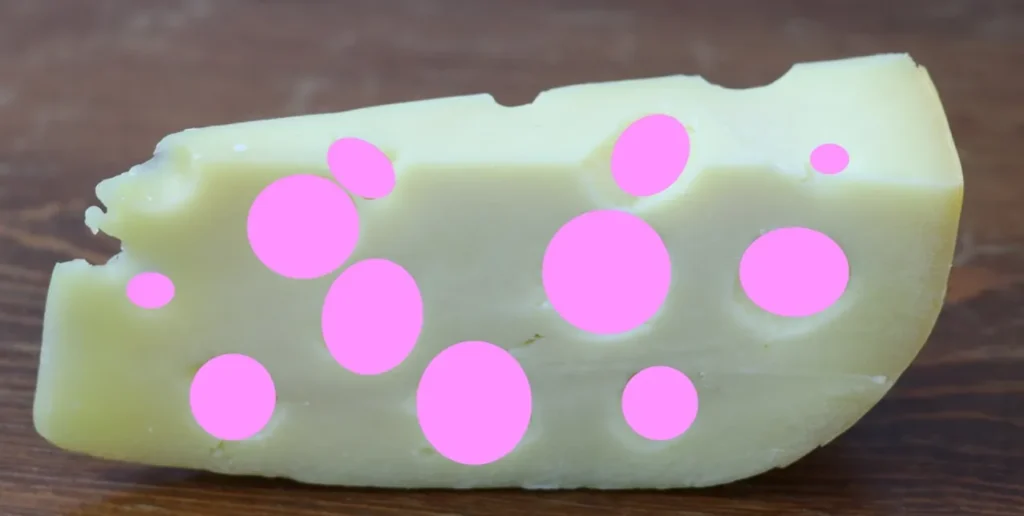
Analogy 1: Swiss Cheese
My first analogy describes how men really work.
Men want us to believe all their work is solid and complete.
But it isn’t.
In reality their work is Swiss cheese. There are holes in everything they do.
These holes are what create chaos, incomplete work, rework and unintended consequences.
Men are taught to be the one who brings the Big Cheese. As women, we’re told to compete with men to bring the Big Cheese. However, it’s very hard to compete with our male colleagues’ boldness and brashness. To them losing to a woman is unacceptable so they gang up on us.
Early in my career I learned not to compete with them, even though I knew I had a better plan or could do the job better.
I took a different strategy.
I looked at their plan or job and compared it to mine. I was looking for all of their holes; all the things that wouldn’t work out right. I then focused on figuring out how to fill in their holes.
So, when their work didn’t produce the expected results, I could stand up and be the one with all the solutions. I was the one who could fix things. This got me recognition. And when our performance soared, I got the credit.
No one cared who started the project.
They only cared about who delivered the results.
Over time I discovered that men couldn’t fill in the holes themselves, no matter what they did or how hard they tried. I witnessed all my workplaces adopt management initiatives to improve performance.
Eventually all of them failed.
The holes could only be filled in by women’s Pink Zone traits – the way women think and work.
When women fill the holes, we create wholeness. And wholeness is the only way to achieve the sustained superior results our workplace wants.
Looking for and filling in Swiss cheese holes proved to be the most powerful tool I used in my workplaces. I transformed so many ideas, plans and practices and made enormous impacts. My male colleagues kept asking, “How does she do that?”
My answer was, “I think like a woman.”
Analogy 2: Cupcakes and Cake Slices
Since my work was always project-based, teamwork was very important. But in men’s concept of teamwork, all parties aren’t of equal value. There has to be an MVP.
There are men who want to prove, “I can deliver this project!” They give the rest of the team permission to back off and ride his coattails. Team members willingly sit back either because they’re relieved to escape responsibility or they believe they aren’t as valuable. So, they wait for the MVP to deliver that big, beautiful chocolate cake that they can all get a slice of.
But in the end, all he delivers is a cupcake that celebrates him.
As women, we need to think of teamwork as a dessert bar where there are many different kinds of cake slices. As women, we find it hard for us to choose just one cake. We want to bring a slice of every cake back to our table to sample. We want to appreciate each of them for their unique qualities.
That is what teamwork is.
It requires everyone to come to the table, everyone to participate and everyone to emphasize their unique characteristics.
Analogy 3: Women Hold Up Half the Sky
Atlas holds up the world all by himself. He doesn’t need the help of anyone, especially a woman. We’re taught that the workplace is the same. Superior men accomplish great things and don’t need the help of women.
The foundation for this belief is the Doctrine of Two Spheres. It says men naturally inhabit the Public Sphere and women the Private Sphere. This of course, harkens back to the old stereotypes that see male traits as superior to female traits.
Consequently, for women to have any value in the workplace, we must adopt male traits and compete with men. Women must take a piece of work away from men or men have to surrender it to us. This is how we will achieve equality.
However, there is another concept:
Duality
Duality refers to two contrasting elements that coexist. They don’t exist in competition or in conflict but rather in a complementary relationship. I think of the value of women in duality with men through the Chinese proverb that says:
Women hold up half the sky.
But given our indoctrination as to the nature of men and women, we still see them as distinct and separate. We also want an empirical measurement to ensure there is equality.
However, that isn’t Duality.
In Duality, men and women aren’t separate.
They are opposing forces who interact and work together in harmony.
This means women don’t have to compete with men. We don’t have to take from men and men can’t take from us. We are inherently equal.
We each have our own half of the sky – our own way of thinking and acting. We need each other to perform our duty of holding up the sky. Most importantly, the sky isn’t complete and whole unless we lift up our half.
This brings me to my final analogy.
Analogy 4: Yin and Yang.
I use Yin (pink)and Yang (blue)to represent women and men as two complementary halves of the whole. They are connected opposites who continually interact and influence each other, creating a dynamic environment.
In this symbol we often miss noticing Yin and Yang are not represented as a solid color. Yin has Yang’s blue qualities and Yang has Yin’s pink qualities. This is because women and men aren’t different species. We share human qualities.
As individual men and women, the size of our complementary qualities can vary. Some of us have more, some of us less. How much we express also varies by our situation and environment.
Yin and Yang are not static within themselves or together.
As connected opposites they both influence and respond to each other. They work in harmony where neither is stronger or weaker than the other. In their dynamic relationship, they continuously balance each other and create balance within their environment.
More importantly, their harmonious, balanced interaction creates Wholeness.
Wholeness is where we find sustained, superior performance.
When men and women interact, work together and influence each other, we become comfortable expressing our complementary traits. We change each other, so we are no longer solidly Pink and Blue.
Even though we remain predominantly Yin or Yang, we transform into our own unique shade of Purple.
We find, balance, harmony and Wholeness within ourselves.
Empowered Women Know They Are One Half Of The Whole