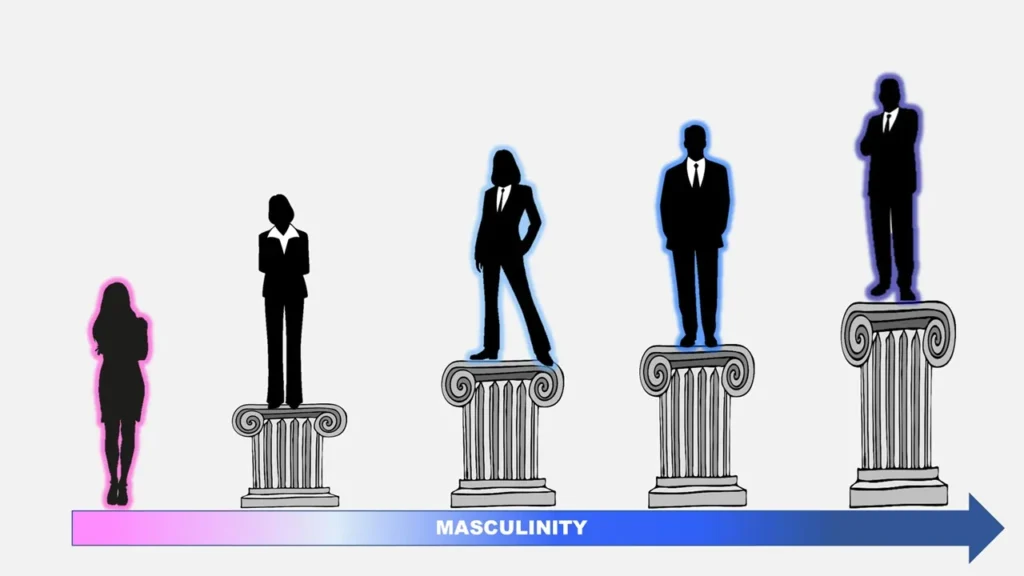
The media likes to boast that women get more college degrees than men. We are “smart girls” who do better academically than men. However, academic achievement doesn’t guarantee workplace achievement.
When we were in school, we knew who the “smart girls” were. They sat in the front of the classroom, they got perfect grades and the teachers really liked them. They got into the college of their choice and graduated with honors. They got great job offers. But that is where their success starts to erode. They don’t go on to become the next great entrepreneur or the CEO of a Fortune 500 company.
Why not?
It’s because the workplace rewards different qualities than academia.
Our employers initially hire us because we have knowledge. However, they don’t pay us to regurgitate that knowledge.
Employers expect us to apply our knowledge to develop skills.
They then expect us to use our skills to achieve workplace objectives. They want us to keep developing and applying our skills, so we gain experience that then allows us to achieve more complex objectives.
The workplace is all about taking action, making things happen and delivering results that positively impact the bottom line.
In the workplace “smart girls” can struggle with workplace expectations because in school they were conditioned to believe there is one right answer. In school they got regular feedback as to whether or not they had the (one) right answer. If they were correct, they were praised with gold stars, high grades, certificates and membership to elite clubs.
However, in the workplace, the textbook “right” answer is seldom the best or correct workplace answer. The textbook answer has to be adapted to the current complex situation and environment. The workplace “right” answer has to be figured out and may not resemble the academic textbook answer at all.
In the workplace, even after you have the “right answer”, you learn that answer didn’t produce the “A” you expected. You lacked experience to know that the “right answer” expected you to also go on and answer more questions. So, you wind up with a “low B” or a “C.” It may even turn out that you earned a big fat “F.”
It’s a test.
Your employer is looking to see how you respond to your low grade.
Are you the type of person who can stay in the arena and keep working the situation to get to the best solution?
Are you the type of person who can take the B, C or the F and turn it into a B+ or even an A?
The workplace is about rising to the challenge in front of you.
Being the “smart girl” in school isn’t good preparation for the workplace arena because the classroom doesn’t teach you to take risks and think beyond the textbook. It can be infuriating watching the “class clown” get ahead just because his silliness taught him to think outside the box and adapt quickly to new situations. He developed skills that make up for his lack of textbook knowledge.
Being the “smart girl” however, can be great preparation for being on the workplace sidelines.
“Smart girls” often discover their comfort zone puts them in support roles, especially communication-based support roles. They get to train or write and speak about what the people in the arena are doing and accomplishing. In these roles they can showcase how intelligent and articulate they are. They get the feedback and validation they want – “Good report,” or “Nice presentation.”
However, there is a danger that is always lurking out there. And when you face it, it feels worse than getting an F.
Too often, when articulate women are asked to speak on behalf of their inarticulate male colleagues, they only know what is in the presentation. Because they haven’t been in the arena, they don’t have the experience that makes them experts on the topic. So, when asked in-depth questions, they don’t know the answer. Many try to bluff their way through with an articulate and sometimes lengthy textbook answer.
But in the conference room that gets you skewered.
You are labeled “Incompetent.” And you are pushed even further to the sidelines.
Over the past several years the media and academic outlets joined forces to increase the emphasis on being the intellectual, articulate person. They sold us on the idea, “Words Matter.” However, we must realize that works well in their world where they sell ideas.
For them, the content of their words may be right, wrong or total BS. It doesn’t matter. They aren’t in a business where they have to prove their words produce the tangible desired outcome. Instead, they’re on a debate team where they only have to sell a point of view and score points for style.
The business world isn’t a debate club.
It’s a sports field.
In business, if you are going to sell an idea, then you also have to score points by delivering the expected results.
Right now, it’s also trendy and prestigious to be in a consulting firm or an organization with “Institute” in its name. However, as I’ve seen in ALL of my workplaces, those consultant recommendations and reports wind up in the trash can.
Why?
Because they are textbook recommendations. They weren’t written by people who honed skills in the workplace arena and had the experience to adapt their skills to the current situation and environment.
So, if women are to advance in the workplace, then we must stop valuing being the “smart girl.” Throughout my career, I watched “smart girls” who had the potential to break barriers and shatter glass ceilings just give up. I watched them leave nontraditional jobs and return to a traditional career or a gender-neutral career with little hope of advancement.
As women we must accept that the requirements for workplace success are different from those for the classroom. We must also prioritize the skills for workplace success over those for the classroom. After all, where are we going to spend more time? Which environment will impact our life more?
As women must spend several years in the arena of our industry. We must learn how it functions, take risks, experience failure, experience achievement and learn to think on our feet to solve problems in the moment. Then we can leverage our advantage – intelligently articulating what we did, how we did it and the results we got.
Being a woman working in a career-field dominated by men, I’ve run into countless men afflicted with BMOC (Big Man on Campus) Syndrome.
Usually the first warning sign that a male colleague has contracted the syndrome is his aggressive declaration “I want to be in charge” accompanied by the look and body language that says, “Because I am The Man.”
Allowed to run its course the syndrome affects the ego, over-inflating it to an unrealistic level. Soon he is stricken with BMOC Syndrome’s most recognizable symptom – a big head.
As women, our conditioned response to BMOC Syndrome is to back off and let the syndrome completely infect him. But, when we do, we allow the disease to spread – and we get infected too.
In us, the disease presents very differently. Our typical symptoms are a diminished ego, a loss of assertiveness and a smaller voice. Since the symptoms of BMOC syndrome are so radically different in women, our male colleagues refer to it as Little Woman Syndrome.
When I first began working one of my male colleagues had a very serious case of BMOC Syndrome. I backed off and let him “take charge.” I developed Little Woman Syndrome.
However, after his second bout of the syndrome I realized his BMOC Syndrome also infected our team and workplace. As a team our symptoms were chaos, disorganization, poor communication and poor performance. In other words, we were a big mess.
After that experience I decided to dedicate my life to stopping the spread of BMOC syndrome and its devastating effects on women and the workplace.
After years of combating countless cases of BMOC Syndrome, I am happy to report that I’ve developed a few remedies for the disease’s various stages.
As women, we typically encounter the first stage of BMOC Syndrome early in our career when everyone is trying to establish themselves – trying to make their mark. Our infected male colleague becomes offensively aggressive and overly competitive. He may also develop a brown nose and/or puckered lips.
As women, we think we have a binary choice when faced with an infected colleague – we can fight him or back off. As I already mentioned, most of us choose to back off and contract Little Woman Syndrome. Once infected it can become a disease that infects us the rest of our career.
Some women choose the fight option and try to contract BMOC Syndrome in the name of equality. They try to be as aggressive and competitive as their colleague. However, that seldom works because very few women can out-man a man with BMOC Syndrome. Instead, they wind up letting their male colleague infect them with Bitchy Woman Syndrome.
Our male colleagues love it when we come down with this!!
The true remedy to BMOC lies in a powerful third option, one that is homeopathic and natural to women. We don’t fight or retreat. Instead, we hold our ground. We stay put. We become immobile and use the Power of “No.”
By holding our ground, we don’t allow BMOC syndrome to elevate one man’s ego at the expense of everyone else’s. We keep everyone equal and working as a team. This allows us to say:
“No. You and your ego don’t get to come ahead of this team. We all have ideas and we will express them. Together we will resolve this issue/problem/project as a team. We will work together, succeed and make our mark as a team. So, park your ego and sit down.”
Using this natural remedy for the first time can be terrifying. We would rather swallow a spoonful of cod liver oil! However, we have to understand that the ONLY reason it is so difficult is because we’ve been taught women have no natural immunity to BMOC Syndrome.
And guess who taught us this?
Men with BMOC Syndrome.
However, once we take a stand, we are inoculated, we are forever immune to BMOC Syndrome. Something happens inside our head, heart and body and all we can say is:
“No. I will not be infected with Little Woman Syndrome just so a man can be The BMOC.And I won’t fall into the trap of Bitchy Woman Syndrome either, no matter how much they want me to get it.
Once we accomplish that physiological change within ourselves, we assert ourselves. We take on leadership roles. We have achievements for ourselves and our team.
It feels wonderful!
But then our success attracts the second stage of BMOC Syndrome.
Men who are pre-disposed to BMOC Syndrome become jealous of our success becauseit’s bigger and better than theirs.
They don’t believe a woman should have that kind of success, power, authority or achievement. All of that should reside within A Man. Consequently, they will try to take our success and claim it for themselves.
In mild cases of BMOC syndrome, they openly challenge to us. As the syndrome progresses, they backstab us. In the most severe cases of BMOC syndrome men actively sabotage us.
However, before we catch a bout of Bitchy Woman Syndrome, we remember:
The reason he is attacking us is because we are better than him.
We are The Achiever who has a track record of meeting goals and objectives.
We have more clout than him. Management depends on us and our performance.
My simple remedy to this is a little attitude and confronting him directly:
“So, we have X problem. Do you know how to fix it? What are you going to do?”
Many times, if we put him on the spot, we shake his fake self-confidence. We remind him that he has to deliver better performance than us. Our challenge and self-confidence more often than not make him back off.
Or another remedy is using our clout with our management allies. Again, with a little attitude that reminds them who they rely on, we request that this pip-squeak stop annoying us.
These remedies work in many workplaces. But not all.
In some workplaces, management itself is deeply infected with BMOC Syndrome. Our colleague knows this so he will us his brown nose and puckered lips on these infected managers to help him usurp you.
Suddenly, you are removed from your job or role for no valid reason – except – “This area is functioning so well, that A Man has to be in charge of it.”
As a woman, it is the most frustrating experience we will experience because we know that there is absolutely nothing we can do. We have no recourse. Of course, we can fight or file a complaint. However, those just lead to us being quarantined because they decided we have Bitchy Woman Syndrome.
At this point we have to be careful.
Our natural immunity is down and it’s easy to feel defeated and become infected with Little Woman Syndrome. We will get advice telling us to take on and be content in a “support role” (traditional female job no real man wants). People will also tell us the fairytale that if we work hard and show our dedication and loyalty then one magical day these men with BMOC Syndrome will notice us, realize our value and reward us.
Ha! That will NEVER, EVER happen! The men will live happily ever after, but we won’t.
To recover, we once again empower our natural immunity and the Power of “No.” We say “No” to contracting Little Woman Syndrome or Bitchy Woman Syndrome.
When we do this, our brain connects to the intuitive wisdom of women.
We realize that the man who usurped us was only after our job title. He doesn’t want the hard work, responsibility and accountability that come with it. He can’t do the job and he knows it.
He is counting on us to contract Little Woman Syndrome. He expects that because we are desperate to prove our worth, we will keep doing his job while he is out playing golf and taking long “business” lunches.
However, we don’t fall for the trap he has laid out for us. Instead, we use our womanly wisdom. We:
Accept that we were kicked to the curb. We lost our role and title. We also lost the work, the responsibility and the accountability.
Accept that we can work our fingers to the bone but we will never be rewarded.
Remember that we are the Achiever, not him. He can’t do the job on his own.
Using our womanly wisdom, we become infected with Empowered Woman Syndrome.
Empowered Women don’t do somebody else’s job for them. Empowered Women make men do their damn own job, especially when they usurp ours.
So, when our usurper demurely comes to us, requesting us to “help him out” and keep doing our previous duties, because “we are so good at them and we are a good team player,” we say:
“No. You wanted the job. You got it.”
Then we turn and walk away.
He wanted the title, he got it. He also got the responsibility, the hard work, long hours and the accountability.
Many women are afraid to say this because we think he will go running to management, complaining we aren’t a team player.
But – we should dare him too.
Remember those managers have BMOC Syndrome so I guarantee their response will be:
“What do you mean you need a woman to help you? You’re The Man. We expect you to do the job. We put you in that position to prove whatever a woman can do a man can do better.”
So, for our usurper, running to management is a really bad idea.
Remember we set the standard for the job and now he has to measure up to it. We let him figure out how to do it all by himself – after all, he’s The BMOC.
Meanwhile, we enjoy our time being kicked out to the curb and the frilly, girly duties we were assigned. And because we are women, we keep an eye on our usurper and wait patiently. We know he is screwing up our job and we know he will fail.
Some of my usurpers quit and walked out the door.
Some were fired.
Others just wiggled their way into a new, less demanding job.
Yes, I’ve been usurped a lot. There is a lot of BMOC Syndrome out there. But that’s okay because in response, I’ve contracted a very severe case of Empowered Woman Syndrome.
And I learned that BMOC Syndrome is no match for Empowered Woman Syndrome.
Eventually, I always got my job back.
However, before I took it back, I had one condition. I knew that when my usurper asked to be paid more than me and the BMOC managers agreed because he’s The Man.
My Empowered Woman Syndrome required me to now be paid more than him because I am The Woman, and I have to clean up the mess made by The Man.
Empowered Women Aren’t Intimidated by BMOC Syndrome
We are now earning 57% of the college degrees!! Whoo-hooo! We will soon close that nasty wage gap and have equal representation in the workplace all the way up to the board room. Right?
Not quite.
When just we focus on getting a degree, any degree, we ignore the two other factors that contribute to wages and promotion:
What employable job skills your degree gives you.
The type of job and career path you take.
So sorry, the reality is that not all college degrees have value. And given the high cost of a college degree, everyone should first ask themselves:
“What kind of job am I going to get with my degree?
Is my degree a good investment?”
For example, I was recently talking to a woman who was very proud of her daughter who was getting her PhD in Art History through an elite program. I bit my tongue instead of asking her, “And what kind of job will she be getting with her PhD?”
When I got home, I looked up the program. The program cost $75,000 per year and it was a 3-year program! Adding in the costs for her bachelor’s and master’s degrees, we can assume this young woman invested a fortune in her education.
But what is the return on her huge investment going to be?
If we look at college majors from the perspective of Return on Investment, we see two categories:
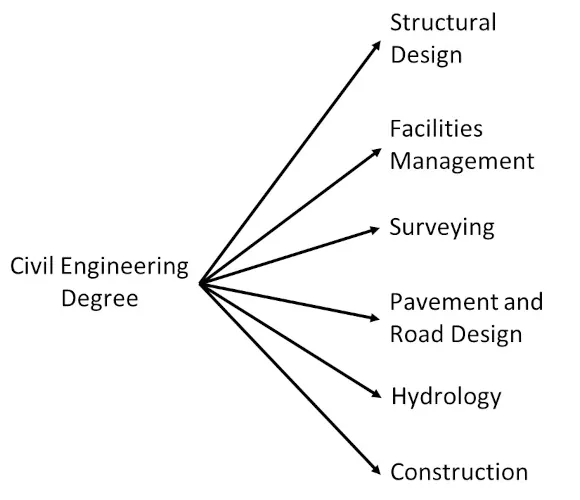
The first category are majors that provide the specialized knowledge required to enter a profession. These majors include architecture, accounting, engineering, nursing, doctor, elementary education, computer science and law.
Trade and vocational programs also fall into this category.
These programs and their degrees give us clearly defined options for our career path. We are offered jobs because employers recognize the value of our skills and/or knowledge.
Career Paths for Civil Engineering
The second category are degrees that don’t result in clearly defined career paths. These degrees give you knowledge in an area, but that knowledge doesn’t convert to job skills. After graduation we can be left wondering, “Now what do I do?”
These degrees make it difficult for us to find a job that pays better than if we never went to college at all. In my day we said women who went to college for these degrees got a degree in “Underwater Basketweaving.” Many liberal arts degrees fall into this category. Even the popular degrees of Business and Psychology, can also fall into this category.
So, before we pursue a college degree we have to remember that companies are in specific industries and they want to hire people with the knowledge, skills and experience specific to their industry. Therefore, a liberal arts or generic business degree may not be very valuable in securing a higher paying job right out of college. The return on our investment may not come until several years later.
But by then was it really our degree that mattered?
Or was it how we performed in our job?
Today too many women still get college degrees that don’t translate to high paying careers because we don’t get degrees that provide employable skills.
Even back in the 19th and early 20th century, women-only colleges provided an education and degree that was on par and equal to the degrees men got in their colleges. They focused on developing critical thinking and problem-solving skills so women could prove their intellectual equality to men.
Today, even when women get degrees from that provide skills, too many of us choose majors that lead to the lower paying jobs. In short, not enough women are getting degrees that lead to the same financial independence, financial security and ability to support their family on par with men.
Last year Glassdoor published a study, The Pipeline Problem: How College Majors Contribute to the Gender Pay Gap. It verified:
Men opt to for the highest paying majors. Of the top 10 highest paying majors, 9 are heavily male dominated.
Women opt for lower paying majors. The one exception is Nursing. It is in the top 10 highest paying majors and heavily female-dominated.
When men and women have the same degree, men choose higher paying career paths than women.
The study concluded that 54% of the gender pay gap is attributed to “occupation and industry sorting of men and women into different jobs that pay differently throughout the economy.”
In other words, 54% of the gender pay gap is attributed to the degrees and career paths women choose.
The study also revealed something else that was very interesting – a reverse pay gap in some professions. In others no pay gap. Even more interesting is that most of these are in the highest paying professions.
Architecture – women earn 14% more.
Advertising – women earn 8.1% more
Environmental Science – women earn 6.8% more
Chemical Engineering – women earn 5.4% more
Kinesiology – women earn 4.9% more
Mechanical Engineering – women earn 3% more
Accounting, Finance, Civil Engineer and Nursing – no pay gap
Personally, I am not surprised by this at all!
In my career I learned that many traditionally male-dominated professions such as engineering, architecture, accounting, finance, medicine and statistics, are actually better suited for women than men.
Celebrating that women get 57% of college degrees is celebrating a gee-whiz fact. How many college degrees women get doesn’t change anything if we aren’t choosing college majors and choosing career paths on par with what men choose.
It’s time to evolve out of our mid-20th century mindset and realize that in the 21st century the male-dominated professions are a goldmine of opportunity for women. If we apply ourselves correctly, we can not only close the wage gap but reverse it in many of the highest paying professions.
It is common to hear that in comparison to men, women lack confidence and therefore seek more validation. I’ve never believed this was a natural trait of women but a product of our conditioning. As we grow from girls into women that conditioning is continuously reinforced so throughout our adulthood we continue to seek external validation.
As children, both men and women are taught to meet someone else’s expectations and in return earn praise. But as boys move to manhood, they naturally move to being more autonomous. Their view the world and what they want to do is more important to them than how other people view the world and what other people want them to do. This gives men a better sense of self and self-determination.
It is why men seem more confident.
Women don’t seem to inherently make this same transition to independence of thought. We remain more aware of others than men do. This awareness is a very powerful female trait but it is misapplied and exploited by society, media and social media. This exploitation teaches women to elevate the thoughts, opinions and ideas of others and subjugate our own.
This is why women seem less confident.
A major difference between men and women is how we perceive ourselves.
Men believe their individual thoughts and ideas are the whole of thoughts and ideas.
Women recognize that our individual thoughts and ideas are one part of the whole.
When women are conditioned to believe other people “know better,” we diminish our individual thoughts and ideas as an inferior part of the whole.
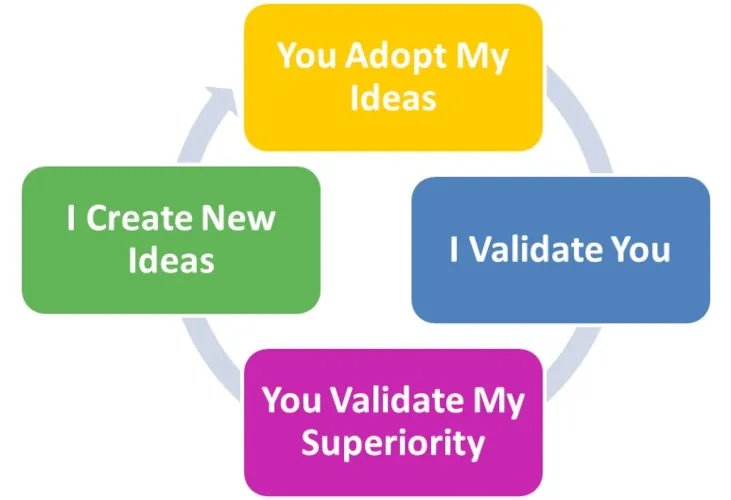
Our conditioning tells us that in order to regain our full value, and confidence, we need external validation. Various groups within society are more than willing to tell women:
“If you think, look and act within the parameters of our defined box, we will validate and accept you.
Women then listen to the ideas of various groups. We choose which group we want to join and which box we will fit conform to. When we conform to their box, we lose some or even all of our individuality.
As a woman who’s spent her entire adult life in male environments, I see the stark difference between how men and women are conditioned to be confident about who they are. I’ve heard all of the messages telling me to choose a box.
Even worse, there were many voices telling me which box I belonged in.
But because I’ve worked around men and their thinking, I developed a strong sense of self and tuned out those messages.
I refused to be in a box that doesn’t fit and isn’t Me.
Instead, I developed my own responses to all the voices telling me who I should be:
Who are you that your opinion matters so much?
Why would I put your opinion above my own opinions and experiences?
If you don’t validate me, why does that make me inferior? Doesn’t it just mean I am different from you?
There is no shortage of people who want to convince us that they are smarter and better than us. I’ve learned that many of these people (men and women) have a need to need to feel superior to others. They need others to look up to them in order to validate their own sense of worth.
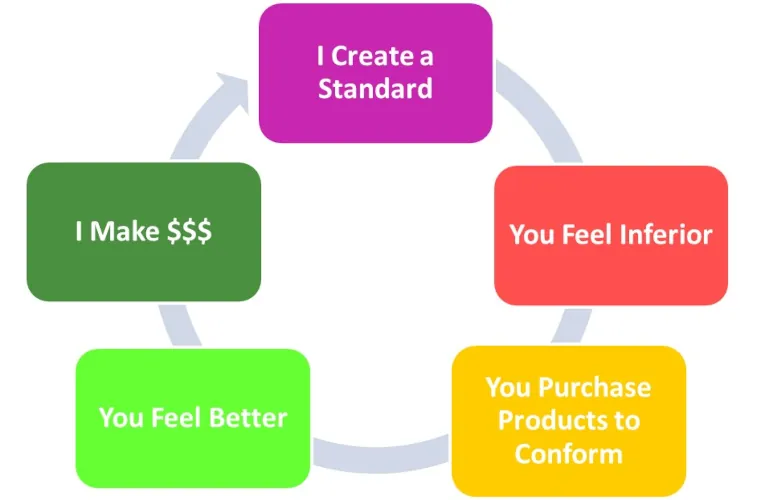
Many others do it because women make up the vast majority of consumers. If they keep the validation cycle going, they make a lot of $$$.
And of course there are the media, social media, and politics who manipulate us with validation and acceptance for their own purposes.
As women need to wise up to how others use us for their own purposes.
We need to break out of these manipulative cycles.
When we elevate other people’s opinions above our own, we disempower ourselves. We don’t voice our ideas, thoughts and opinions. We don’t express who we are. We deny our value and our equality.
Women we need to take a lesson from men and have a stronger sense of self. This doesn’t mean we ignore other people and their ideas. It means we think highly enough of ourselves so we are a full and equal participant in our family, team, workplace, community and society.
When we step outside the box that confines us, we find a big world of ideas, concepts and thoughts.
For many women going outside the box is scary.
Boxes are safe. They have well defined and validated boundaries that provide us security. However, the price we pay for that security is a denial of being our complete true selves and the personal fulfillment that comes with it.
When we explore outside the box we are exposed to lots of ideas, concepts and thoughts that we can evaluate. We can figure out if they fit into and add value to our life and who we are.
We find there are lots of “standard ideas.” Some fit into our lives. Some don’t.
We learn other people have unique ideas.
Some fit into our lives. Some don’t.
We learn we have unique ideas. Some people will benefit from our ideas. Others won’t.
When we are willing to step outside the box, we can go on the lifelong journey of pulling all of this together and discovering the unique person we are. That person is so much more open, colorful and interesting than the person inside the box.
Outside the box the only validation we seek is from within ourselves. We validate that we are being true to ourselves. This truth becomes our source of genuine confidence.
When we live our lives as our unique selves, we also give other people permission to be their unique selves. We destroy the boxes that confine people, make people think small and let people diminish others.
Women have a unique opportunity to change the world by allowing everyone to be their full unique self. But first, each of us has to choose to get out of our box and be our true selves.
It seems like a really intimidating situation for any woman. But it isn’t – if you understand what is really going on.
Like us, men get frustrated. But unlike women, men don’t “tend and befriend.” They don’t go running to each other to talk about their feelings or what is bothering them. They tend to bury it and keep it inside, periodically letting little bits of their frustration come out.
Many men were conditioned to keep it all bottled up inside. They then use alcohol, smoking, drugs etc. to help suppress their feelings. But then at some point it builds up and they explode – they yell and scream in a long expletive filled rant.
This is their coping mechanism.
For women, being at the receiving end of the rant can be nothing short of traumatic. It can (and has) driven many women out of the male-dominated workplace because we don’t know how to handle it and we take it personally.
To deal with these situations we first have to recognize that the rant isn’t about us. So even though the anger and frustration is directed at us, we don’t have to receive it and absorb it.
We also must recognize that many men work in high pressure jobs where the finger of blame is pointed at them. They are under pressure to make things happen or risk losing their job.
You must win this contract.
You must make $X in revenue.
You must fix this problem by X date
Even men who aren’t under this kind of pressure they can still have the perception that they cannot fail in order to protect their image or status. Consequently, they put a lot of unnecessary extra pressure on themselves.
In either case some men just have a hard time dealing with the stress and pressure of their work environment.
So, we should men’s rants as men trying to cope.
And their inability to deal with deal with it!
Rants are simply about their frustration, stress and being overwhelmed.
Women are often at the receiving end of these rants because men typically pick out “the weakest person” to unload on. They don’t think “the weak person” will fight back or stand up to them
Men don’t want to rant to a person who is going to remind them of their perceived “weakness’ or “failure.” They just one directional rant where they can release the emotion.
So, as hard as it may seem this is why we shouldn’t take these rants personally or believe they say anything about us. They aren’t about us, they are about him. They are about his stress and frustration.
I learned to see men having rants as sad, lost boys crying for help.
As women we are in a unique position to provide that help. We can put our empathy and understanding into action and ask him, “What do you need to get done and what help do you need to get it done?”
Contrary to what we are taught, men are much, much, much more receptive to opening up to women if women just ask the simple question “What do you need help with?”
Men like having a woman, they can trust, who they can be vulnerable with. They like having a Girl Friday to whom they can say “I need X done” and she replies “I’ll take care of it.” That task can be trivial, or it can be significant.
Our willingness to help opens up a goldmine of opportunity for women especially since it is usually our boss or a manager who needs help. We can use it to get our foot in the door, work on issues above our pay grade, give us exposure to the Bigger Picture and build a key relationship. It is an advantage of being the woman in the room that we should take advantage of.
We should also consider that sometimes men unload on us because of issues in their personal life. They need someone to talk to. The man I mentioned at the opening of this article, screamed at me because he was working away from home and his wife just called him to tell him she had brain cancer. His outburst was a huge cry for help.
Of course, not every man will want the help. But we can still help him, even if he doesn’t know it. We do it – not because we are doormat – but because we want to lead our workplace to becoming a supportive team environment.
And it’s amazing how many men will come back later and thank us.
Women who don’t work in a predominantly male environment, may be surprised (shocked)about how much men open up and confide in a female colleague. They will open up and talk to us about anything and everything!!
So, with more women in the workplace, men can find a woman they trust to talk to and vent with. Then as we work through issues, and come together as a team, the number of the emotional rants decrease.
This is just another advantage of women in the workplace.
It can be intimidating to be a woman entering an all-male workplace. Even though the reception is professional you aren’t sure it’s an accurate representation of the environment. You don’t know what your male colleagues really think about working with a woman in their career field and what they are saying about you behind your back.
I’ve navigated this situation many times. I was successful because I didn’t look at the situation from my perspective but through the perspective of my male colleagues.
I know. Many women don’t like me to say that. They believe men simply need to get over their biases and just accept that a woman can do the same job as them.
However, that response fails to recognize that most of the men are in a situation they are absolutely clueless on how to handle.
They need help.
That is why I go into this situation seeing myself as the bigger, more secure and confident person who can help my male colleagues learn and grow. I see beyond myself and my personal interests to recognize that my male colleagues – in spite of their bravado – also have trepidations.
Their primary concern is that they don’t know what my presence means to them personally. Therefore, they don’t TRUST me.
To men trust is enormously important. They want to know that the presence of a new person will not negatively impact them. That is how they define Trust.
As a woman, I only had to look to the negative stereotypes to figure out my male colleagues’ “Trust issues” with a female colleague. Unfortunately, most of them heard about or experienced women that men couldn’t trust. This put an extra burden on me so they needed to Trust that I would:
Not be a man-hating feminist with an agenda to take down as many men as I could.
Not be a DEI hire with special privileges.
Do my job thoroughly, completely and accurately so none of my work was dumped on them.
Be willing to work hard, get my hands dirty and put in the hours needed to get a job done.
My male colleagues also had some positive expectations of women that I used to build Trust. They learned these from working with women in traditional support roles. And while a few of my male colleagues bravely admitted men knew these were true, they told me not to expect men to admit to it.
Men knew women were much better at communication. They needed women in writing assignments and for creating presentations. Women could transform their garbled ideas into logical, flowing expressions.
Men knew women are far better at details and forming complete ideas and solutions.
They knew women had a smartness, wisdom and intelligence that they needed to listen to because it could keep them out of trouble.
Women had a different kind of strength. We can handle a tough situation better than men. So, when men really needed to be bailed out, they knew they could depend on women to rescue them.
As women, we need to understand that all of the items I listed are starting points for building Trust. Men have fears so we can’t play into those. Instead, we focus on our strengths and demonstrate that our presence doesn’t create a burden.
We aspire to show that our presence is an enhancement to our workplace.
From my experience I know that the male-dominated workplace is very flawed. And men, no matter how hard they try, can’t fix it on their own because the critical flaw is that their workplace is too male. Therefore, when women come into a male-dominated workplace, we are a natural enhancement if we assert ourselves properly.
However, many women immediately stumble and create unnecessary challenges for themselves. We focus too much on being a woman. We focus on the negatives of biases, discrimination, harassment and what men need to do to make us feel accepted. We create obstacles to building Trust which damage our relationships and careers.
Any woman entering a male environment must recognize that Trust is the foundation on which working relationships are built. After we create Trust, then we can earn Respect. Trust and Respect then work in conjunction with each other to build alliances with our male colleagues.
Those alliances are what we use to advance our career.
In order to advance women in the workplace, women need solutions for the unique issues and challenges we face. That is why I started this website.
When I began, the women who had worked deep in the male-dominated workplace weren’t sharing the lessons they learned. So, through this website my original intent was to share a lot of “How To’s” such as:
How to get your voice heard and take command of the conference room when you are the only woman in a meeting with 25 loud, opinioned men who all want to be in charge.
How to prevent sexual harassment and what to do when it occurs.
How to get a lot of recognition for your achievements without being an obnoxious braggart.
How to recognize and seize the hidden opportunities in your workplace that will propel your career forward
How to deal with women in traditional roles when you are the first female manager and upset the decades old informal power structure.
How to be a leader as a woman.
How to be confident when you don’t have all the answers.
How to approach any job so you always out-perform your male colleagues
How to deal with very competitive male peers.
These are the solutions women need. However, as soon I began putting these solutions out there, I met resistance. I quickly discovered that women had a larger, more fundamental problem:
We don’t understand how the male-dominated workplace really functions.
Our perceptions about the male-dominated workplace are based on narratives written over 40 years ago. And these narratives have been repeated decade after decade. Consequently, young women today think they are facts. They aren’t.
What women don’t know is:
Those narratives weren’t written by women with any experience working in traditional male roles.
Even now when I speak to a group of women, I sometimes get lambasted by women who want to protect these old narratives. Meanwhile the women who have been “the woman in the room” as computer programmers, mathematicians, procurement specialists and statisticians are quietly sitting, nodding their head in agreement with what I am saying.
It seems many women are focused more on protecting the narratives, than on advancing women. They don’t want to hear how their bad workplace experiences come from the bogus narratives. They don’t want to know how the male-dominated workplace really functions.
We know that if we want to succeed in an environment, then we have to understand that environment.
Therefore, if women want to advance in the workplace, one of the first solutions we have to put in place is and understanding of how the male-dominated workplace functions.
Here are some basics:
Men and the male-dominated workplace are driven by a quest for Autonomy, independence and self-determination. (Women’s narratives say they are driven by a quest for power and domination over others.)
Trust and respect are paramount in the male-dominated workplace. (Women’s narratives eradicate men’s trust.)
Men fear blame. In some men that fear is intense. (Women’s narratives blame men.)
A good sense of humor is critical. (If you have never LMFAO at a Trump tweet, you will have problems working with men.)
The result of not understanding of how the male-dominated workplace really functions is having a devastating effect on advancing women. Too many women see themselves as powerless.
Consequently, too many young women accept that the only way women can become empowered, and advance is when men decide to give up some of their power and give it to women. Since this idea follows the dictionary definition of empowerment, women accept it as a real-world truth. We accept that this is the way the world works.
Out of all of the narratives this definition of empowerment is the most devastating to women. To remedy this woman must adopt men’s attitude towards empowerment:
I turned 18. I am a legal adult. I am fully empowered. Period.
Women need to understand that our full empowerment and equality already exist. They are just sitting there waiting for each of us to pick them up and do something with them. We just have to choose to do so.
As women we should never accept that we aren’t fully empowered. And when someone says we aren’t we should do what men do – challenge them.
But many women resist accepting this perspective on empowerment and equality. Why?
Why don’t women want to see our own inherent equality and power?
I found one answer when I first began talking about my career. I wasn’t cheered for my success. Instead, I was slammed with comments that I was lying or making it up. Women didn’t want to hear that a woman was successful in a male-dominated job.
Why not?
Because I could then turn to them and ask:
Why didn’t you try?
Why didn’t you go into a male-dominated profession where you could break barriers and shatter glass ceilings?
The truth is that the old narratives give women an excuse not to try. They give us an excuse to play it safe and stay in our traditional roles and protect our feminine privilege.
The fundamental, underlying reason women don’t want me speaking out is because I was willing to give up my feminine privilege in order to achieve equality and advance my career.
Feminine privilege says women can assume less responsibility in the workplace but still have the same pay and promotion opportunities as men who take on more work, responsibility and accountability.
But that is not how the workplace functions. Ultimately the workplace is merit based. So, we need to prove we merit the same opportunities, pay and promotions as men because we take on the same work, responsibility and accountability as men.
If we really want to advance women in the workplace, then the very first thing we have to do is give up our feminine privilege.
I know that the male-dominated workplace is a goldmine of opportunity for women. My blogs, videos and book can help women advance and achieve their full potential.
We just have to choose to do it.
Empowered Women Give Up Their Feminine Privilege To Achieve Their Equality.
When women need career advice our first instinct is to look on the internet. This is what I did a few years ago.
After a few hours of reading and skimming through internet articles, I stopped. I was horrified by what I read. My only thought was:
If this is the career advice women are getting, it’s no wonder we aren’t advancing!
I forgot about looking for my own career advice and dove into this new problem. I kept reading and realized the articles could be divided into four groups.
The first group and by far the largest, was what I called:
The Feel-Good Group.
These articles, blogs, pictures and quotes offered an abundance of inspiration and empathy. They let me know I wasn’t alone and other women were dealing with the same issues as me. I felt like my frustrations were heard and shared with the world. This group made me feel better as it inspired and motivated me.
But then, after reading what seemed like hundreds of these articles, I still wondered what behaviors I was supposed to adopt or change in order to advance my career. As an engineer and a business woman, I wanted actionable solutions. However, The Feel-Good Group offered only inspiration.
The second group had the opposite effect so I called it:
The Feel Bad Group.
These articles and blogs made me feel like women are doomed. It didn’t matter what I did, how I acted, or what I achieved, the male-dominated workplace was inherently unfair and would always hold me back simply because I was a woman. According to them, it didn’t even matter if I worked for a female manager because they often treated women worse than men. Reading these articles I felt more victimized and powerless than I actually ever experienced my hard-core male-dominated the workplaces. From these articles I concluded that I should stop looking for solutions because my situation was hopeless.
The third group of articles was summaries of research papers, so I called them:
The Studies Group.
Written by various institutions and organizations these articles were basically long problem statements loaded with lots of facts and figures documenting all the ways women aren’t advancing and achieving parity with men. I also noticed that the way the facts were sliced and diced led women to conclusions that were inconsistent with my real-world experiences. I decided that many of these studies were worthless, not only because they didn’t offer solutions, but because they didn’t give me credible information I could use to derive my own solutions.
For 11 months, I searched and read. Then finally I was sent an HBR article that I was told belonged to the elusive fourth group:
Solutions for Advancing Women.
I read the article with great anticipation, expecting the wisdom of the ages to spill off the page. After reading it though, I wasn’t excited. There was something about it that bugged me. And I mean it really, really bugged me. Something about it wasn’t right but I couldn’t figure out what.
Then, it hit me.
“The Solution” to women’s career advancement issues could be summed up as:
Act like a man.
Wow! What does that advice tell women about their value in the workplace?!
I was disappointed that a year of researching and reading countless articles yielded no feasible and actionable solutions to advance women in the workplace. However, there were a few things that stuck me.
The first was that society’s perception of women hasn’t evolved.
We still believe in the stereotypes.
We still believe women are more emotional than intellectual.
So, when women have problem, just make us feel better, and – *POOF* – all of our problems magically go away. In the old days we gave women Valium. Today we are given dopamine through social media feel good posts and bias confirmation.
The second thing that struck me was that it seems we still believe that female traits are inherently inconsistent with workplace success.
Is this why women aren’t given actionable solutions?
Do we still believe femininity and workplace success are mutually exclusive?
This made me question how many people, organizations, institutions and workplaces truly believe men and women are equal and of equal value in the workplace. This goes well beyond just a gender bias:
Is there a true belief that women and female traits are inherently inferior in the workplace?
After thinking about all that, I was struck by another alarming thought:
Women are being played.
It seems that many of the organizations, institutions and media aren’t as interested in advancing women in the workplace and society as they advertise.
Why not?
Because there is so much $$MONEY$$ to be made off of maintaining the status quo!
It’s actually very simple.
We know women are the largest consumer group. And, if you read any article or book on marketing to women, it will tell you that to sell to women, appeal to their emotions. (Stereotype)
The productthe media and social media sells to women is:
Emotional Responses.
If women feel bad, give them an inspirational message, so they feel better. Then the next time they feel bad, they will return to the site again so they can feel better.
To generate even more revenue, start generating negative messages so women will seek out the posts, images, a class, a training program or coaching that make them feel good. By manipulating the cycle and women’s emotions they can generate tremendous revenue.
(Take an internet marketing course and this is what they teach.)
In the years since I began monitoring how the internet uses women, there have been some changes.
Women caught onto The Feel-Good Group and want more than just empathy and inspiration. We want to feel like we are intelligent too.
In response, the technique changed and the floodgates opened producing articles and posts that fall into The Studies Group. There is a reason this is so effective.
You probably read a study that says women get more college degrees than men. Therefore, the media knows it can make women feel good by reminding women that we are academically superior to men.
Now, most real studies are long, dry and boring. So, to appeal to women, there has to be an emotional element. The facts must be sliced and diced to create an emotional reaction.
And the chosen the emotional reaction is outrageand an intense feeling of unfairnessreminiscent of The Feel Bad Group.
A prime example of this is the wage gap.
We’ve all read many studies that cite that women earn 78 or 80 cents to every 1 dollar men earn. Seeing these numbers, women are outraged! Our workplaces are discriminating against women! We are led to believe women that women earn 20% less than men for doing the exact same job.
However, that’s NOT what the facts say.
But to the media that doesn’t matter. It achieved its goal:
It successfully sold Intellectual Outrage to women.
The media could now produce countless programs, books, articles, videos and podcasts about the “unfair” wage gap WITHOUT providing any solutions. (Solutions would kill the revenue source.)
www.123rf.com 24390717
As women we need to get wise to all the ways we are being sold Intellectual Outrage without any solutions to the problem.
It’s everywhere!
We’re being conditioned to believe we’re acting out of intellect when we’re really being emotionally manipulated.
Emotional manipulation then gives people power over us.
It’s all a cycle to take advantage of women, not advance women.
Don’t believe me?
Conduct your own study. Read through posts on social media. Watch any “news” show that discusses politics. Listen to a podcast.
Monitor your own response. Is it emotional? Then ask yourself:
If you haven’t figured it out from reading my articles, I believe in women standing up for themselves. I believe women can stand up to anybody and to institutional power. After thinking about why I feel so strongly about this, I realized I learned this powerful lesson in the first grade.
My first grade teacher was mean and a bully.
To this day I can’t tell you her name because I never really knew it. I always called to her Mrs. Poo-Poo Head.
Within the first hour on the first day of school she made very clear that she hated boys and blonde-haired girls. Reading through the attendance roster, she rearranged us to let us know who she favored and who she didn’t. My friend Shelly, who was a sweet blond-haired girl was removed from her desk in the front row and sent to the desk closest to the door. The teacher then moved two brunette girls up to the front and made it clear that they were her favorites.
All the boys were sent to the back rows.
I was a redhead with curly hair and freckles. After she informed me that redheads are the devil’s children I was moved to the back row, next to Gino, the boy she despised most of all.
She demonstrated her hatred of boys every day.
When we had to line up to go somewhere, she typically called for the girls to line up first with her two favorites at the front of the line. Shelly and I took our places at the end.
If boys jumped the gun and lined up at the same time as the girls she humiliated them. Her favorite punishment was to put bows in their hair and make them walk around all day with the bows.
As the last girl in line, I tried to make the boys sit down before they were caught. I was scolded for helping the boys and sent to sit in the hall as my punishment.
In those first months of school I was sent to sit in the hall about once a week for helping the boys or speaking out that something was unfair.
I remember a spelling bee where the final 3 were myself, another girl and a boy. When the boy correctly spelled his word, our teacher told him he spelled it wrong. I spoke out and said he spelled it correctly. Other kids joined my protest. The boy and I were sent out of the classroom to sit in the hall.
As The Girl in the Hall, I got some attention because my school used this punishment to remove unruly boys from class. After the first couple of punishments, other teachers began asking me what I did to warrant my punishment. I replied with the truth that I challenged my teacher’s unfairness. After a while I became aware that the teachers next door and across the hall monitored how often I sat in the hall.
One day Gino came to school with a broken leg. It was no secret that he was abused at home by his father and his two older teenage brothers. Seeing his broken leg our teacher came back to him and asked him what happened. He said he fell down the stairs and after more questioning it was clear that his father pushed him. Our darling teacher then sided with his father, told him he was a bad kid and deserved it as well as the beatings he got from his brothers.
Sitting at my desk and listening to her, I began crying. She scolded me for crying.
I will always remember it was at that moment that I began hating this woman.
My tears turned to anger. I kept whispering to Gino that it was going to be all right and not to listen to our teacher because she was a mean wicked witch.
Later that day we went to gym class. Our teacher told the gym teacher that Gino couldn’t be excused from gym class because he didn’t bring a note from home. Listening to our teacher I learned that Gino’s mother couldn’t write a note because she was in the hospital with cancer.
The gym teacher didn’t challenge our teacher and Gino wasn’t excused. I got the impression they considered Gino’s family “trash” and if was OK abuse Gino because it was what he deserved.
My anger and hatred intensified
As we did our jumping jacks I looked over at Gino who was struggling with his full leg cast. Our teacher and gym talked as they stared at him. To me, my teacher seemed obviously proud of the punishment she inflicted on him.
My 6 year old mind saw the evil, wicked witch portrayed in fairy tales. My anger exploded. I got out of line and went up to the teachers and began yelling at them. The gym teacher pulled Gino out of the line and had him sit along the wall. I was told to sit down next to him. Then another boy got out of line to defend me and Gino. He was sent to sit along the wall too.
I didn’t consider being expelled from gym class as punishment. Using my imagination, I pictured us sitting under a big sign that said, “The Winners.” I was never afraid of standing up to that witch again.
In early December our teacher said she had a “special” holiday project for the last week of school. She said that whoever brought in the most potpie tins could help her. I told my mother and we collected the tins from our neighbors and family. A week before the deadline I brought in a bag containing 18 -20 tins. My classmates were all excited about how many I was able to round up.
On the big day of the project, everyone told me they knew I would be the helper. However, our teacher announced that one of her favorites would help her. I felt betrayed. My classmates sat in shocked disbelief.
Then one of the boys spoke up on my behalf. Before the teacher could reply, the rest of the class joined in, including her two favorites.
She had a full blown mutiny on her hands.
I knew the reason they stuck up for me when I was wronged was because I stuck up for them when they were wronged.
I spent the day helping my teacher do our project of filling the tins with plaster and putting a candle in the middle. Amazingly we got along extremely well. I could tell that for some reason this project meant a lot to her. It had a personal and special meaning that made her very happy.
Those last two days before Christmas break were the happiest days in the classroom. After the holidays it was all back to “normal.”
In the spring, she eventually went too far. When 3 boys lined up with the girls, instead of putting bows in their hair, she made “bonnets” for them out of doilies and ribbon. She then made them walk through the school wearing their “bonnets.” I remember some other teachers questioned her about it. She gave her standard reply that if the boys wanted to line up with the girls, then she would treat them like girls.
When we got back to the classroom, she had the girls and the boys with bonnets remain lined up against the wall. She then berated the boys and told them she was going to call their fathers and tell them their sons want to be girls.
The boys got very upset and began crying. One boy got hysterical and kept pleading, “Don’t call my father, don’t call my father.” (It was 1967 in New Jersey so you can imagine how some fathers would react to that phone call.)
Most of the girls started crying. Then two boys who were seated stood up. From the look on their faces, I thought they were going to attack our teacher who was still mocking the boys relentlessly. Since our teacher was standing in front of me, I got out of line and placed myself between her and the boys who were ready to attack. I began yelling at her to stop. Other kids started yelling at her to stop. Every kid in the class was either yelling or crying.
She got control of herself and sent me and the three crying boys still wearing their bonnets to sit in the hallway again.
This time other teachers came out of their classrooms to check on us. I remember sitting there trying to console the boy who had been hysterical. I don’t remember what I said but it was clear something had to be done. The teacher in the classroom next door went back into her classroom and called the principal. The principal and some other women came and we were taken to the lunchroom for the rest of the day.
For the remainder of the year, our teacher was a lot more subdued. I assumed she got in a lot of trouble. I also noticed our classroom door was always left open as was the teacher’s next door. And every day the principal or another adult stopped by our classroom.
On the last day of school our teacher tried to get in her last little jab in at me. I got 100% all year on my spelling tests so I was supposed to get a BIG gold star on the front of my spelling book. However, she gave me a little gold star. I knew she did it deliberately, so I called her out on it.
I stood there at her desk going through my book, showing all my perfect tests. She never looked at me or said a word but eventually slammed a BIG gold star on the front of my book. Everyone looked up. I gathered my book and walked back to my desk in the last row in triumph.
To me, I didn’t earn my BIG gold star for spelling.
I earned my BIG gold star for standing up to the wicked witch.
After reading this story it is easy to focus on my teacher and be outraged that she was allowed to bully, abuse and victimize her students. We can blame the school administration and the organizational power structure for not doing their job, intervening and removing her from teaching.
But if you focus on the teacher, you miss the real moral of this story.
Back in the 1960’s and 70’s, bullying was a battle between the bully (and their friends) and the person being bullied (and their friends.)
It was up to us to stand up to a bully and make the bullying stop.
With this principle as my foundation, my first grade experience taught me all I needed to know about bullying:
Bullies thrive when no one stands up to them.
Adults can be intimidated by a bully and be bullied too.
People can witness bullying and choose to look the other way.
You have to be your own knight in shining armor. If you wait to be rescued, you will be bullied while you wait because of lessons 2 and 3.
Most people are afraid to be the first one to stand up to a bully.
If you are the first to stand up against a bully, you have to rally support.
Other people will join you in your fight against a bully because most people want to do what’s right.
If you stand up for other people, they will stand up for you.
People who stand up to bullies together form a bond and become allies.
Bullies don’t stop just because you stood up to them once. You have to keep standing up to them.
If you keep standing up to a bully, eventually something will change, something will be done.
All bullies can be defeated. It just takes one person choosing to step forward and start the process.
As a 6 year old, I summed up these lessons in fairytale terms:
When Good fights Evil, Good always wins.
As it turned out my first grade experience prepared me well for the rest of my life.
In third grade two different groups of boys thought they could beat up the girl with the curly red hair. They both learned I always fight back. And when you rip my favorite coat, I get really, really mad and there is hell to pay.
In college when a guy tried to grab me to sexually assault me, I grabbed him back…in the crotch. I then squeezed as hard as I could, yanked down and twisted. He screamed out in pain.
As a woman in a male-dominated workplace, first grade taught me to never be intimidated by any of the men I worked with or any of their power plays. I didn’t care who they were, I believed I could stand up for myself. If they retaliated, which some did, I just kept standing up for myself.
I refused to let evil or bad behavior win.
Of course there were times when I questioned if I should back down (usually from listening to the advice of others.) There were also times when I questioned if I should get involved in a situation because the person being bullied didn’t want to stand up for themselves.
But then I always remembered Gino with his broken leg and I felt compelled to take a stand.
(BTW, Gino’s mother passed away during the school year and he went to live with his grandmother…without his older brothers.)
I lived by the lessons I learned all through the first half of my career with success and great satisfaction. But in the latter half, Rule 4 went away.
Society decided that people shouldn’t stand up for themselves. Instead, we must report incidents to people with the proper authority and rely on them to rectify the situation on our behalf.
Because of my experience in first grade, I don’t like this. It disempowers us and empowers people with the “proper authority.”
It gives them the power to decide if we are worthy of defending or if we deserve how we are being treated.
And because the new policies didn’t eliminate Lessons 2, 3 and 10, I got mixed results from reporting bullying, harassment and unfair practices.
Some of my managers handled the situation so badly they made the situation worse. In one workplace we discovered that the person we had to file the complaint with, was severely bullying the bully we complained about.
I’ve also learned the hard way that many, if not most, of the people with proper authority who are supposed to deal with the situation, don’t want to and won’t do anything. I’ve had them try to intimidate me and bully me to make the complaint go away.
However, in all of these cases I kept going and eventually found the good people who sided with me.
There are good people who will do something.
When I was sexually harassed at work and did get the fairytale response every woman hopes and dreams of:
A true (though not handsome) knight in shining armor who was more upset by the incident than I was, was willing to fight for my honor.
However, he said he had to delay his response a day because he was so angry that he knew he would punch my offender in the face that day.
I’ve also known senior managers who dropped everything to get on a plane and intervene in a situation.
The latter half of career taught me that in spite of these new corporate policies and our heightened awareness, Rule 4 still exists:
You have to stand up for yourself.
You have to be your own knight in shining armor.
Don’t expect chivalry. Don’t expect that even when a friend offers hours of listening, compassion, understanding, and empathy, they will put themselves on the line to fight alongside you.
Most importantly, don’t expect anyone to fight harder for you than you are willing to fight for yourself. And if you are afraid to stand up for yourself, then just remember:
If a classroom of first graders can stand up to their bully teacher, then grown adult women can certainly stand up to their workplace bully.
I never stopped believing in the lessons I learned in first grade. As I applied them throughout my life, I learned one more powerful lesson women are seldom told:
There is GREAT POWER in doing what is right, standing up for what is right and speaking the truth.
Bullies and evil-doers are afraid of this power because,
I read an article about women and sexual harassment. After reading the article I got in a comment battle with another woman over how women should respond to sexual harassment and assault. She was very focused on offering empathy and sitting up all night with a woman who has been hurt. To her offering empathy and understanding is what empowered women do.
To me, empowered women do a lot more – they also take a stand and pursue justice. An empowered woman, after sitting up all night listening to her hurt friend, goes out the next morning and starts the process of getting justice. She is her advocate.
She puts her empathy, caring and understanding into action to help her friend get the justice she deserves.
The other woman focused on being a victim and creating a lot of energy around those feelings of victimization. But putting a lot of energy into that state perpetuates that state. And as the author of the article also discussed it’s hard not to be affected yourself by the story of others and let it drag you down.
To me, we need to put the energy towards healing and moving beyond the incident, so it doesn’t permanently alter our lives in a negative manner. I think of these negative incidents as someone pushing you down and infusing you with their negative energy. Our recovery process should then focus on working our way back up, ejecting their negativity and replacing it with our own positive energy.
I’ve always found that standing up for myself and pursuing justice works miracles in speeding up the recovery process. It gets me and the energy moving in the right direction. Sometimes the justice process is swift and easy, sometimes it is really hard, but you keep moving forward. If you are lucky enough to have an advocate she ensures you keep taking steps forward, even if they are baby steps.
When I feel I got the justice I deserve, I feel empowered and strong.
This is why I don’t reflect back on my career and see a long list of harassment, discrimination or unfair incidents. I see challenges and obstacles that made me stronger and more confident. They are a reminder that men don’t have power over me.
The subtext of the other woman’s comments (and what really fired me up) was that it implied that when men act inappropriately, empowered women can only respond in an emotional manner. Therefore, change can only come when men decide to change their own actions. Until then, it is women’s duty to keep pouring out the empathy and understanding to other women.
Doesn’t that sound a lot like the stereotypes?
Men act. Women are emotional.
What about women taking action?
After reading many comments on many posts, it seems that many women don’t believe or don’t want to believe that women have the power to act and influence men to change their actions.
Our society is conditioned to believe women won’t act. It believes if we give women their #MeToo moment to vent, appease them emotionally, sacrifice a few men, then eventually women will sit down, shut up and go away.
We conditioned men to believe they just have to wait it out. They don’t have to change because women aren’t going to do anything to make them change. Women aren’t going to impose consequences.
If women want real and lasting change in men’s behavior, then women have to stop just talking and empathizing. We need to act by standing up for ourselves, pursuing justice and imposing consequences.
But again, from reading through lots of comments, there are a lot of women who don’t want us to see women as actors and doers because it then makes women responsible and accountable for their own actions. In every incident they want women to be seen as innocent little lambs who are attacked by the big bad wolf in order to put 100% of the focus on men’s actions.
They don’t want us to ask:
“Why did you go up to his hotel room?
“Why did you get falling down drunk with those guys?”
“Why did you let him in?”
I can hear women screaming now “You want to bring back Victim Blaming!”
No.
I want women to understand the negative consequences of us denying our action, responsibility and accountability.
We’re way too anxious to believe our equality means we can act just like men. However, there are many environments and situations where we face vulnerabilities men don’t. We need to wise up to these.
Empowered women aren’t afraid to admit their mistakes and learn from them.
Fear of Blame is a guy thing. Men are afraid of admitting mistakes because it can affect their status.
Unfortunately, they’ve projected it to women and use it against us as victim blaming.
Men intimidate us with our 10% mistake, so we don’t expose their 90% mistake.
Men use our Shame to avoid their Blame.
We need to get wise to this and stop falling for it.
I’m not afraid to expose my mistake and take my 10% of accountability. If anyone wants to victim blame me then my response is “I know I’m not perfect. I am human. We all make mistakes.” Then I give them the look that says “Shall we discuss your long list of mistakes?”
This attitude let me to file an 80 page complaint against a serial abuser in which I included all of my dirty laundry. Not only was the serial abuser addressed but the company instituted a lot of policy changes to prevent the abuse he doled out.
I know I keep harping on how important our attitude and perspective are to standing up for ourselves (and others) and getting justice. This is why we can’t see ourselves as a powerless victim.
Several years ago I was sexually harassed at work and filed a complaint. My complaint was not kept confidential. Luckily someone who received it intervened and stopped a subsequent email that would have made it public.
I was horrified, disgusted and angry. As I drove home from work, I realized I was victimized – twice. I got very upset. After wallowing in my victimization for 20 minutes I thought:
“What the hell do I have to be ashamed of? I didn’t do anything wrong. The man who breached my confidentiality after being instructed to protect it was who was wrong.”
(My harasser was already fired.)
I realized how thinking of myself as a victim disempowered me. So I picked up the phone, called the appropriate person and got my justice.
That was the only time in my career I ever associated myself with “victim.”
Justice in her womanly form – raised sword and no blindfold.
I prefer to be a justice seeker and someone who always stands up for what is right. I found there is a lot of power in that.
And that probably explains why women are discouraged from believing in our power to act, our power to influence men and our power to invoke consequences.
The true secret to success is being yourself – your true authentic self, full of strengths, weakness and quirks.
We all gladly embrace our strengths. We love to show them off. But we should also be proud of our weaknesses and quirks because through them we find real strength.
Embracing our weaknesses and quirks demonstrates confidence. Declaring them out in the open makes us strong.
We’re taught our weaknesses and quirks are something we should be ashamed of, so we try to hide them. That makes us vulnerable and insecure. We’re afraid of being found out. But when we put them out there – no one can hold anything over us – there is nothing left to expose. We have freedom.
For example, I can do many things as well as a man. I like to cycle and I like it when I pass younger men. It makes me feel good.
But don’t ask me to throw a ball. I throw like a girl.
No, actually a 6-year-old girl throws a ball better than me. When I was in middle school and we tried for the Presidential Fitness Award, I was the top girl in all of the physical tests except for throwing the softball. For two years, I didn’t get the Presidential Fitness Award because I couldn’t throw a freaking ball.
I can make business decisions and solve problems all day long. But don’t ask me where to eat. My mind literally goes blank and all I can say is “I dunno know.”
On weekends I get dressed to go out to eat but then drive around in circles because I can’t decide where to go. I wind up going home to eat.
Now that’s a quirk!
And I cannot tell left and right. All through elementary school I put my left hand, then my right hand then my left hand over my heart for the pledge of allegiance. My family knows that if I am driving and they tell me to turn left or right, they have to point. Ironically I can do izquierda y derecha (Spanish) with no problem. Weird huh?
Laugh at me. It’s funny. And I’m not embarrassed. It’s who I am.
At work when we share our little quirks with each other, we find out that each of has a peculiarity to laugh at ourselves about. We discover that we can help each other deal with our quirks and it feels good to help them.
My colleagues learned that when they ask me to go to lunch, I would reply “Sure, where are we going?”
I would go to any hole-in-the-wall eatery and eat anything as long as I didn’t have to decide.
Our quirks are what make us real, authentic and unique. They show we are human. So, embrace them and share them.
Empowered Women Embrace Who They Are, Quirks and All
Growing up women learn to say “No” to unacceptable behavior. But people don’t always listen. That’s because we are just saying “No” and not using the Power of “No.”
Just saying “No” leaves the door open for negotiation.
Does she really mean it? Let me see. Maybe if I pester her enough she will give in. Maybe if I am nicer or promise her something she wants in return, she will give in.
Just saying “No” allows the encounter to become a challenge to see who will back down or give in first. If the woman gives in, the antagonizer feels they won – and they learn that “No” doesn’t really mean “No.” It means that she is open to negotiations and wants something in exchange. Or, that she doesn’t have the strength and confidence to stand up for herself.
The Power of “No” is different.
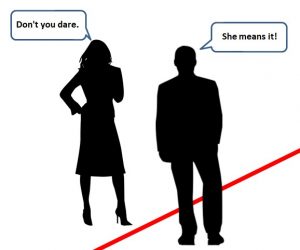
It draws a line and says “Don’t you dare cross it.” The woman has a look in her eye that says she is serious. She will not back down or budge one iota from her position. Anyone who dares to cross the line will suffer the consequences.
The Power of “No” is intimidating. It makes the antagonizer stop and think about their actions. If they cross the line they know they are choosing to do something wrong. They have to decide if what they want is worth the consequences.
Way back in the mid-20th century young girls used to learn the Power of “No” by watching their mothers and the women in their family enforce the rules in the home. Mothers didn’t say “Wait till your father gets home.” They pulled out the wooden spoon themselves.
Girls also witnessed countless examples of female power, determination and intimidation every Sunday night on Mutual of Omaha’s Wild Kingdom. Their role models were the females of every species who protected their young. The females didn’t just say “No” and open negotiations:
Predator: “I want to eat your babies”
Female: “No. Go away.”
Predator: “Oh come on, let me eat your babies. If you let me, I’ll take you to this really nice watering hole.”
As soon as a predator came too close animal mothers used the Power of “No.” It didn’t matter how big or powerful the predator was, the mother never backed down. She never thought “This is going to be too hard or I might get hurt or he has too much power so go ahead and take my babies.” She always stood up for herself and her young and fought back.
We still see some examples of women using the Power of “No.” We see it in the mother who drags her son home from the middle of a riot. I saw it all the time in the construction trailer where the administrator laid down the law and enforced the trailer rules:
Clean your boots off before you enter.
Don’t use the copier without permission.
Don’t take office supplies.
Don’t ever use the women’s bathroom.
She made even the most macho obnoxious men obey. No one dared cross her.
The Power of “No” is female power. It recognizes that women have an inner strength and a determination unmatched in men. It says women have the authority to set the rules for acceptable behavior and the power to enforce those rules with consequences.
When women use the Power of “No,” they assert and stand up for themselves. They turn #MeToo into #HeSangSoprano, #IFiledCharges, #HeNeverDidThatAgain, #HeListened and #ProudofMyself.
Unfortunately over the past couple of decades women have distanced themselves from the Power of “No.” When my daughters were growing up other mothers and I discussed how girls were no longer getting the same messaging we received. That’s because the Power of “No” was no longer politically correct because it was associated with motherhood and maternal instinct.
By taking away the Power of “No” girls and women were left with just saying “No” and a belief that men have this incredible power that women can’t overcome. We diminished ourselves as we traded in the Power of “No” for the political power we expected to find in victimization.
But victimization doesn’t advance women. It never has and it never will.
Asserting ourselves, standing up for ourselves and using the Power of “No” does advance women.
As women, we need to go back and reclaim our inherent female power. We need to draw the lines of acceptable behavior… and then give that deadly look that says “Don’t you dare cross that line.”
Several years ago I was working on a project where some senior male managers didn’t want a woman in charge. They wanted to prove that anything I could do, a man could do better.
www.123rf.com – 57566386
This was a particularly difficult project and men lasted about 2 months. So every 2 months, I was back in charge with a mess to clean up until they found another man to take over. I stayed in this revolving door for over a year. My direct supervisor fought hard on my behalf, using every bit of clout he had but even he couldn’t make a difference.
Eventually they ran out of men who were my peers, so they decided to promote their star up-and-coming young man, a man who I was mentoring. I was basically out of a job because this time all of my responsibilities were taken away. A couple of days later, the young man approached me in the hallway and said “You are still going to do everything you’ve been doing right?”
I gave him a steely cold stare and said “No. You wanted it, you got it.” I turned and walked away.
Four weeks later he gave his notice.
He approached me again and said “I didn’t realize how much you did.”
My cold response was “No you didn’t.”
He then apologized and confessed to back-stabbing me to get the job. He showed me emails, leaving no doubt that a particular manager saw me as the company’s Token Woman.
After my young colleague left, no man would take over. They threatened to quit if assigned to the project. This time I didn’t step forward. Instead, my supervisor went to bat for me again and this time they gave in – with a 15% pay raise. By this time the project was in dire straits and everyone ran away from it like rats leaving sinking ship. They were happy to have somebody, anybody take over.
In the end the company lost a tremendous amount of money trying to prove the impossible – that a man could run the project better than a woman. Soon after I was put back in charge, another woman joined the project and together we kicked butt and got ‘er done while all the men scratched their heads wondering how we did it.
All these years later, I find myself in a similar situation. For several years I’ve been the President of a board for a small organization. This year, a man came forward, wanting to be President. I chose to take a break and let him be President. Since taking over he’s made a mess of things.
As he tries to squirm out of his responsibilities I am holding him accountable and find myself again saying “You wanted it, you got it.”
All too often men take on positions they aren’t ready for. As women we watch them mess up and then we make a HUGE mistake – we clean up their mess for them.
For some reason we find power in this. We find power in secretly knowing that men need us and can’t do their job without us. But that is our mistake – we keep it a secret when it should be a hugeflashingneon sign that our male colleagues need the skills we bring to the male-dominated workplace.
It is time for women to take off our aprons and put down our dust pans. If a man wants a position then he’s got it along with all the responsibilities and accountability. He can clean up his own mess or step down.
If we wind up taking over and have to clean up someone else’s mess, then we only do it with full recognition – the authority, job title and pay. And our pay must be higher than what the mess-maker earned….because that is what any other man would demand.
Empowered Women Don’t Clean-up Other People’s Messes for Free!
For more articles on harassment and discrimination go to The Ugly Stuff article category
Empower Yourself – Subscribe to my articles – Contact Me
Assert Yourself by Expressing Yourself – Leave a Comment & Share this article