At a recent dinner a woman and I were talking about women in tech. She brought up a story about a young woman who was the only woman in her department. One of her male co-workers dropped $2 every day into her cubicle. He did it to diminish her – to make her feel like a sex object.
The woman was upset that women have to deal with stuff like that. I told her that if women think outside the box, we can get the upper hand.
I said that if it was me, I would bring in a jar and sit it on my desk with a big note that says “Dot Appreciation Jar.”
Every day I would add my colleague’s money to my jar. Then after a couple of days, when my co-worker arrived, I would hold out my hand expecting the $2. Once in my hand I would give him a perky “Thank you.”
I suspect that would throw him off because he would get the message that I wasn’t insulted.
When I had enough money, I would stop by Starbucks in the morning and get him a Venti Caramel Macchiato (men always seem to like those) and a pasty and something for me too…with his money.
Then with my best perky sunshine and smiles voice I would deliver his coffee as if he and I are besties who do little things for each other all the time. (Very girlie).
Of course, that would get the attention of all the other guys. They’d want to know why he got coffee and pastry and not them. What did he do that was so special?
He was the one who was insulting me every day!!
My answer would be:
“He appreciates me!! He knows he could be working with someone who looks like the rest of you guys, but he’s got ME instead!”
As I told this part, the men sitting near us started laughing. I asked, “That would work right?” They nodded it would.
I told the woman:
If a woman allows herself to be insulted or offended she automatically loses.
The guys would then continue to do stuff to her because they know they can get a reaction.
The trick to dealing with these situations is to NOT react and figure out how to turn the tables to your advantage.
Making a joke out of the whole thing shows you have a sense of humor – something men like their colleagues to have. It also demonstrates strength and that you can stand up for yourself without diminishing any of the guys.
It’s a power play where you establish that everyone (especially you) is an equal.
That is a power women have.
We don’t acknowledge that there is a hierarchy that has the power to elevate and diminish people. If we eliminate the hierarchy from our perspective, then it doesn’t exist. And if it doesn’t exist then we never respond to it and we never give energy to it.
The HUGE MISTAKE women make is that they believe men are all about power and hierarchies. (Men encouraged us to believe it.) This is what we’ve been taught but it is WRONG!
Men are all about their AUTONOMY. They like their independence and they rebel against men who make power plays over them.
As women, we must show our male colleagues that we have autonomy too. We have the power to CHOOSE how we respond to their games.
If women want to be seen as equals, then it is up to us to act as equals. That means we can’t engage in a power dynamic even if our male colleagues do. We simply refuse to play their game and by their rules.
Our equality means we play our game by our rules.
Remember Star Trek and how Capt. Kirk beat the Kobayashi Maru test?
It was a no-win scenario. But Kirk didn’t like to lose and he didn’t believe in no-win scenarios.
So, he changed the conditions of the test. He gave himself an opportunity to win and he won. Initially, he was accused of cheating. But in the end, he was awarded a commendation for original thinking.
Women need to pull their own Kobayashi Maru.
Who says we have to play the workplace games according to the rules written by the guys?
Who????
All the people who make a living off of telling women how the male-dominated workplace oppresses us???
All the people who tell women we need to fit in, conform and think and act like the guys???
Or is it all the people who want power hierarchies because they hope to be at the top or they want an excuse for not having done more with their opportunities???
. And there all the people who tell us men have power structures that diminish us and discriminate against us. And all those people who tell us we have no power and change has to come from the top down through new policies.
These people think inside-the-box. They set us up to play the no-win scenario for their personal reasons. They don’t want us to prove we can win.
It’s up to us to think out of the box so we can break out of the box.
Women need to stop conforming and playing men’s games by men’s rules. We have to pull our own Kobayashi Maru and play our game by our rules using our original female thinking.
That is how we advance women and change the workplace.
Empowered Women Think Outside The Box
To learn how I handled a similar situations with my male colleagues, watch these YouTube videos:
Do the rest of your co-workers, especially your male co-workers feel the same way?
Do most of your workplace’s meetings start late because you are waiting for everyone to show up?
That’s how mine were until I discovered the cure:
Food.
Nothing gets people’s attention in the office more than food.
If there are donuts or bagels in the break area, that is where you will find everyone gathering in the morning. If there is a potluck lunch and the smell of homemade food is wafting through the office, people seem to come out of the woodwork.
Food makes us feel good. If you think about every big life event and every holiday, food is an important part of it. Food creates comradery.
That is why I like using it to lure people to meetings.
For morning meetings there is the standard lure of donuts, muffins and bagels. But don’t forget about fresh fruit with homemade muffins or banana bread. While homemade food is the pinnacle of the food pyramid, a coffee cake or danish from a real bakery (not the grocery store) can rival it.
Bring in good food a few times and that guy you’ve been trying to get to attend a meeting, suddenly shows up.
Personally I hate staff meetings.
They are so freaking boring and worthless. People invent crises just so they don’t have to attend them. Issues go unresolved because everyone who needs to address the issues are never at the meeting at the same time. It is frustrating!
My cure was to hold “staff meetings” at lunchtime. And provide lunch.
Actually, I cancelled the traditional “staff meeting.”
I didn’t need my staff telling me stuff I already knew. With my first work-computer in 1987, I learned to generate reports that gave me all the information I needed. I already knew what was going on and where the problems were.
So, I created a meeting that wasn’t a waste of time and everyone liked to attend.
In one workplace, I first broke us down into 4 different groups who rotated responsibility for providing lunch. After a few weeks of the regular pizza, fried chicken and deli sandwiches, people got creative. They began bringing in homemade food. (The company reimbursed them for the cost of the groceries.)
People love to share their (or significant other’s) homemade specialty. It made all the difference because people opened up.
We spent the first half hour or so eating and talking. (People started showing up early.) As a manager this is when you find out all the things nobody tells you about. Guys especially love to tell tales and joke around with each other. I learned that the joking was typically based in an issue that needed to be resolved.
I replaced that whole formal, charts and graphs, bullet point, agenda-driven meeting with informal and productive conversation.
For the second half hour, we addressed a project problem or a workplace process that wasn’t working. Many topics came right from my team’s informal conversations.
With everyone in a good mood from eating and talking first, we had great collaboration and cooperation. We resolved the issue within 30 to 45 minutes. It is amazing what a team can achieve when everyone is in the right mood.
We became the company incubator of solutions.
Our solutions spread throughout the company.
We spent less than $125 per week on food and saved the company hundreds of thousands of dollars. The company didn’t need to hire expensive consultants to rewrite procedures and processes. We did it.
Our meetings were also a super-cheap way to provide relevant professional development for everyone. I paid for the lunches out of my “training” budget. Everyone got training, not just a select few.
Consequently, our performance soared.
Early in my career I also discovered how to use food to promote and advance myself. I used food to crash meetings I wasn’t invited to.
When management has a meeting you want in on, bring them some homemade muffins, bread or whatever you know how to make to get your foot in the door. Start up a conversation about the meeting topic and invite yourself to stay.
I actually crashed an important Saturday morning meeting with homemade banana bread.
“I made two of these last night. Since I had to stop by the office to pick up something and knew you guys were working, I brought the extra.”
It got me in the door and I didn’t leave. From that meeting I got on the project of my dreams. I then made that project a huge success.
I owe so much of my career and its success to that banana bread.
Using food to crash meetings works. But you have to bring homemade food. Store-bought is “too canned” and just not effective. I’ve watched my male co-workers try to copy my technique with store-bought. It didn’t work. (I snickered.)
Being a woman also gives us an advantage when there are important out of town visitors.
For these meetings lunch is often brought in. So, on those occasions I was never afraid to play “Hostess with the Mostest.”
I found out what time lunch was being delivered and I was at the door to greet it. I escorted the food to the conference room and took my time directing the set up. As the “hostess” it was my duty to graciously greet our guests and make sure they were well-fed and taken care of.
No, I wasn’t demeaning myself.
I was working an angle.
You see, in these meeting there is always a man whose job it is to introduce people to each other and start conversations. Typically he is the first one to approach the food. I would introduce myself and make it clear that I was not the admin, PR or marketing person.
I made sure he knew I had a job directly involved in the meeting topic.
Often surprised that a woman had my job, this man then introduced me to the other guests. And I was invited to join them for lunch. After all, that is the courteous and professional way to thank me for being a courteous and professional hostess.
Sometimes I would get invited to stay for the rest of the meeting. Either way, I made connections but more importantly, I gathered “intelligence” I could later use.
Meanwhile my male co-workers were walking back and forth up and down the hall trying to figure out how to get into the room.
Never underestimate the power of food. Use it. Leverage it.
Today many women are afraid to be associated with food whether it is store-bought or heaven forbid, homemade. They fear being cast into the realm of domesticity. All I can say is:
“GET OVER IT!!”
This isn’t the 1960’s. Men cook too. You may even be surprised by how many of your male colleagues like to talk about the food they love to cook.
Remember:
Food is universal bonding.
So, if you can use food to give yourself an advantage, then do it. After all, your male colleagues aren’t about to stop talking to senior managers about sports or cars because it gives them an unfair advantage over you.
Empowered Women Use The Amazing Power of Food To Their Advantage
If you haven’t figured it out from reading my articles, I believe in women standing up for themselves. I believe women can stand up to anybody and to institutional power. After thinking about why I feel so strongly about this, I realized I learned this powerful lesson in the first grade.
My first grade teacher was mean and a bully.
To this day I can’t tell you her name because I never really knew it. I always called to her Mrs. Poo-Poo Head.
Within the first hour on the first day of school she made very clear that she hated boys and blonde-haired girls. Reading through the attendance roster, she rearranged us to let us know who she favored and who she didn’t. My friend Shelly, who was a sweet blond-haired girl was removed from her desk in the front row and sent to the desk closest to the door. The teacher then moved two brunette girls up to the front and made it clear that they were her favorites.
All the boys were sent to the back rows.
I was a redhead with curly hair and freckles. After she informed me that redheads are the devil’s children I was moved to the back row, next to Gino, the boy she despised most of all.
She demonstrated her hatred of boys every day.
When we had to line up to go somewhere, she typically called for the girls to line up first with her two favorites at the front of the line. Shelly and I took our places at the end.
If boys jumped the gun and lined up at the same time as the girls she humiliated them. Her favorite punishment was to put bows in their hair and make them walk around all day with the bows.
As the last girl in line, I tried to make the boys sit down before they were caught. I was scolded for helping the boys and sent to sit in the hall as my punishment.
In those first months of school I was sent to sit in the hall about once a week for helping the boys or speaking out that something was unfair.
I remember a spelling bee where the final 3 were myself, another girl and a boy. When the boy correctly spelled his word, our teacher told him he spelled it wrong. I spoke out and said he spelled it correctly. Other kids joined my protest. The boy and I were sent out of the classroom to sit in the hall.
As The Girl in the Hall, I got some attention because my school used this punishment to remove unruly boys from class. After the first couple of punishments, other teachers began asking me what I did to warrant my punishment. I replied with the truth that I challenged my teacher’s unfairness. After a while I became aware that the teachers next door and across the hall monitored how often I sat in the hall.
One day Gino came to school with a broken leg. It was no secret that he was abused at home by his father and his two older teenage brothers. Seeing his broken leg our teacher came back to him and asked him what happened. He said he fell down the stairs and after more questioning it was clear that his father pushed him. Our darling teacher then sided with his father, told him he was a bad kid and deserved it as well as the beatings he got from his brothers.
Sitting at my desk and listening to her, I began crying. She scolded me for crying.
I will always remember it was at that moment that I began hating this woman.
My tears turned to anger. I kept whispering to Gino that it was going to be all right and not to listen to our teacher because she was a mean wicked witch.
Later that day we went to gym class. Our teacher told the gym teacher that Gino couldn’t be excused from gym class because he didn’t bring a note from home. Listening to our teacher I learned that Gino’s mother couldn’t write a note because she was in the hospital with cancer.
The gym teacher didn’t challenge our teacher and Gino wasn’t excused. I got the impression they considered Gino’s family “trash” and if was OK abuse Gino because it was what he deserved.
My anger and hatred intensified
As we did our jumping jacks I looked over at Gino who was struggling with his full leg cast. Our teacher and gym talked as they stared at him. To me, my teacher seemed obviously proud of the punishment she inflicted on him.
My 6 year old mind saw the evil, wicked witch portrayed in fairy tales. My anger exploded. I got out of line and went up to the teachers and began yelling at them. The gym teacher pulled Gino out of the line and had him sit along the wall. I was told to sit down next to him. Then another boy got out of line to defend me and Gino. He was sent to sit along the wall too.
I didn’t consider being expelled from gym class as punishment. Using my imagination, I pictured us sitting under a big sign that said, “The Winners.” I was never afraid of standing up to that witch again.
In early December our teacher said she had a “special” holiday project for the last week of school. She said that whoever brought in the most potpie tins could help her. I told my mother and we collected the tins from our neighbors and family. A week before the deadline I brought in a bag containing 18 -20 tins. My classmates were all excited about how many I was able to round up.
On the big day of the project, everyone told me they knew I would be the helper. However, our teacher announced that one of her favorites would help her. I felt betrayed. My classmates sat in shocked disbelief.
Then one of the boys spoke up on my behalf. Before the teacher could reply, the rest of the class joined in, including her two favorites.
She had a full blown mutiny on her hands.
I knew the reason they stuck up for me when I was wronged was because I stuck up for them when they were wronged.
I spent the day helping my teacher do our project of filling the tins with plaster and putting a candle in the middle. Amazingly we got along extremely well. I could tell that for some reason this project meant a lot to her. It had a personal and special meaning that made her very happy.
Those last two days before Christmas break were the happiest days in the classroom. After the holidays it was all back to “normal.”
In the spring, she eventually went too far. When 3 boys lined up with the girls, instead of putting bows in their hair, she made “bonnets” for them out of doilies and ribbon. She then made them walk through the school wearing their “bonnets.” I remember some other teachers questioned her about it. She gave her standard reply that if the boys wanted to line up with the girls, then she would treat them like girls.
When we got back to the classroom, she had the girls and the boys with bonnets remain lined up against the wall. She then berated the boys and told them she was going to call their fathers and tell them their sons want to be girls.
The boys got very upset and began crying. One boy got hysterical and kept pleading, “Don’t call my father, don’t call my father.” (It was 1967 in New Jersey so you can imagine how some fathers would react to that phone call.)
Most of the girls started crying. Then two boys who were seated stood up. From the look on their faces, I thought they were going to attack our teacher who was still mocking the boys relentlessly. Since our teacher was standing in front of me, I got out of line and placed myself between her and the boys who were ready to attack. I began yelling at her to stop. Other kids started yelling at her to stop. Every kid in the class was either yelling or crying.
She got control of herself and sent me and the three crying boys still wearing their bonnets to sit in the hallway again.
This time other teachers came out of their classrooms to check on us. I remember sitting there trying to console the boy who had been hysterical. I don’t remember what I said but it was clear something had to be done. The teacher in the classroom next door went back into her classroom and called the principal. The principal and some other women came and we were taken to the lunchroom for the rest of the day.
For the remainder of the year, our teacher was a lot more subdued. I assumed she got in a lot of trouble. I also noticed our classroom door was always left open as was the teacher’s next door. And every day the principal or another adult stopped by our classroom.
On the last day of school our teacher tried to get in her last little jab in at me. I got 100% all year on my spelling tests so I was supposed to get a BIG gold star on the front of my spelling book. However, she gave me a little gold star. I knew she did it deliberately, so I called her out on it.
I stood there at her desk going through my book, showing all my perfect tests. She never looked at me or said a word but eventually slammed a BIG gold star on the front of my book. Everyone looked up. I gathered my book and walked back to my desk in the last row in triumph.
To me, I didn’t earn my BIG gold star for spelling.
I earned my BIG gold star for standing up to the wicked witch.
After reading this story it is easy to focus on my teacher and be outraged that she was allowed to bully, abuse and victimize her students. We can blame the school administration and the organizational power structure for not doing their job, intervening and removing her from teaching.
But if you focus on the teacher, you miss the real moral of this story.
Back in the 1960’s and 70’s, bullying was a battle between the bully (and their friends) and the person being bullied (and their friends.)
It was up to us to stand up to a bully and make the bullying stop.
With this principle as my foundation, my first grade experience taught me all I needed to know about bullying:
Bullies thrive when no one stands up to them.
Adults can be intimidated by a bully and be bullied too.
People can witness bullying and choose to look the other way.
You have to be your own knight in shining armor. If you wait to be rescued, you will be bullied while you wait because of lessons 2 and 3.
Most people are afraid to be the first one to stand up to a bully.
If you are the first to stand up against a bully, you have to rally support.
Other people will join you in your fight against a bully because most people want to do what’s right.
If you stand up for other people, they will stand up for you.
People who stand up to bullies together form a bond and become allies.
Bullies don’t stop just because you stood up to them once. You have to keep standing up to them.
If you keep standing up to a bully, eventually something will change, something will be done.
All bullies can be defeated. It just takes one person choosing to step forward and start the process.
As a 6 year old, I summed up these lessons in fairytale terms:
When Good fights Evil, Good always wins.
As it turned out my first grade experience prepared me well for the rest of my life.
In third grade two different groups of boys thought they could beat up the girl with the curly red hair. They both learned I always fight back. And when you rip my favorite coat, I get really, really mad and there is hell to pay.
In college when a guy tried to grab me to sexually assault me, I grabbed him back…in the crotch. I then squeezed as hard as I could, yanked down and twisted. He screamed out in pain.
As a woman in a male-dominated workplace, first grade taught me to never be intimidated by any of the men I worked with or any of their power plays. I didn’t care who they were, I believed I could stand up for myself. If they retaliated, which some did, I just kept standing up for myself.
I refused to let evil or bad behavior win.
Of course there were times when I questioned if I should back down (usually from listening to the advice of others.) There were also times when I questioned if I should get involved in a situation because the person being bullied didn’t want to stand up for themselves.
But then I always remembered Gino with his broken leg and I felt compelled to take a stand.
(BTW, Gino’s mother passed away during the school year and he went to live with his grandmother…without his older brothers.)
I lived by the lessons I learned all through the first half of my career with success and great satisfaction. But in the latter half, Rule 4 went away.
Society decided that people shouldn’t stand up for themselves. Instead, we must report incidents to people with the proper authority and rely on them to rectify the situation on our behalf.
Because of my experience in first grade, I don’t like this. It disempowers us and empowers people with the “proper authority.”
It gives them the power to decide if we are worthy of defending or if we deserve how we are being treated.
And because the new policies didn’t eliminate Lessons 2, 3 and 10, I got mixed results from reporting bullying, harassment and unfair practices.
Some of my managers handled the situation so badly they made the situation worse. In one workplace we discovered that the person we had to file the complaint with, was severely bullying the bully we complained about.
I’ve also learned the hard way that many, if not most, of the people with proper authority who are supposed to deal with the situation, don’t want to and won’t do anything. I’ve had them try to intimidate me and bully me to make the complaint go away.
However, in all of these cases I kept going and eventually found the good people who sided with me.
There are good people who will do something.
When I was sexually harassed at work and did get the fairytale response every woman hopes and dreams of:
A true (though not handsome) knight in shining armor who was more upset by the incident than I was, was willing to fight for my honor.
However, he said he had to delay his response a day because he was so angry that he knew he would punch my offender in the face that day.
I’ve also known senior managers who dropped everything to get on a plane and intervene in a situation.
The latter half of career taught me that in spite of these new corporate policies and our heightened awareness, Rule 4 still exists:
You have to stand up for yourself.
You have to be your own knight in shining armor.
Don’t expect chivalry. Don’t expect that even when a friend offers hours of listening, compassion, understanding, and empathy, they will put themselves on the line to fight alongside you.
Most importantly, don’t expect anyone to fight harder for you than you are willing to fight for yourself. And if you are afraid to stand up for yourself, then just remember:
If a classroom of first graders can stand up to their bully teacher, then grown adult women can certainly stand up to their workplace bully.
I never stopped believing in the lessons I learned in first grade. As I applied them throughout my life, I learned one more powerful lesson women are seldom told:
There is GREAT POWER in doing what is right, standing up for what is right and speaking the truth.
Bullies and evil-doers are afraid of this power because,
The current narrative says that all unwanted sexual attention and harassment is based in power. It isn’t.
Sometimes it is simply about sex.
Like many women I experienced a lot of unwanted attention and been harassed by outside associates, peers and even the men who report to me. Most of the time, I was the one with more power. I knew their advances weren’t intended to diminish me.
They just saw a woman who was different from most women and decided “I want to try her out.”
Many men cross the line into unwanted attention simply because they are looking for sex and believe the old saying: “Nothing ventured, nothing gained.” If they take their shot, they might get lucky.
This game gets played a lot when we are out of town. Men want to know if we are one of those women who also believes “What happens in Vegas, stays in Vegas.”
Do we transform from serious career woman to party girl?
Too often women make the mistake of being too polite when we reject these advances because we don’t want to hurt the man’s feelings or come on too strong. But when we are polite, he interprets it as us leaving the door open. He again thinks nothing ventured, nothing gained so he tries to open the door some more.
The harassment begins.
So ladies, we can’t be polite in our rejection – we take our shot and send him down in flames. His ego will recover.
There are also some men who have this weird notion that if he is interested in us, then we want him too. The idea that we aren’t attracted to him doesn’t even register as a possibility.
I’ve dealt with this and so have most of the women I’ve work with. And again, women have to give an absolute “No” and sometimes take action to make these guys leave us alone.
In one of my workplaces a lower-level man who worked for me developed a crush on me. One day I walked in on a group of my male colleagues including his supervisor talking about how the man could make some overtures to me. My angry reaction was:
“Guys, let me make this really clear. I GET A SAY IN THIS. Just because he’s interested doesn’t mean I going to say, ‘Ooohhh I’m so lucky, a man likes me.’”
“I decide who I date! And I DO NOT want him coming around me. So, you better get out there and start discouraging him because if I hear you encouraging him, I will come after all of you for sexual harassment.”
My colleagues did follow through. They made it very clear to him that I was way out of his league, and they intervened whenever he attempted to come near me.
Then there are the men who don’t believe a woman can be single – she must have a man in her life. She MUST have sex with someone!
It’s another strange thought process that only make sense in the male mind.
These men play match maker and try to set you up with every single man they know, including men you wouldn’t date in a million years.
They don’t understand that you have standards for the men you date beyond the possession of male genitalia.
Since I’m not easily offended by male antics, my approach to dealing with this is to give the guys my list of dating requirements and say, “Find me this guy.”
The list of course has very high requirements. But if they can find him….
Then there are the weirdos and naturally creepy men.
The first time I ran across this man was 6 months into my career when I went to a training course. The last man to enter the classroom was looking for a seat and I motioned that the seat next to me was vacant. That was my mistake.
He interpreted my offer of a seat as me saying: “I want you to sit next to me because I want you.” Two days later, this man, who was the stereotypical geek, professed his love for me and began stalking me. By the end of the week, he said that he was leaving his wife and child for me.
At first, I was concerned for my safety but then realized I could break this little geek in half like twig, so I tried to ignore him.
Ironically his stalking turned out to be helpful.
One of our classmates became extremely ill and needed to go to the hospital. We didn’t have a car to take him, but I knew who did – my stalker. And being a good stalker, he was standing right there. He gladly gave us a ride.
After the course, thankfully, I never saw or heard from him again.
Unfortunately, he wasn’t the last creeper I dealt with. However, I took all of the others much more seriously.
We must remember that there is a lot about our colleagues that we don’t know. We only have a professional relationship with them and even if we are friendly a lot about them remains hidden.
We should always listen to our gut instincts. If something feels off, then something probably is off.
I’ve worked with quite a few men who seemed normal but then their behavior changed. They either developed a mental illness or had one all along that they hid. A few became dangerous.
As women we will face a variety of situations and incidents. The one size fits all POWER narrative is far too simplistic. We have to recognize situations for what they are, so we deal with them appropriately.
When we follow the narratives that say every situation is about POWER, we automatically cast ourselves in a weaker, subordinate position.
We tell ourselves we have to be afraid. We fear if we say “No” there will be consequences and reprisals. This makes us less willing to act or fight back – either in the moment or afterwards.
So, instead of assuming a man wants to assert power over you, consider he may just be looking for sex. After all, we had a sexual revolution several decades ago and men know women want (good) sex too. And we all know colleagues who got involved.
By now I’ve written enough articles like this to know there are some women who don’t want to hear anything other than it as all about power and are chomping at the bit to counter and say:
“Well, what about abuse and assault – that’s about power.”
I don’t disagree – those are about control and power. But just because they are, don’t make all incidents about power.
When we make all incidents about power, we hand men power they don’t have.
They will gladly take it and use it to their advantage.
Some then think, nothing ventured, nothing gained so why not try mixing power with a request for sex. If we fall for it, they use it again and again and again. They learn they can harass and abuse and get away with it.
So, remember, it’s not always about power.
Sometimes it’s about sex and getting laid. And we have the power to say “No” and take action if our decision isn’t respected.
Empowered Women Don’t Give Men Power They Don’t Have
Women have a HUGE misperception about the male-dominated workplace that has done incredible damage to our efforts to advance.
Women work from a narrative that says men want to climb to the top so they can have POWER over others. Many women believe men aspire to control and dominate others – they want to be authoritarians, dictators and the king.
But if you think about it, that makes men sound really dysfunctional and as if all men are inherently insecure with control issues. And from our personal experience know most men aren’t like that. They are normal guys. However, the few that have real control issues – such as the powerful men who are sexual harassers – get a lot of attention and reinforce the narrative.
In reality, men don’t aspire to have power over others.
Men aspire to keep others from having power over them.
Men aspire to be autonomous
Men want to be independent and have self-determination.
They want to exercise their own judgement to do what they want, when they want, how they want. They don’t want to be treated like a child who has to ask permission or be told what to do.
Therefore, reason they really aspire to rise higher in the organization is so there are fewer people above them who can tell them what to do.
If you think about that too, you realize it is why every revolution, rebellion and resistance movement was fought. It is why there are very few monarchies left. Men fought for autonomy, self-determination and self-governance.
So, if men aspire to be autonomous then why do so many women believe men want POWER and are driven to protect their POWER structures?
To understand that, we have to go back in time to when women had no legal rights and were completely dependent on men. Women spent their lives in a precarious and vulnerable state. Their only means to attain financial security, power and status was to attach themselves, through marriage or family affiliation, to a strong man with those attributes. Therefore women needed to see the public sphere (the world of government and business) as the male proving ground where survival of the fittest played out and the strongest man rose to the top. Women used men’s success in the public sphere to measure how good of a marriage prospect he was.
Women saw the public sphere for what we needed it to be.
Our perceptions about how it functioned were formed by being on the outside looking in. They weren’t formed by actually watching and observing how men interact with each other in the workplace.
So, when women went into the male-dominated workplace we brought these perceptions with us. Consequently, we wrote our own narrative:
“Tear down to rise up.”
This narrative said women had to fight men for power. Women had to tear down men’s power structure in order for women to rise and take power for ourselves.
We weren’t shy about stating we wanted to be the CEO’s, on corporate boards and in top government positions for power. Once we obtained this power, we believed we could dictate new rules and exercise our control.
Ironically, women stated that we wanted to be just like the men we wanted to tear down.
However, women’s belief in how we thought the male-dominated workplace worked clashed with how it really worked.
Men who aspired to be autonomous, saw women’s quest for power and control as a threat to the autonomy they valued and the entire structure they built to promote their autonomy. Faced with this threat, men resisted the advancement of women.
For 40+ years, men and women have interacted through a huge misunderstanding of what the other wants and values.
Women interpreted men’s resistance to advancing women as men wanting to subjugate women. And when men treated women just like other men – like people who value autonomy – autonomy made women feel rejected.
To women autonomy feels like you are being left to fend for yourself, like no one supports you and you are in a sink or swim situation with no life preserver. It doesn’t feel like you are being treated as an equal to your male colleagues.
Autonomy makes women feel ostracized.
So when men treated women as their “equals”, women still saw it as men rejecting women in order to keep power for themselves. It reinforced the narrative that men work off a power and control structure and that women needed to tear down that structure. This in turn caused men to believe women worked off a power and control structure and men had to stop women in order to protect their autonomy.
We created a perpetual cycle of misunderstanding each other.
Even worse for women, men learned how to use women’s perception about the power and control structure against women. If women want to believe men have all the power and women assume they are in an inferior position, men, especially dysfunctional men, will take advantage of that.
I suspect that much of the harassment and bullying women experience is due in large part to this dynamic. Many men believe they will get away with it because women are taught, we are powerless victims who cannot overcome men’s power structure. And as I said earlier, these dysfunctional men get all of the media attention, which then perpetuates the cycle of misunderstanding.
Today we have a huge mess of misunderstandings and misperceptions we need to fix.
In order for women to achieve equality and parity with men, we must first change our perspective and stop buying into the power and control narrative. We have to see the male-dominated workplace for how it really functions and for the huge role AUTONOMY plays in its structure.
Women need to watch and listen to the men they work with.
Are men acting to have power and control over others?
Or, are they acting to preserve their AUTONOMY – to do what they want, when they want, how they want?
Are they being isolationists who want to pretend their actions don’t affect other people and resist other people’s actions affecting them?
Do they resist listening to others, wanting only their voice to be heard?
Do they take autonomy to an extreme by becoming selfish, self-centered and even narcissistic?
I guarantee that if you look around the male-dominated workplace you will be shocked by how AUTONOMY you see.
It’s rampant. If we tune into all those things that bug us about working with men, we will probably find autonomy as the cause.
When women learn to recognize autonomy and understand its power in the male-dominated workplace, we will finally put ourselves on the right path to realizing our own equality.
One more point.
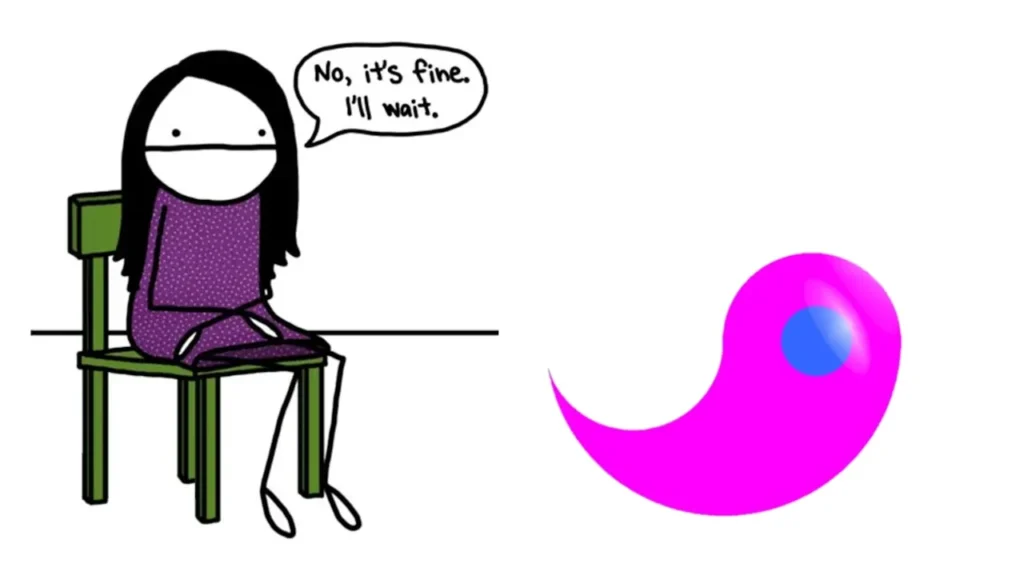
I use the Yin-Yang concept to describe the natural and correct interaction of men and women. Notice in this image there are no power and control mechanisms. It is about mutual influence and harmony.
Therefore, for everything men do, women have a balancing, influencing reciprocal action. We are inherently equal.
However, women will never recognize and exercise our inherent equality if we continue to work off of bogus narratives. So, change your perspective. See the male-dominated workplace for how it really is.
Empowered Women See the Male-Dominated Workplace For How It Really Functions
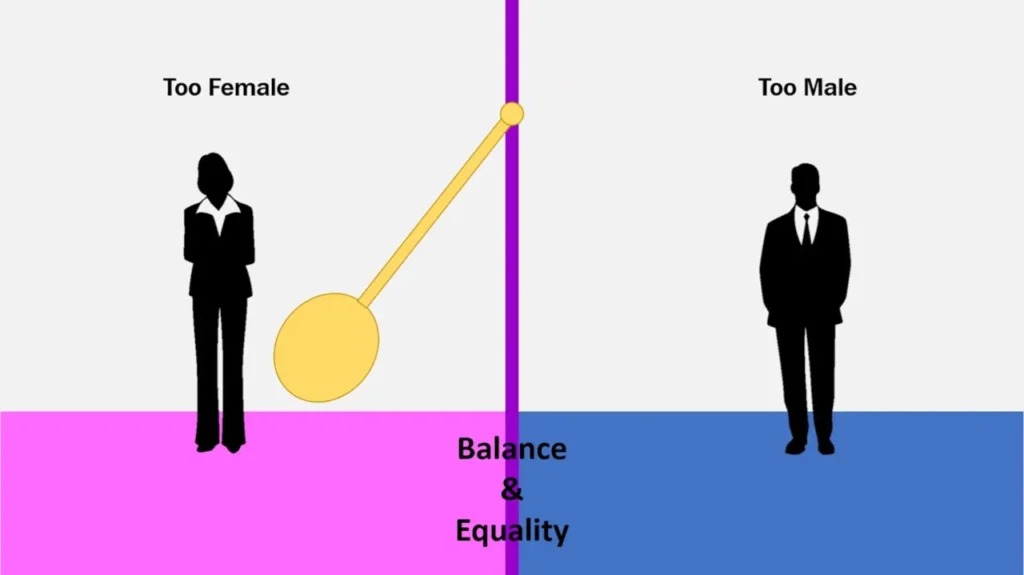
When we talk about how women influence the male-dominated workplace we often say that women create balance. But that isn’t very impactful and it doesn’t portray the full power of women.
Often when we think of women balancing men, we equate it to men going too far and women tempering their efforts. It creates the perception that men are the driving force who get things done while carelessly going 120 mph. Women then, out of fear, apply the brakes and slow them down to 80 miles an hour.
However, this concept of balance doesn’t portray women as an equal driving force. It doesn’t portray women as capable of getting things done at 80 mph, or even 60 mph or 40 mph.
It only portrays women as fear driven.
Another common way we think of balance is through pendulum swings.
For a while the pendulum swings in one direction. But then it goes too far causing things get out of balance and no longer function properly. In response we then swing the pendulum in the opposite direction…until it goes too far and we decide to swing it back in the opposite direction.
Whenever the pendulum is swinging upward, we think we are making progress and accomplishing great things. We push the pendulum to greater heights and greater extremes. We forget that we will eventually push the pendulum too far and cause it to come crashing down creating turmoil, chaos and negativity.
This drive to extremes and the resulting cataclysmic crashes are causing us to associate balance with high drama. But balance isn’t about drama. It is about two forces of equal strength and importance continuously interacting and influencing each other so they produce a steady state of harmony and equilibrium.
We find this type of balance in the concept of Yin and Yang.
When men and women apply Yin and Yang to themselves, they recognize that they are each one half of the whole and need each other for balanced action. As we picture the Yin and Yang acting on each other, we see them rotating in a circle. Yin and Yang each take turns being the driving force that pushes over the top to create the rotation.
Their rotation is gentle, peaceful and very efficient. There is none of that clumsy wasted energy we find in pendulum swings. Acting together, Yin and Yang build up energy and increase their momentum without falling out of balance.
If you read Jim Collins famous book Good to Great you remember him talking about the “flywheel effect.” He described the way the flywheel begins rotating as “a cumulative process – step-by-step, action-by-action, decision-by-decision, turn-by-turn of the flywheel – that adds up to sustained and spectacular results.”
But what he doesn’t say it that the flywheel mimics Yin and Yang interaction – it requires women to assert themselves as full equals in the workplace. Without women helping to complete the rotation, the flywheel becomes nothing more than a pendulum.
This explains why Collins’ flywheel companies like Circuit City couldn’t sustain their results and came crashing down.
Many companies avoid the crashes by moderating their pendulum swings. But this won’t create sustained and spectacular results.
That is why we need to stop thinking about balance and start thinking about working in wholeness.
Wholeness is a much larger concept than balance. Wholeness has the power to hold everything together and create unity. It doesn’t allow Yang to disregard Yin as it goes off to act independently or put itself first. Wholeness reminds Yang that its actions affect Yin and will cause Yin to act in response. Yin’s resulting actions will then impact Yang.
Wholeness creates a complete circle so an entity’s negative actions always come back to them. Likewise, so do their positive. Therefore, wholeness inspires people to act positively. And it is only through positive action that we can achieve sustained spectacular results.
Where we have gone wrong for centuries is believing in the great myth that men have the miraculous power to create wholeness all by themselves.
So, in comparison to women, men have all of this incredible power. Consequently, women have demanded men give up half of their power and give it to women. But in reality, men only have their half of the whole and only one half of the power.
Women’s half has been sitting off to the side patiently waiting for women to recognize it, realize its value and put it into action.
Men cannot put women’s half into action. As women we have to act on our own volition and do this ourselves. That after all is what equality and empowerment really are.
Whether or not we continue to function through wild pendulum swings or begin functioning like the flywheel is completely up to women. Because at this point, the power to create wholeness lies entirely with women. It depends on whether or not women recognize our inherent equality and put it into action.
I am on the board of a small organization where all board members have equal power. However, our current President is on a power trip and is trying to use the organization for his own personal purposes. Another woman and I are countering his efforts but we go about it very differently and get different results.
The other woman is upset because he doesn’t respond to her. At first she assumed she intimidated him and made him back down. But, now she realizes he dismisses her entirely – like she isn’t even worthy of a response or acknowledgement. She is very upset by his dismissal.
She doesn’t realize that the reason he dismisses her is because she doesn’t assert herself as his equal.
For example, he cancelled a next board meeting with no explanation. My response was to question why the meeting was cancelled and when it would be held – I wanted an explanation. By making him owe us an explanation, I didn’t let him treat the rest of the board as insignificant minions, subject to his whims. I didn’t let him off the hook. I asserted our equality.
The other woman’s response to the cancellation was “Thanks for the update. Do you have a future date in mind?”
She responded as if he were her boss. She subjugated herself and put all the power in his court. She didn’t ask for an explanation and therefore gave him permission to treat her according to his whim. She left it to him to decide when and if the meeting would be rescheduled. She gave him exactly what he wants – control with no accountability to the rest of the board.
When he didn’t respond, she didn’t have anything left in her court to reassert herself with. But I did. And I continued to assert myself and the rest of the board.
If you are going to challenge a man then you must continuously assert yourself. Once you concede your ground you will not get it back. You will be dismissed from that point on. This is the situation the other woman put herself in and got very frustrated by.
She, like many women, believed that if she asserted yourself, it would be interpreted as her trying to subjugate, diminish or control the man. She was afraid of getting into a conflict with the President. However, asserting yourself is about establishing and maintaining yourself as an equal, as someone who has a right to information and to exercise your role.
When you are dealing with a man like our board President, who I label an Alpha-Wannabe, it is easy to be intimidated by your fear of a big, nasty conflict. But Alpha-Wannabes are typically very conflict adverse and back down – that is why they are Wannabes. When they do lash out, it is as a means of last resort. They are a sinking ship on their way down.
When we continuously assert ourselves, we establish our own power. This enables us to counter the over-reach of men like our board President who are on a power trip. We create a powerful dynamic of full equality for all.
Update: What I said would happen, did happen. He realized the rest of the board wasn’t going to be a bunch of bobble-headed minions subject to his whims. He quit and blamed me. I gladly accepted “the blame” as well as the thanks of many people for asserting myself and holding my ground.
One of the traits women are most credited with is improving collaboration. We get more people to open up and participate in conversations and problem solving. The result is a more complete solution to a problem.
Sounds great – in theory!
The issue many women face is that collaboration isn’t valued. Collaboration goes against the company’s driving, hard charging, make it happen culture – it is sissy stuff. In these environments the merit of an idea is based upon how hard the promoter is willing to fight for and drive his solution through. If you are not willing to fight hard for your idea, then it couldn’t have been a very good one.
Even in an environment where men are less contentious, they may already have their minds made up as to who they aren’t going to listen to, whose ideas are going to be shot down even before they are voiced. They know who is going to be shut down and shut out of all discussion. They are very good at enforcing the shut out.
For women getting their ideas heard in these environments is hard enough, let alone getting men to listen to each other and discuss all ideas.
So what’s a woman to do – how can she make a room full of men collaborate? (more…)
When women entered the workplace in the 1970’s there was a lot of talk about women doing it all and the conflict of having a career and raising a family. Growing up in that era, it seemed we had such a short time to get it all done. We grew up hearing about working 30 years and retiring with a pension. The retirement age was 60. Life expectancy for men was 68 and for women 76.
Today life expectancy is 78 for men and 82 for women. My mother is 89. Baby boomers who were raised expecting to retire by 60 are now retiring at 65 and 67. Baby boomers who are younger than 55, can now expect their full retirement age (based on Social Security) to be 70…at least.
Wow – 50 years – that’s a long time to work!
That’s also long enough to have it all!! Without having to do it all at once! (more…)
I read another one of those articles on a post from the Harvard Business Review stating that women often don’t get what they want or deserve because they don’t ask for it. Does anyone else feel like me after I read these types of articles – here’s another thing I’m doing wrong. Here’s another article that makes it sound like women aren’t cut out for the business world.
But who decides what is and isn’t right?
I read all this stuff about what I am supposed to do and get the impression that when I go to work I am supposed to be all about Me. Me, Me, Me, Me, Me. But those aren’t my values – being all about Me, isn’t Me. (more…)
As a woman, you don’t want to embrace this concept for yourself but it is important to understand it because it is still relevant. In a humorous way it explains what your male peers may be aspiring to.
As I often talk about, the male workplace produces a slew of problems and crises it must deal with and make go away. If we go back to the old analogy and equate problems to alligators, a company that is plagued with problems is “up to its waist in alligators.” So what do they do?
They hire – The Great American Alligator Slayer!(more…)
I introduced the concept of the power seat and told you how to find it in your conference room in my article Understanding the Power Seat. Now it is time to learn how to use it so you can take lead a discussion and lead your collegues to better solutions. (more…)
One of the most difficult things for most women to do is get their ideas heard when they are in a room full of men. Men can be loud and assertive, if not aggressive, in order to shut down the ideas of others. At the extreme a discussion can turn into nothing more than a competition to see who will win – where the original objective – to find the best solution – is lost.
What is a woman to do in these situations? Can she get all of this ruckus back on track?