Category: Acting As Empowered Women

  • How to See Someone Else’s Point of View

    Recently I listened to a woman complain about a male colleague during which she said “I hate passive-aggressive behavior.”  After our conversation I realized that she was the one who was being passive aggressive.

    Our conversation reminded me of a simple, yet very powerful tool I learned  years ago to understand how my colleagues see the world around them.

    I simply LISTEN and when they talk about other people (or me), I hold up a mirror in front of them.  More often than not, they are telling me how they see the world.

    Each of us has a perspective shaped by who we are and our experiences.  We think our perspective is accurate and complete.  We think we are see things as they really are and without bias or limitation.   And too often we fail to recognize there is a larger perspective and our point of view is only a slice of it.

    It is difficult for each of us to look in the mirror at ourselves and widen our perspective by ourselves.  We need the help of others.  Therefore, it is up to each of us can help other people grow and broaden their perspective.

    www.123rf.com – 17870734

    We start by simply listening and holding up the mirror.  We don’t comment or critique.  We don’t try to interject our all-so-important point of view.  We don’t pretend to listen as we really think over in our heads all the ways the person is wrong and what we are going to say to prove our point of view is better.

    We just listen and let the other person reveal themselves.

    It is amazing how much people will reveal when we just shut and listen.  They will tell you about their fears that shape their perspective.

    It is also amazing how much we learn about our own perspective and its limitation when we listen to others.  We start seeing our own fears that limit our perspective.

    It is only after we listen a few times that we can begin to have a good understanding of who the other person is and why they think the way they do.  We can then begin to expand their point of view (and ours).

    We also have to recognize that just like us, the other person is naturally defensive about their point of view.  Therefore, we don’t want to trigger a defensive response – we want them to think, not react.  This is why I like starting with the phrase “I was thinking about you said about….”

    www.123rf.com – 6818438


    It invites a conversation.  And once the conversation starts, it is difficult to keep other people and their points of view from joining in.  That is what we want.

    Each of us has a different slice of the whole and our diversity of experience, knowledge and points of view helps us form a larger, more complete perspective.   It is from this larger point of view that we can solve problems and address issues more effectively and completely.

    So next time you hear someone talking about someone else, hold up a mirror.  What you see may be very revealing.


    Empowered Women Listen


    Find this article helpful?

    Sign up to receive more and check out my New Book!
    Follow The Woman In The Room on Facebook
    Take a quick moment to share 
  • Have the Right Attitude to Stand Up for Yourself

    When women experience inappropriate behavior, sexual harassment, bullying or discrimination in the workplace, we have a lot of reactions – shock, anger, resentment, fear.  Our mix of emotions creates confusion as we try to figure out what we should do about it.

    We want to hit the right and appropriate response but we aren’t always sure what it is.  We don’t want to come off as a trouble-maker by blowing the incident out of proportion.  But we also don’t want to downplay the incident and feel like we let ourselves be diminished.  All we really want is stand up for ourselves and be treated with respect for doing so. 

    I found that finding the right response begins with having the right attitude.  The right attitude says that no one has the right to diminish anyone else.  This attitude also infers that no one is superior to or better than anyone else.  Being higher in the organizational structure, having more education, more job experience, more authority or more anything doesn’t make a difference.   As human beings we are all equal and deserve to be treated as such.

    When you apply this attitude you come to terms with how diminished the incident really made you feel.  Too often women are taught to go right into victimization, no matter who the man is or what the comment or behavior was.  However I don’t like victimization because it automatically assumes the offender has power over you and the ability to diminish you.   It assumes a natural or inherent inequality.

    The right attitude however makes you ask one simple question:  Who is this guy that he thinks he has the right to diminish me?
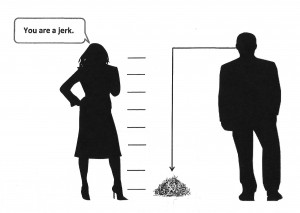
    That is an empowering question.   It makes you think about why you elevated this guy’s opinion and subjugated yourself to it.  Why does his opinion matter to you?

    It reminds you that no matter who he is, or thinks he is, he still puts on his pants one leg at a time.  Therefore, he is just an ordinary human being and not part of a superior alien species.  He may have more power and authority in our workplace but again that doesn’t give him the right to diminish others.  It simply means he has a different role and responsibilities.  And his responsibilities often dictate that he ensures everyone be treated fairly and equally.

    When you recognize your inherent equality, your perspective changes and a new question quickly comes to my mind: What the heck is wrong with this guy?

    This question helps you recognize that the incident says nothing about you and only makes a statement about your offender.  It allows you to refocus on your offender and why he acted the way he did.

    Armed with the right attitude, we can then come up with effective, empowering and appropriate responses to incidents.  Personally, I divide incidents and my response into three categories based upon the severity of the incident.   In the first two categories, the offender doesn’t have or isn’t using his organizational power to impact to you.  This makes it easier to see him simply as a jerk and the incident as representing that something is off with him.

    My first response category is the Eye Rolling Response.  These incidents are very minor and not worthy of any concerted response on your part.  The eye rolling, smirk or “what is wrong with you” expression conveys the message that you aren’t impacted, diminished or subjugated.  It is the “I’m rubber, you’re glue, what you say bounces off of me and sticks to you” response.

    You want to be careful not to over-respond to these incidents because your offender can be feeling you out, interpret your over-reaction as a sign of weakness and continue to target you.

    My second response category is where most incidents fall.  You want to stand up for yourself and make a point but, you are afraid it will be blown out of proportion and backfire on you.  All too often we let these offenses go without a response.  Then we feel bad about that too.  We feel trapped in a no-win scenario.

    When you think about what you really want, you realize you want culture change.  You want your response to help the offender(s) to grow out of their behavior.

    The reason we struggle with this category so much is because we’ve been taught to be limited in our responses.  We are taught the only acceptable response is to file a complaint and take the issue to management to resolve.  But there are two problems with this.

     

    The first is that when we take the problem to HR or management we feel like we are acknowledging being diminished, and that we aren’t capable of standing up for ourselves.  It is disempowering.  It doesn’t make us feel strong or equal.


    The second problem is that the offender will be blamed then possibly punished.  In either case he will see himself as being diminished.  He will want to restore his equality and respect.  And that means you probably just made an enemy in your workplace.
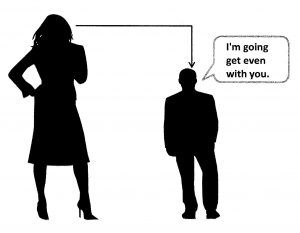
     

    The problem with the standard file a complaint response to these types of incidents is that the solution usually raises one person up and diminishes the other.  It doesn’t maintain the equality and the balance of personal power.  It is further complicated by the fact that men and women perceive the situation from two very different perspectives.


    Women are fighting for their respect and self-esteem.  We assume men are too but they aren’t.

    Once men are diminished they see themselves as fighting for survival.  At this level they fight back more fiercely than women who see this situation from their perspective think is warranted.   This leads women to conclude that men are fighting back because they believe in the subjugation of women.  So women then fight back harder.

    This misunderstanding of perceptions throws the situation way out of wack.  Each party feels diminished and blames the other without understanding the other party feels diminished too.  The conflict goes round and round with no happy kumbaya ending.  It teaches all us that standing up for yourself just creates a bigger mess and isn’t worth it.

    This is why in this category we need to think beyond the file a complaint response and be more creative.

    Over the years I’ve written several articles about being creative and the effectiveness of using humor to stand up for yourself, address an incident and create culture change.  Contrary to what we are taught, humor doesn’t diminish the seriousness of our response or suggest we are merely laughing it off.  Instead humor creates a positive environment where no one is diminished so the offender can grow and change their attitude without blame or shame.  (super-important to men)

    Creative and humorous responses demonstrate that you are equal, strong and confident without conflict.  This earns you the respect you wanted all along.

    My third category of responses is for the really egregious and ugly stuff.  It is where I make a firm stand and take formal action because the offender’s comment, action or behavior successfully impacts me and I can’t stop it.  The impact can be:

    • Monetary affecting my role, promotion, raise, bonus or lay off.
    • Invasive physical contact
    • Unwanted attention from a Creeper so I longer feel comfortable or safe in the workplace and/or away from it.
    • Bullying

    Out of all of these issues, the monetary ones are actually the easiest and most clear cut to resolve.  However they are often an indicator of a larger culture that will tolerate the other issues.
    So, whenever you face incidents in this category take a good look around your workplace.  You will probably discover that you are not alone in your situation.  This includes your male colleagues who often silently endure degrading behavior.

    In this category the offender is more emboldened.  He’s gotten away with his actions before and that made him feel powerful.  He began spinning a flywheel and created a cycle where he abused and intimidated people to make himself feel more powerful.  As he abused more people his flywheel spun faster, produced more energy and making him seem invincible.  Consequently, no one stood up to him.  It is an intimidating one-on-one situation that makes many of us back down and then feel guilty about it.   We know the offender is counting on us backing down just like everyone else did and this makes us angry.  We want to stand up for ourselves.  We want what’s right.

    Again this is where your attitude reminds you that he is just a man who created an image and you aren’t totally powerless against him.  This fact gives you the determination to stand up for what is right and see it through to the end.

    It also forces you into a reality check and recognize that dismantling his intimidating flywheel may take time – there may not be that satisfying swift and dramatic victory.  So, check your attitude – are you really trying to diminish and punish him?  Or, are you trying to neutralize him, hold him accountable and get justice?  There is a big difference between the two and only the latter will be successful.

    When you are dealing with an offender especially those with a long list of victims you are not engaging in a battle of wills or power.  You are engaging in a battle of flywheels.  Therefore, your objective is to put a new flywheel into motion that counters his.  You take a stand in order to create momentum against the offender that allows just a few more people come forward.  They then increase the momentum of your flywheel.  As word spreads, more people come forward and your flywheel is further energized.  Your offender becomes less intimidating and his flywheel loses momentum.  Eventually the offender is neutralized by the momentum of the forces against him.

    It is a scary to be the first person to take a stand and be the one who starts the second flywheel into motion.  But if you really believe that all people are equal and no one has the right to diminish anyone else, then you have a duty to stand up.  And remember you won’t be in this alone – you will recruit others to increase the momentum of your flywheel.

    I’ve found that finding other people to join you is easier when they know you are committed and will not back down.  I then present them with a binary choice:  Do they want to be on the side that stands up for what is right?  Or, do they want to be on the side that supports this bad behavior?

    I keep their decision black and white.  They can choose to go on the record as a good guy or a bad guy.

    Most people want to be the good guys and want to do what is right.

    Your “good guys” help recruit the other “good guys” they know and trust.   Together you increase the momentum of our flywheel and spread its influence across the workplace.  Sometimes you will be fortunate and the right good guys get on board and immediately stop the behavior.  Sometimes it takes a while.  In these cases, I find that there is an irony.  The  offender keeps up his behavior to energize his  flywheel but in reality he is adding momentum to my flywheel.  In the end he destroys himself – and I never had to go negative or get ugly.  I just had to stand up for what is right.

    I lost count of how many times I’ve successfully put the second flywheel into motion on behalf of myself or others.  While it is scary to do the first couple of times, you realize that when we exercise our inherent equality we can restore power and respect to everyone.  This energizes a new flywheel within yourself that strengthens your attitude that no one has the right to diminish anyone else.  The next time you have the opportunity to take a stand, you do so but with even more confidence.


    Empowered Women Have the Right Attitude to Stand Up For What is Right


    For more articles on harassment and discrimination go to  The Ugly Stuff article category

    Empower Yourself  – Subscribe to my articles – Contact Me

    Assert and Express Yourself – Leave a Comment & Share this article

    Follow The Woman In The Room on Facebook for more empowering ideas and solutions!



  • Women Can Lead Men Through Culture Change

    www.123rf.com 51741376
    www.123rf.com 51741376

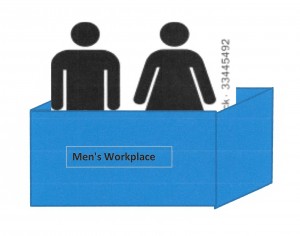
    Construction sites have a reputation for crude behavior and the women who work on them can face behavior seldom found in other workplaces. This situation keeps most women away from the industry and those that do enter it often opt for support jobs in the office. Those of us who do venture out onto the construction site enter an extreme male-dominated workplace where it is essential that we know how to handle situations correctly so we don’t ruin our career.

    To understand what I am talking about let’s examine a situation I’ve encountered a couple of times – the crude and denigrating drawing of me in a porta-pottie.

    If someone made a derogatory drawing of a female colleague in the men’s room at the main office we know what would happen. HR would get involved, a company-wide email would go out denouncing the drawing, there would be mandatory training and the culprit if identified would be fired. In short there would be expressed outrage.

    However if a woman took this same approach out on the construction site, it would back fire on her – big time!

    Why?

    Our first instinct may be to blame construction site culture full of sexism, discrimination and a good ole boy’s club that doesn’t want women intruding into their territory. However, that is wrong and reveals our inherent misunderstanding of the situation. The reality is that any man who used expressed outrage to deal with a site situation would face the same consequences as us. However, most men already understand it back-fires is because it goes against the reasons men enjoy working on a construction site.

    As women we are taught to use expressed outrage as our go-to solution.  We are taught that men want to have power over us and we have to fight back in order to have our own power. But again, that is wrong and reveals our fundamental misunderstanding of the male-dominated workplace.

    In reality, the vast majority of men don’t aspire to have power over others – they aspire to preventing others from having power over them. They want to be independent and autonomous.N3A11

    The construction site epitomizes a work environment where men get to be independent autonomous. Since it is away from all of the office rules, policies and structure, the construction site has a freedom most workplaces never experience. That is why men (and women) like working there.

    When a woman expresses her outrage at the crude comment, men interpret it as her dragging the office rules out to site with her and trying to control them. She and her rules are trying to have power over them. In response they rebel.  They they no longer work with her and even sabotage her so she fails at her job and leaves the site.

    From a discrimination standpoint, that is extremely unfair. But it is reality.

    No one can come onto the site, dictate behavior and be successful. (Every good Safety Manager knows that.) To change site behavior requires coaching, building relationships, earning respect and a healthy sense of humor.  These are behaviors women excel at.

    A woman who works out on the site must understand these fundamentals and apply them in her response. This should be easy because they align with the culture she wants. Therefore, unacceptable behavior becomes an opportunity to lead and establish a rapport that propels our career forward. That is the approach I took in responding to my porta-pottie drawing:

    Many years ago when I worked on a construction site, I could tell something was up. As I walked around site, the guys all looked at me and whispered to each other as if they were expecting me to react to something. After a couple of days I asked a man I had a good relationship with what was going on. He refused to tell me. That made me really curious. As the situation continued and I got more looks, I kept pestering him and a few others to tell me what was going on. Eventually, the man I first asked told me that there was a drawing of me in a crude position on the wall of a porta-pottie. He wouldn’t tell me which one.

    News spread fast that I knew. The titillating drama on site sky-rocketed as everyone wondered – What is she going to do?

    I didn’t react at all. For the next two days I went about doing my job as normal, all the while chuckling to myself at the men who were obviously waiting with anticipation for my reaction. The waiting fed the titillating drama.

    By not reacting right away, I put the ball in my court, I was in control. I also gave myself a couple of days to think about my reaction and figure out how I would use it to my advantage.

    Eventually, I went around to different port-potties and just looked at them. This got everyone’s attention and heightened the drama some more.  Is she going to open the porta-pottie and see the drawing? How was she going to react?

    Again by not reacting, I remained in control.  I created an image of strength for myself which began earning me respect.

    The next afternoon as I made my rounds on site I stopped in front of a porta-pottie and said “Is this the one with the drawing of me?” No one answered. So I asked, using a tone appropriate for opening a big gift-wrapped present, “Which one is it? I want to see my drawing!”

    I never opened up a porta-pottie door which again fed the drama.

    Over the next day or two as I made my rounds, the guys brought up the drawing themselves.  They wanted me to know they didn’t do it. Of course they all knew who did and with a little prodding eventually gave me enough information for me to figure out which porta-pottie and who drew it.  The man was no longer on site.

    By waiting a couple of days and playing off construction site drama, I completely changed the situation. No one wanted to be associated with the drawing and how it denigrated me.  This was the sign I was looking for – they respected me and wanted me to respect them in return.

    However, I still needed to resolve the situation and do it in a way that earned me even more respect.

    When I felt the time was right, I went to see the drawing for myself. As I approached the porta-pottie, every eye on site was on me and some men approached. When I looked at the drawing I used my planned reaction “Dang I didn’t know my butt looked that good!”

    I wanted to give a humorous reaction to show I wasn’t offended. The crude drawing didn’t have power over me – it couldn’t diminish me, my role or my authority on site. My reaction showed I was strong and confident. It also showed that I understood and valued how the construction site doesn’t conform to office rules.

    The ball was still in my court and I needed to pass it to someone else so we could play ball and build teamwork. So, right after my joke reaction I said “Johnny I heard you drew this.”

    I purposely accused Johnny because everyone knew Johnny already respected me and followed me to this project so he could continue working with me. I also knew Johnny had a good sense of humor and he would banter back with me as he proclaimed his innocence.

    As women we need to appreciate and take advantage of how much men like to banter with each other. Banter and humor are more effective in making a point than outrage or blame. However, we have to be extremely careful. Too often when women banter with men we stay engaged too long and wind up getting hurt. To be effective our banter has to be short and direct.

    After Johnny denied the drawing, I bantered back with “I don’t know, I kept hearing you did.”   Then I looked at the other guys as if to say “Aren’t you the one who told me he did?”  This brought everyone into the joke on Johnny. (No one was thinking about the drawing anymore.)

    Johnny of course responded with his own banter back, asserting himself.  He drew a good line for the banter to end. If I continued to banter back he could feel like I was unfairly blaming him, trying to make him the scape-goat and trying to assert power over him.

    To exit the banter I needed to shift everyone’s attention again so I replied “Johnny, you may be a good artist but is unit 18 ready for inspection tomorrow?”

    I already knew it wasn’t. There was a problem Johnny was having trouble resolving. So before Johnny could give his excuse I interrupted him with “Show me what the problem is.”

    That simple statement showed I cared about and respected the men who worked on site. It distinguished me from a lot of my peers who avoided getting involved with the problems until they absolutely had to.

    As I walked away with Johnny, another man took a marker and covered over the drawing. That proved that I earned the respect of the men on site. From that point on, any time a new man came on site and wanted to denigrate me, the guys stood up for me. It didn’t take long for me to have a great reputation and be the project the guys requested to work on.

    When we are disrespected and even denigrated, the easy response is to express outrage.  But we have to think about what that really accomplishes and if it is the best response.  Does it change the culture?  Does it earn us the respect we want?

    As I’ve said many times before, our goal isn’t to accumulate notches in our “How women have been treated unfairly belt.”   Those notches won’t advance us or our careers.   They won’t create culture change.  They will however discourage us.

    This is why we have to think beyond our expressed outrage, blame and shame responses.  To do so requires understanding how your male-dominated workplace really thinks and acts.  We then have to think outside the box and be creative.  We want to work with our colleagues; encourage and coach them; ease their fears and insecurities; broaden their perspective so they realize they just may enjoy working with us a lot more than working with another man.  If we can do that then we’ve led men through the culture change we want.


    ***If you are being sexually harassed or discriminated against please read this article:  The Important Thing Women Still Don’t Do When Sexually Harassed.


    Empowered Women Lead Men Through a Cultural Change

    Find this article helpful?

    Sign up to receive more and check out my New Book!
    For more articles on harassment and discrimination go to  The Ugly Stuff article category
    Follow The Woman In The Room on Facebook
    Take a quick moment to share 
  • You Wanted It, You Got It!

    Several years ago I was working on a project where some senior male managers didn’t want a woman in charge.  They wanted to prove that anything I could do, a man could do better.

    www.123rf.com – 57566386

    This was a particularly difficult project and men lasted about 2 months.  So every 2 months, I was back in charge with a mess to clean up until they found another man to take over.  I stayed in this revolving door for over a year.  My direct supervisor fought hard on my behalf, using every bit of clout he had but even he couldn’t make a difference.

    Eventually they ran out of men who were my peers, so they decided to promote their star up-and-coming young man, a man who I was mentoring.  I was basically out of a job because this time all of my responsibilities were taken away.  A couple of days later, the young man approached me in the hallway and said “You are still going to do everything you’ve been doing right?”

    I gave him a steely cold stare and said “No.  You wanted it, you got it.”  I turned and walked away.

    Four weeks later he gave his notice.

    He approached me again and said “I didn’t realize how much you did.”

    My cold response was “No you didn’t.”

    He then apologized and confessed to back-stabbing me to get the job.  He showed me emails, leaving no doubt that a particular manager saw me as the company’s Token Woman.

    After my young colleague left, no man would take over.  They threatened to quit if assigned to the project.  This time I didn’t step forward.  Instead, my supervisor went to bat for me again and this time they gave in – with a 15% pay raise.  By this time the project was in dire straits and everyone ran away from it like rats leaving sinking ship.  They were happy to have somebody, anybody take over.

    In the end the company lost a tremendous amount of money trying to prove the impossible – that a man could run the project better than a woman.  Soon after I was put back in charge, another woman joined the project and together we kicked butt and got ‘er done while all the men scratched their heads wondering how we did it.

    All these years later, I find myself in a similar situation.  For several years I’ve been the President of a board for a small organization.  This year, a man came forward, wanting to be President.  I chose to take a break and let him be President.  Since taking over he’s made a mess of things.

    As he tries to squirm out of his responsibilities I am holding him accountable and find myself again saying “You wanted it, you got it.”

    All too often men take on positions they aren’t ready for.  As women we watch them mess up and then we make a HUGE mistakewe clean up their mess for them.

    For some reason we find power in this.  We find power in secretly knowing that men need us and can’t do their job without us.  But that is our mistake – we keep it a secret when it should be a huge flashing neon sign that our male colleagues need the skills we bring to the male-dominated workplace.

    It is time for women to take off our aprons and put down our dust pans.  If a man wants a position then he’s got it along with all the responsibilities and accountability.  He can clean up his own mess or step down.

    If we wind up taking over and have to clean up someone else’s mess, then we only do it  with full recognition – the authority, job title and pay.  And our pay must be higher than what the mess-maker earned….because that is what any other man would demand.


    Empowered Women Don’t Clean-up Other People’s Messes for Free!


    For more articles on harassment and discrimination go to  The Ugly Stuff article category

    Empower Yourself  – Subscribe to my articles – Contact Me

    Assert Yourself  by Expressing Yourself – Leave a Comment & Share this article

    Follow The Woman In The Room on Facebook for more empowering ideas!


  • To Be Taken Seriously, You Must Assert Yourself

    www.123rf.com - 9007407
    www.123rf.com – 9007407

    I am on the board of a small organization where all board members have equal power.  However, our current President is on a power trip and is trying to use the organization for his own personal purposes.  Another woman and I are countering his efforts but we go about it very differently and get different results.

    The other woman is upset because he doesn’t respond to her.  At first she assumed she intimidated him and made him back down.  But, now she realizes he dismisses her entirely – like she isn’t even worthy of a response or acknowledgement.  She is very upset by his dismissal.

    She doesn’t realize that the reason he dismisses her is because she doesn’t assert herself as his equal.

    For example, he cancelled a next board meeting with no explanation. My response was to question why the meeting was cancelled and when it would be held – I wanted an explanation.  By making him owe us an explanation, I didn’t let him treat the rest of the board as insignificant minions, subject to his whims.  I didn’t let him off the hook.  I asserted our equality.

    The other woman’s response to the cancellation was “Thanks for the update. Do you have a future date in mind?”

    She responded as if he were her boss. She subjugated herself and put all the power in his court.  She didn’t ask for an explanation and therefore gave him permission to treat her according to his whim.  She left it to him to decide when and if the meeting would be rescheduled.   She gave him exactly what he wants – control with no accountability to the rest of the board.

    When he didn’t respond, she didn’t have anything left in her court to reassert herself with.  But I did.   And I continued to assert myself and the rest of the board.

    If you are going to challenge a man then you must continuously assert yourself.   Once you concede your ground you will not get it back.  You will be dismissed from that point on.   This is the situation the other woman put herself in and got very frustrated by.

    She, like many women, believed that if she asserted yourself, it would be interpreted as her trying to subjugate, diminish or control the man.   She was afraid of getting into a conflict with the President.   However, asserting yourself is about establishing and maintaining yourself as an equal, as someone who has a right to information and to exercise your role.

    When you are dealing with a man like our board President, who I label an Alpha-Wannabe, it is easy to be intimidated by your fear of a big, nasty conflict.  But Alpha-Wannabes are typically very conflict adverse and back down – that is why they are Wannabes.  When they do lash out, it is as a means of last resort.  They are a sinking ship on their way down.


    When we continuously assert ourselves, we establish our own power.  This enables us to counter the over-reach of men like our board President who are on a power trip.  We create a powerful dynamic of full equality for all.

    Update:  What I said would happen, did happen.  He realized the rest of the board wasn’t going to be a bunch of bobble-headed minions subject to his whims.  He quit and blamed me.  I gladly accepted “the blame” as well as the thanks of many people for asserting myself and holding my ground.


    Empowered Women Always Assert Their Equality


    Find this article helpful?

    Sign up to receive more and check out my New Book!
    Follow The Woman In The Room on Facebook
    Take a quick moment to share


  • She Should Have Stood Up For Herself

    38335949 - view of scared woman during job interview
    www.123rf.com – 38335949

    Recently I read an article in which a woman wrote about her experience interviewing for a new job.   She did all the research on the job and knew how much she should be paid.  During the interview, the men who interviewed her offered her 30% less than she expected and said it was because she was married, her husband had a high-paying job and her career was secondary to her husband’s.  Her response was simply “If that’s how you think then this job probably won’t work out.”

    Reading the article my first response was ‘Bravo!  See you proved there still are gender biases.”  But halfway through my gut response, I stopped myself and wondered why she didn’t challenge them or push back.  She just walked away.  We should never do that!

    There are a few sexist behaviors that we should never let go unchallenged.  One is unwelcome and inappropriate physical contact.  Another is unfair compensation – MONEY.  As a woman working in traditionally male roles, equal pay for equal work was a continuous concern.

    Back in the early 80’s when I began my career most married women didn’t have careers.  If they worked they had menial jobs so, the men in my all-male office  didn’t understand why I pursued a career on par with them.  I could have been offended and cited a feminist mantra but that wouldn’t help me build rapport.  So I gave them a creative but honest answer: “My husband has a long list of expensive toys he wants to buy and my income helps us do that.  Wouldn’t you like it if your wife earned as much as you?  It takes all the financial pressure off you and you get to buy more toys.”

    After thinking about my answer for a couple of minutes one of my coworkers asked “Can you talk to my wife?”

    Over the years I’ve come up with other creative and yet effective responses.  My responses flip the situation and make men think about how their sexist behavior could personally impact them:

    • “So you guys are willing to pay a man who won’t do nearly as good of a job as me, more money, just because he has a family?  That sounds like a really bad business decision and like you really need me.  How hiring me instead of him hurt your bonuses?  Will your wife appreciate you bringing home a smaller bonus because you had to take care of another man’s family?”
    • “My husband and I may be getting a divorce.  He would very much appreciate it if you would hire me and pay me as much or more than him so he doesn’t have to pay spousal or child support.  Are any of you divorced?”  (Believe me, that gets men really thinking!)

    As women we want the workplace to be a meritocracy where we are fairly compensated based on the results we deliver.  Our performance also helps determine our manager’s bonus so we flip the situation and make our compensation about his bonus.  I have no qualms about asking the simple question: “Who do you want to trust your bonus to – him or me?”

    It works because men place a specific monetary value on their work and the correlation between their effort and their compensation is never far from the front of their minds.  We sell them on ourselves by offering more compensation (a bigger bonus and possible pay increase) with less effort.  They do the math and they get it.

    As women we always have a concern that our compensation is less than our peers so ensuring our compensation is equitable is something we must always stand up for.

    Admittedly when we are faced with a compensation offer that is unfair, it is difficult to come up with a good response in the moment, other than expressing our anger.  Too often we let it go.  We out to our car or back to our office and think of all the things we wish we said.  We kick ourselves for not saying them and that only feeds into how we already let someone else diminish us.

    However, just because we didn’t respond in the moment, it doesn’t mean we missed our chance to stand up for ourselves.  To stand up for ourselves we again flip the situation and our perceptions – we make it all about them.

    We realize inappropriate, dismissive or demeaning comments and offers says nothing about us.  Just because someone tries to diminish us, it doesn’t mean we have to accept it.  We can push it back on them and make it say something about them.  In this case, it means they are stupid – like really stupid.  Who in their right mind in the 21st century makes a sexist offer or comment?

    There is nothing to stop us from going back in (when convenient) and saying in our “dumb me, I just realized this” tone, say “I can’t believe you did that in an interview.  Do you realize you’ve given me a reason to claim discrimination? Do you realize the can of worms you just opened?  You realize of course I have to report this! Good, I have your business cards. Thanks for wasting my time while I deal with this!”

    Yes, a little acting does help. It’s even good to be a little nervous, flustered and upset because it makes them more nervous.  They just had the ownership of their stupidity put back on them.

    Follow up and report it to someone else in the company.  You will probably get a very favorable response, especially if the company is larger.  I did this early in my career when I was being interviewed for a contract job and walked out with a very generous contract.

    When we stand up for ourselves we step into our own empowerment and demonstrate we won’t get pushed over and run over – and that is very important to our employers.  Think of it this way – if you aren’t even willing to stand up for yourself, then you certainly won’t be willing to stand up for the company.  Employers want people who take a stand.


    Empowered Women Stand Up For Themselves 

    Find this article helpful?

    Sign up to receive more and check out my New Book!
    For more articles on harassment and discrimination go to  The Ugly Stuff article category
    Follow The Woman In The Room on Facebook
    Take a quick moment to share


  • How to Change Sexist Perceptions

    www.123rf.com -11057286
    www.123rf.com -11057286

    I read a lot of articles about women in the workplace and it seems we are fixated on identifying every slight, bad comment and bit of poor behavior. I’ve been told many times that the intent is generate awareness of sexual biases in the workplace and let women know what they are facing.

    I can accept that but sharing bad experiences without presenting solutions that change workplace behavior does nothing to advance women. It only lets us make another notch in our “how women are treated unfairly” belt. We need solutions that actually work.

    So why don’t we get solutions?

    There are many reasons. One reason is because many people believe an individual woman can’t do anything to change her workplace. They believe change only happens from the top down and it takes CEO and senior management intervention to advance women.

    However, that is a myth. The male-dominated workplace already knows (and it can cite lots of its own examples) that top down directed change does NOT work. Real change can only happen from within. This is why it is up to individual women to change their workplace’s behaviors.

    So how do we do that?

    We think outside the box. We get creative so we make sure we don’t absorb the negativity being thrown at us and allow it to diminish us.

    Typically we are taught that that when we are faced with unacceptable behavior we have a binary choice – Let it go or Fight back. Too often women let things go when we would really prefer to take a stand because we don’t want conflict. We are afraid that the conflict will back fire on us – we will be seen as a troublemaker and the sexist behavior dismissed.

    There is however a third option that is effective – teach men through humor.

    Humor works because men like to jab, joke and prank each other. (It is what makes working with men so much fun.) When we use humor we show that we aren’t easily offended which men then interpret that as being strong and confident. Humor is also an easy way to build rapport and become part of the gang.

    I’ve used humor to deal with a variety of situations from mild to crude. Here is an example of how I handled one sexism based situation:

    I was a project manager working in a construction office out on a construction site when I kept hearing rumors that I wore “high heels” to work. I typically wore one of two pairs of old shoes. They had 1-1/2 to 2 inch heels and were far from my definition of “high heels.” To me they were “construction office shoes” and not something I would wear if I worked in the main office. If I went out on the construction site, I put on another pair of “site shoes” that I kept under my desk.

    One day while sitting in my office I overheard another project manager on the phone whispering about my unsuitability for being a project manager. He whispered “She even wears high heels to the office.”
    That was it! It was time to put this issue to rest.

    The next time I went home I brought back a pair of black high heels. They weren’t sexy. They were just a nice pair of heels that I would wear with a business suit to look “professional.”

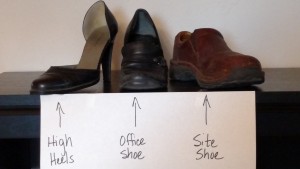
    ShoesWhen I got to my office I took one of each pair of shoes and set them on my desk. Under the shoes I hung a sign that said “High Heels, Office Shoe, Site Shoe” with arrows pointing to the appropriate shoe.

    That got a discussion going. The guys began an all-day discussion of women’s shoes and their personal preferences. I learned that my “high heels” were nice but not sexy enough to be considered “date shoes.” I told them I left my Carlos Santa shoe collection at home because I didn’t want them drooling all over my desk.

    By the end of the day the matter was settled. It was determined that I didn’t wear “high heels” in the construction office. I wore “ugly shoes.”

    After that the other project manager and I developed a really good working relationship. We teamed up and used our similar sense of humor to lighten the mood in an otherwise stressful environment. By not getting mad, offended and preaching to the guys, I built rapport and strengthened our team.

    Throughout my career I probably experienced many more sexist incidents than most women. However, I’ve only made a few notches on my “how I was treated unfairly” belt because I chose to use humor to flip the situation. By flipping the situation, I stood up for myself and I made a positive impact on my male colleagues. Consequently the sexist behavior that was intended to diminish me only made me stronger and more secure in who I am.
    I have more stories and I will share them in future articles.


    Empowered Women Use Humor to Take a Stand Against Sexism

    For more articles on harassment and discrimination go to  The Ugly Stuff article category

    Empower Yourself – Subscribe to my articles – Contact Me

    Express Yourself – Leave a Comment & Share this article

    Follow The Woman In The Room on Facebook 

  • Be Confident In Your Doubts and Questions

    15478082 - thinking businesswoman staring upwardsWe’ve all worked with that guy – you know, that guy who is so confident he has the answer for every situation and problem.  I’ve worked with lots of these guys over the years.  However, it was the first guy like this that I helped me figure out how to deal with them.  His name was Terry.


    Terry and I were in the Air Force as 2nd Lt’s together.  He was “a big boy” who liked to project his body mass in an attempt to intimidate.  Every morning he spent the first half hour walking around the office, coffee cup in hand announcing what time he got to work.  We were supposed to believe that he was so important he had to get to work before anyone else.

    As brand new 2nd Lt’s we were given a lot of “special assignments” – things no one else wanted to do so they dumped them on us.  On our first group assignment, all the 2nd Lt’s gathered in a small conference room.  Terry automatically assumed he was in charge.  I was surprised none of the other men challenged him because according to the stereotype they should all be fighting to be in charge.  Curious as to how this would unfold, I settled back to watch the Terry Show.

    Terry obviously read the playbook that described how to distinguish yourself and get ahead.   He followed it word for word.  I remember wondering who taught it to him and if he had an overbearing father who had high expectations.

    Taking charge, he decided what we were going to do and how we were going to do it.

    Listening, I had questions.  I didn’t think his plan was well thought out and would work.  So I raised my questions to Terry and he blew me off.  (I got mandozed)  He was confident he knew better.

    If Terry expected me to now fall in line (because the playbook says I should be intimidated) he was mistaken.

    I didn’t allow his confidence to override my confidence in my doubts.   

    After the meeting I raised my concerns with some of the other guys but in the end we went along with Terry’s plan.

    As it turned out I was right.  We wound up in turmoil.  Fortunately because I never gave up on my doubts, we were able to quickly put together a recovery plan.  It was not fun but we pulled it out in the end.

    On our next group project Terry assumed he was in charge again.  He came up with the plan and again I had questions.  He mandozed me again.  I looked to my male colleagues for support but they didn’t want to challenge him.

    After the meeting I grabbed a couple of the guys I had become good friends with  and told them we couldn’t repeat the mess from last time.  We held our own meeting and I told them where I thought Terry’s plan would fail.  We developed a recovery plan in case I was right.

    I was right – Terry’s plan failed where I expected.  My colleagues and I put our recovery plan into action without even consulting Terry.   We saved the project.  And even though this experience wasn’t as bad as the first, it still wasn’t enjoyable.  I was done working this way.

    When we gathered to plan our third project, Terry stood at the head of the table assuming he was our de facto leader.   As I sat along the conference room wall, I observed how he stood at the front of the table exuding the confidence of a man in charge.

    However, he wasn’t the only highly confident person in the room.  I was also confident.  I was confident that:

    • Terry was primarily interested in making a name for himself and promoting his career.
    • Terry’s plan wouldn’t work and we would have to jump through hoops again to save the project.
    • If we continued to go forward with poorly planned projects all of our careers would suffer.
    • I didn’t have the perfect plan either.
    • If we all worked together we could come up with a good plan.Cat Dozer


    So, as Terry began talking, my frustration got the better of me and I suddenly blurted out “We’ve done it your way twice.  Both times were a mess.  We’re not doing it your way anymore.”

    I got up and stood at the side of the table daring him to challenge me.  (My  girldozer dared him to try to mandoze me again.)

    He didn’t challenge me.

    Initially I took the lead.  As a team we figured out how to do our project.  As we worked on the project, one of my male colleagues transitioned into the project leader.  Terry occasionally challenged him but the project team pushed back.  Working as a team, our project was more successful than we expected.

    We learned teamwork and allowing different people to lead as their skills are needed was the key to success. 

    For our fourth project we had to hold a fundraiser and were expected to raise at least $2,000.  Our team decided to put on a carnival.  As the scope of the carnival grew, we all took a leadership role.  We hoped to beat expectations and raise $8,000-$10,000.

    Unfortunately the week of the carnival a blizzard hit and we had to postpone.   We held our carnival two weekends later and it was a hug hit!  We raised over $32,000.

    But our biggest surprise was how Terry stopped working to promote himself and became a team player.  Over the next two years we remained a tight team.  No one threw anyone else under the bus in order to order to advance themselves.

    Our projects taught us a lot about leadership and teamwork, however I also learned a lot about confidence.

    I learned to be confident in my questions – in what I don’t know and what I don’t understand. 

    Too often men want to charge off without proper planning or understanding the consequences of their actions.  Women are told this is being bold and confident.  But after lots and lots of experience in dealing with this, I learned it’s a red flag that they really don’t know what they are doing.

    I’ve learned to counter men’s need to act by firing up the girldozer and blocking them.  I voice my questions and concerns.  If men can’t answer my questions then they can’t proceed until they can.

    As a manager and leader, this has been critical to my success.  It has saved us from wasting countless dollars and man-hours and from making mistakes that make us look professionally incompetent.

    Many women don’t explore the power of their girldozer because we are taught that the mandozer is more aggressive and powerful and can run right over us.  Believe me, it can’t.  We have an incredible power to hold our ground, to not give in and to say “No.”

    By being confident in our doubts and questions, we drive better planning and avoid catastrophes.  I can’t even count how many times the guys have come back to me, hat in hand, grateful I stopped them from making a mistake.  It’s in these moments my confidence gets bolstered and I get to hold up that infamous girl-sign that says “I told you so.”

    Empowered Women Are Confident In The Value of Their Doubts and Questions

     Express Yourself – leave a comment

    To Subscribe to my articles Contact Me

    For more ideas on Empowering Women follow me on Facebook

  • What Are We Doing Wrong?

    After last week’s presidential election, many of us are questioning what it will take for women to finally shatter the big glass ceiling.  Is there something we are missing – something we aren’t doing or doing wrong?

    http://www.123rf.com/photo_52414922
    http://www.123rf.com/photo

    The answer is – Yes.

    We are too focused on motivating, inspiring and encouraging.  And not focused enough on achieving.

    Men climb the ladder to success starting at the bottom as a Doer.  When I began my career, this is the secret that was shared with me – I was told what types of jobs and roles to go for.   And which ones were dead-ends.

    As Doers, our jobs are directly involved in producing our workplace’s tangible products and services.  These jobs are traditionally male – they develop, plan, sell and execute the workplace’s products and services.  There is direct one-on-one interaction with the product or service.  This interaction allows Doers to directly correlate their actions to results.  They get to say those very important words:

    “This is what I made happen!”

    When we create results, we transform ourselves from Doers to Achievers.

    Achievers are the ones who climb the corporate ladder and create a merit-based workplace.

    Being an Achiever levels the playing field to help women overcome any gender-biases that may exist.  When we play the Achiever card, we literally say “You can go with his performance or you can go with mine.”  Then we give them the look that says “Do you really want to risk your career and bonus with him?”

    Because our workplaces are performance driven, they tend to go with the best Achievers. Therefore, achievements give us power.

    To me, this presidential election drove this point home.  Voters wanted change, they wanted achievements so the best Achiever won.

    But wait – Trump won.  Wasn’t Hillary the most qualified person to ever run for President?!

    This is the important distinction we need to make.  Qualifications aren’t achievements.

    There is no doubt that Hillary prepared to be President.  However there was a hole in her preparation – she wasn’t the traditional workplace Doer who worked her way up based upon the merit of her achievements.  Ironically, she took a very traditional path – she spring-boarded off of her husband’s political success to in order to launch her own political career.

    Historically, this is very acceptable.  Many of the first female leaders came into their positions because their husbands or fathers were leaders.  Widows filled their husband’s vacant positions – 47 women have filled their husband’s Congressional seat and many of the early female governors came to office following their husband’s death.  The world’s first female prime minister, Sirimavo Bandaranaike of Ceylon, took over her husband’s seat after he was assassinated.  Indira Gandhi built her political career using her father’s legacy.  So there is ample precedent for Hillary to launch her career from her husband’s.

    Except this is America.  The land of Doers and Achievers.  The land of the self-made man…and the self-made woman.   We are wary of people who short-cut their way to the top – we expect them to earn it.  So anyone who takes the short-cut, better produce a host of achievements.

    This included Hillary.

    She ran for the NY Senate seat vacated by longtime Democrat Sen. Moynihan at the urging of the Democratic establishment.  They were interested in her because of her high profile, not because she had a long list of achievements in NY state government.

    When she ran for the Democratic nomination in the 2008 presidential race, she had to make it on her own merit.  To be honest, I don’t think in 2008 America was fully ready for a female president.  However I still think she could have gotten the nomination if she had a long impressive resume of achievements.  She could of played the Achiever card and told Obama he was still wet behind the ears and needed to go back to the Senate and accomplish something before he thought about being President.

    Following the 2008 election, Hillary became Secretary of State, but again, not because she had great international experience and achievements.  It was preparation for the 2016 presidential race where yet again, the system/ the establishment decided she would be the 2016 Democratic nominee.

    By 2016 Hillary had all of the qualifications, but did she have a resume full of achievements to go with it?

    I did a google search on Hillary’s accomplishments and made a list of them.  Then I looked at them as a manager who was hiring someone and applied the infamous “so what” test.    (This is when you read the accomplishment and then ask “so what?”)

    Early Career:

    • Fought for children and families. So what? (What did you accomplish?  What did you change?)

    First Lady:

    • Told the world that “Women’s rights are human rights.” (What did you do next?    What countries changed their laws as a result of your efforts?)
    • Fought for Healthcare Reform as First Lady. (It failed.)
    • Worked with Congress to pass Children’s Health Insurance Program. (Good accomplishment! But that was 25 years ago. How did you capitalize on to improve other programs for families and children?)

    NY Senator:

    • Helped get 9/11 responders the healthcare they needed. (Helped.  As NY Senator you should have “led the effort.”)
    • Helped expand veteran benefits for National Guard and reservists. (Again, helped – not “led the effort.”)
    • Negotiated ceasefire between Israel and Hamas. That year was the most peaceful in Israel in years.  (Good accomplishment!  Saved lives!)
    • Forced Iran back to the negotiating table and temporarily halted its nuclear enrichment program. Helped negotiated tough sanctions against Iran.  (Good! But again, helped – not led.)
    • Was present in the situation room when Asama Bin Laden was killed. (So were the fly on the wall and the mouse in the corner.  What was your contribution to getting Bin Laden? )
    • Convinced President Obama to use military intervention in Libya. (One word – Benghazi)


    I was surprised how much the word “helped” was used to describe Hillary’s accomplishments.  I don’t know if the people writing the articles used “helped” to convey a team effort or because she really had a secondary role , but I guarantee you, that if it this was a man, “led” or “lead” would be used a lot more.  There would be a direct connection between his actions and results – there would be no doubt he made it happen.

    There are no short-cuts to real success for anyone because even if you take the short-cut up the ladder, you still have to achieve.

    For most of us, there are no short-cuts.  We have to become skilled Doers who get things done, make things happen and get results.  Our resumes have to read as a list of our accomplishments:

    • Led marketing campaign and secured $250 million in new contracts, raising annual revenue by 85% for 4 years.
    • Reduced safety lost time incident rate from 1.4 to 0.8 in 2 years.
    • Reduced quality defects from 10 per unit in 0.8 in 6 months.
    • Converted a projected $7 million loss into a $3.2 million profit in 10 months.
    • Reduced employee turnover from 22.4% per year to 12.1% per year in 2 years.
    • Doubled the number of women in management positions over a 3 year period.


    Creating results is how we get seen as Achievers and Leaders.  This is how we get people to support and promote us.  We always have to remember that our workplaces must perform, they must produce so they look for  Achievers and Leaders.

    And we can’t be shy about touting our achievements.  If we are, then we miss out on the best part – achievements make us and our team feel good about who we are!  Achievements motivate, inspire and challenge us to grow and to reach for even greater achievements.  They create the enthusiasm we need to aspire to be our greatest selves.

    http://www.123rf.com/
    http://www.123rf.com/

    Being an Achiever working with a team of Achievers is one of the best workplace experiences we can have. 

    When we are ready, women will break through every glass ceiling.  But it won’t be one selected woman doing it for us.  That’s not our way.  We will do it together as a group of highly qualified Achievers and Leaders.


    Are you ready to join that group of women?

    Explore my website to learn more about HOW to empower yourself to lead the male-dominated workplace.

    Empowered Women Play the Achiever Card, Not the Woman Card 


    scanEmpower Yourself – Think outside the male-dominated workplace box


    Subscribe to my articles – Contact Me

    Express Yourself – Leave a Comment & Share this article

    Follow The Woman In The Room on Facebook for more out-of-the-box ideas!


  • The Important Thing Women Still Don’t Do When Sexually Harassed

    42589506 - stop it
    www.123rf.com – 42589506

    Sexual harassment is back in the headlines.  And it is pretty much a repeat of what happens every time the issue is raised.  There is a lot of sensational media drama as the story swirls around pitting her word against his.  Without witnesses or proof there is no resolution and no accountability.

    As women we still think we’ve achieved something because we “increased awareness” and shined a light back on an important issue.  But in reality we’ve done little to help women feel they can take a stand and get justice.  We’ve done little to make women feel they will be believed.

    At the heart of the problem is that we no longer have a definitive line that says “You don’t treat women that way.”  I am old enough to remember when that line existed and there was more gentlemanly behavior.  Over the years I watched the line become blurred and erased.

    One reason why is because we empower every woman to draw her own line as to what offends her.  What offends one woman another woman lets drop.  So there a lot of different lines.

    Each woman also draws more than one line.   Most of us divide inappropriate comments and conduct into three categories.

    The most flexible category is all the stuff we roll our eyes at and blow off.  It is “inappropriate” but we aren’t so sensitive that we are personally offended.  We can even find some of it funny.  We know that if we call men’s behavior “unacceptable” then we also have to police some of our own.

    http://www.firerescuedogs.com/
    http://www.firerescuedogs.com/

    I remember when they guys in the shops were told to take down all of their Snap-on Tools calendars because they were labeled “offensive” even though there were no women around.  They protested because the secretaries had Hot Fireman calendars out in the open in the office.   After some good and eye-opening discussion the Hot Fireman calendars were banned too and all the sexy calendars were relabeled “unprofessional.” (Even if the calendar was to raise money to save puppies – Lifeline Puppy Rescue)

    At the opposite end of the spectrum is the category of all of the comments and actions that are worth taking a stand against.  These are the sexual harassment situations we speak up about immediately – sometimes on our own by simply saying “Stop It” and sometimes by reporting it.  We expect the behavior to stop and the offender to suffer the appropriate consequences.

    In between these two categories is all the murky stuff.  In here we find all of the comments and actions we find offensive and consider sexual harassment but don’t report.  We don’t know what to do about it, so we let the offender get away with it.  We buy into the idea that it isn’t worth the hassle or that nothing will come of it anyway.  This category makes us feel unhappy with ourselves because we want to take a stand but don’t.

    There are a myriad of reasons why we don’t report an incident.  I’ve been in that situation.

    A male colleague made an offensive comment and I didn’t report it because I didn’t think my employer would treat the situation properly.  Two weeks later the man’s employer approached me because they had complaints about him from other women.  I told him the man made an offensive comment but I needed a day or two to think about it because I suspected my employer would handle it incorrectly.  Ironically I trusted the man’s employer to handle the situation with complete integrity.

    I decided to report the incident.  The man was fired.  And my employer did as I expected – it was mishandled in a manner that was even more offensive than the original comment.  What was done fell into the category of reporting immediately and wanting consequences.  Fortunately when I reported how it was mishandled, my complaint was handled appropriately and I felt vindicated.

    15032672 - piled up office work papers


    When we get into this murky category there is an important change we need to make in how we deal with the incident.  Even though we don’t report it, we document it!

    I document incidents by sending an email to myself.  I like this method because it automatically records the date and the content of the email can’t be altered.  It is also easy to file away on your computer for safe keeping…just in case you need to pull it out later.

    I typically write the email while I am still at work while the incident is still fresh in my mind.  The email should states all of the facts about what happened, how you felt about it and why you didn’t report it.  It doesn’t have to be eloquent.

    If you have a good friend and confident, copy them on the email or forward it to them.  Have them send back a reply that they received it.  They are your witness.

    I typically send the email from my work email to my personal email account because I think it adds a little extra credibility.  But then I also delete it from my work email and empty the bin.  (See my article Why You Should Keep Professional and Personal Separate In The Workplace.)

    Make sure you also use your email to document the incidents you report – no matter how supportive your workplace seems!  You can also document all kinds of murky incidents at work including safety and ethical issues.  I’ve used it a lot to document when I saw someone else being treated inappropriately who wouldn’t report it.

    We should never assume we are being singled out and are the only one being treated inappropriately.  I guarantee you, you are not alone.  The person who is inappropriate with you is also doing it to someone else.  It could be women in other departments, female clients or outside associates.

    It could even be a male colleague.  In an environment where women experience inappropriate behavior, men are also harassed and bullied.

    Without documentation all the behavior in this murky category stays a dirty little secret.  But with documentation comes the power to do something.

    Word about inappropriate behavior eventually gets out.  The stories start and people discreetly talk about their experiences.

    You realize this is a bigger problem and there is a pattern of behavior.

    Because of your emails you now have documentation and proof.  You can take a stand.  Even if each of the single incidents isn’t “that bad” the volume or repetitive nature of them, make them worthy of reporting.  You can do something about the scummy little secret that pollutes your workplace.

    All too often we brush off behavior in the murky category and regret it later.  But if we document the incident we can say or do something about it when the time is right.  Even if we don’t take a stand for ourselves, our documentation may give credence to someone else who is taking a stand.

    We have the power to reduce the endless swirl of he-said-she-said that stagnates this issue.  We can build the credibility that encourages more women take a stand so we build momentum.  In time we can re-draw the definitive line where we all agree “You don’t treat people that way.”


    Empowered Women Document, Document, Document!


    For more articles on harassment and discrimination go to  The Ugly Stuff article category

    To subscribe to my articles Contact Me

    Express Yourself – Leave a Comment / Share this article

    Follow The Woman In The Room on Facebook for more new perspectives on empowering women

  • Championing Women’s Issues

    48421484 - young mother or pregnant woman rights in work.
    http://www.123rf.com/photo_48421484

    Every 4 years, when the U.S. has a presidential election, women’s issues are discussed…mainly by male politicians, commentators and pundits who ignorantly speak with great authority .  This cycle was no exception.

    We had a debate over which bathrooms transgender people should use.  My facebook news feed had posts and comments from men who didn’t want trans women using the women’s bathroom for fear of sexual predators.  My response was: “Guys stay out of it!  We are fully capable of policing our own bathrooms.”


    This goes to a larger societal issue – lingering paternalism where women’s issues are usurped by men.  When this happens, women’s thoughts, perspectives, opinions and solutions on the issues that affect us are lost.

    As women we need to change this.  We need to reclaim our issues and solve them amongst ourselves.

    This of course requires us to step forward and shush men.   For years I’ve harbored a fantasy of being up on a Presidential debate stage with a bunch of men.  When the inevitable question is asked about a women’s issue, I walk out from behind my podium and tell the men, who are all talking over each other, to “Shut up.”  Then, using the death stare, I dare any of them to utter a single word.  Now that I have the stage, I invite all of their wives up to join me and inform the Moderator that we will resolve the issue.  After we decide how to move the issue forward, we will expect our male-dominated government to enact it.  If they don’t, well then they will go to that special place called Hell on Earth for men who don’t support women.

    This fantasy sustains me through the drama of our politics.

    Many women were hoping this cycle all the issues we care about would have a louder voice.  I had more hope when Ivanka Trump used her clout to put out a plan for maternity leave and child care tax credits.  From the announcement, it sounded like a group of female political leaders developed and wrote the plan.  If true, that’s a significant step forward.

    However, the subject of women’s maternity leave and the discussion it merits, is being overshadowed by the need to fill the media with political drama.   The plan drew immediate criticism: “More than any other problem with the plan…omitting half the population is its profoundest and most revelatory flaw.”

    This is where I say “Hold on.  What are they really saying?”

    Are they saying that women can’t have maternity leave unless fathers get paternity leave too?  Isn’t that men usurping another women’s issue?

    Let’s take a minute and look at maternity leave from a purely woman’s perspective and understand what we are asking for.

    Women give birth.

    We need to time to physically recover and for our bodies to transition to a postpartum state.  As birth mothers we also have a unique relationship to our babies.  We were once one, and now we are two.  That relationship deserves respect so both mother and baby emerge healthy.  (Adopted children also deserve this consideration)

    The U.S. is the only OECD country that doesn’t give mothers any paid maternity leave.  Many women aren’t even covered by FLMA so their employers can still say, “Congratulations on the new baby.  Are you coming into work tomorrow?”

    Giving women 6 weeks to physically recover and adjust to motherhood meets the lowest bar of civilized consideration and respect for new mothers.

    So before anyone chimes in with – “What about fathers?”  Or, “Maternity leave without paternity leave is discrimination.” – can we first establish that the basis of maternity leave is due to the physical demands of giving birth and give women just this little morsel of respect?

    After all, we all know that getting the bare minimum of 6 weeks of paid maternity leave for all U.S. women is an uphill battle.  Adding in paternity leave men will kill any plan.  So let’s achieve something for women’s health so we put women’s health issues more on par with men’s.

    http://www.123rf.com/photo_44699633_
    http://www.123rf.com/photo_44699633_

    To get our maternity leave we have to overcome politicians and the male-dominated workplaces that offer up reasons why the U.S. “can’t afford” it.  They say small businesses can’t afford or accommodate it.  They make it sound like it will be too much of an inconvenience or have too great of a negative financial impact on a company.

    However, this is where I pull out and wave the great big BS flag!

    Sorry, guys.  Let’s be honest.

    The male-dominated workplace accommodates men’s illnesses and unexpected long absences all the time.  I know this because I’ve dealt with them countless times!

    Early in my career my workplace had to schedule a critical Red Team review meeting around the panel members’ individual prostrate surgeries.  My workplace was very accommodating even though it impacted their largest and most important contract.  (As the only woman on the team, I learned more about prostates than I cared to.)

    Since then I received many phone calls telling me the man who supervised a project, won’t be back to work for a while (3 months) because he had a heart attack or needed by-pass surgery.  I can’t even begin to count how many times I was called to tell me a man suddenly had to take off an unknown amount of time for his high blood, diabetes, stress related ailment, immediate surgery or rehab.

    We dealt with all of these situations.  And they are far more difficult to deal with than a 6 week maternity leave that you know about for months.

    Oh, and let’s not forget that there were financial safety nets for all of the men, even in a small mom-and-pop company.  The men and their families were taken care of, somehow, someway.

    The reason the male-dominated workplace can deal with these situations is because men empathize with the ailment.  They also understand the work the absent man did so they don’t panic about getting his work done.   The absence gives someone else the opportunity to step up and fill-in.  And if the replacement screws up, no worries.  The man will straighten it out when he returns.  There is no doubt his job will be waiting for him.

    Let’s compare this to a woman who works in the office paying bills or collecting payment from customers who takes maternity leave.  If she is part of a large office, her colleagues help fill in as she takes her unpaid leave.  Yes, there may be some overtime and the office may fall a little behind if temporary help isn’t brought in.  But the impact is minimal.

    The more critical situation is in smaller businesses where the woman is the one and only accounts payable and receivable person.  The man who owns the small business doesn’t know what she does or how she does it.  He is completely dependent upon her and lost without her!  While he can manage when she takes a week off for vacation, a 6 week absence gives him an absolute panic attack.  And that is the real issue.

    So when asked about maternity leave it is easier for him to express all his fears and say “No” than to figure out how to replace her for 6 weeks.   If there’s no maternity leave, he never has to leave his comfort zone.

    This is why we need to take charge of our own issues.  This is why we sought our empowerment and equality – so we no longer have to wait for men to champion our issues.

    How do we begin?

    We can all take the small steps – just keep talking about the issue.  Make it a topic that is always in the air.  This is an effective way to build men’s comfort with the topic and lower their resistance.  (If I can hear about prostates at work, men can hear about pregnancy.)

    If your company doesn’t provide any paid maternity leave, ask “Why not?”  Is there something that can be done with a PTO policy?  Or a short term disability plan?  Find out how your workplace deals with typical male conditions that require long recovery times.  Raise the idea that there should be equitable treatment across the board for all health issues.

    Keep in mind that solutions come from thinking outside the box and challenging the “we can’t do that” attitude.  When it comes to business, our male-dominated workplaces are very good at overcoming the “we can’t do that” attitude and making things happen.  We always come up with solutions to business problems because failure is not an option.  When we apply the same “failure is not an option attitude” we will find solutions to women’s issues.

    If you have a Congresswoman or female Senator, keep pressure on them.   I’ve already contacted my Congresswoman Martha McSally.  She was the first woman to fly in combat and the first woman to command a combat aviation squadron so she is experienced in breaking through barriers to advance women.  Recently, she formed a Working Group for Women in the 21st Century Workforce.  I intend to get involved so the group comes up with solutions and not just talk.

    The issue can also be worked at the state level.  Right now California, New Jersey, and Rhode Island have paid maternity leave by making it part of a disability claim.  Massachusetts guarantees 8 weeks unpaid maternity leave for all women regardless of the size of her employer.  As more states implement maternity leave, it makes it easier to adopt a national policy that accommodates all women.

    The bottom line is that as women we need to champion our own issues.  Yes, there are a lot of challenges to making sure we don’t get lost in political or media circus.  But we (our mothers, grandmothers and great-grandmothers) have been here before and with a lot less clout and power.  They were successful and we can be too.


    Empowered Women Champion Their Issues


    To subscribe to my articles Contact Me

    Express Yourself – Leave a Comment / Share this article

    Follow The Woman In The Room on Facebook for more new perspectives on empowering women


  • How to Break the Power of the Top-Down System

    Beginning in childhood we are taught that we can’t act on our own. We have to wait for permission from our parents and other adults with authority.

    We are also taught that best people – the smartest, most educated and most experienced – rise to the top of our businesses, organizations and institutions.  We believe that these people have earned the right to do what they want and have the power to control the actions of those under them.

    We are taught to believe in top-down systems. 

    Women and other disadvantaged groups are told that we need to be empowered – that those at the top need to write laws, rules and policies that grant some of their power to us.  They have to give us the right to have more self-determination over ourselves.  We have to prove ourselves worthy so they let us move up.

    As a result we were conditioned to wait for permission.  

    But what if I told you that while men support the top-down system as a group, they don’t believe in conforming to it?

    Unlike us, men believe that as soon as they turn 18 and become legal adults they are fully empowered.  They have self-determination.  They don’t have to ask permission.  Men will exercise their empowerment unless a law, rule and policy specifically limits it.

    This is the complete opposite of what women are taught.  We are taught that  “the system” oppresses us and won’t let us exercise our empowerment.

    But are you sure this is true?

    Or is this just what you are conditioned to believe?

    If you want to do something do you ask permission of the person in authority? What do you do if they tell you “No?”  Do you immediately back down?  Or do you challenge:

    “Why not?”

    “How are you going to stop me?”

    From my experience working with and managing men, I can tell you that men immediately challenge any restriction because they interpret it as limiting their empowerment and self-determination.

    Actually most men don’t even ask for permission.  They just go and do what they think is best.  This is because men value their right to do what they want, how they want, when they want.  They value being autonomous.

    This is the real reason why men want to rise to the top in an organization.  At the top they have more autonomy.  To men this more important than having the power to control others.  (Men know how difficult it really is to control other men so they don’t try.)

    This is one of women’s greatest misunderstandings of the male-dominated workplace.  Consequently we have given much more power to the system than it really has.

    Even worse, we embolden those people who have control issues to abuse their positions of authority.  When they do, it reinforces our beliefs in the power of the system and that we aren’t empowered.  It becomes a self-fulfilling prophesy.

    Men understand how not standing up for their right to exercise their autonomy erodes their autonomy.  Therefore, they look at situations by asking – How is this going to affect my Autonomy?

    The real reason your boss or the person of authority tells you “No” is because if they say “Yes” then you erode their autonomy.  Initially they may put your request at the bottom of their priority list hoping you won’t follow up.  But as do follow up and question how they are proceeding on your request, you impact their priorities – you erode their autonomy.

    For them it is often easier to tell you “No” right from the beginning or challenge you and make you drop your request.

    Have you ever considered what would happen if you didn’t ask your boss for permission?  What would happen if you exercised your autonomy to do what you think is best?  Would your boss get mad?

    Probably not.  The male-dominated workplace follows the rule:

    “It’s better to ask for forgiveness than for permission.”

    It tells us we are empowered to act according to what we think is best.  It assumes we are capable employees who sees something that needs to get done and will take the initiative to get it done correctly.  If we screw it up, then we will hear about it.

    For many women this type of autonomous behavior is difficult.  We don’t like just going off and doing something on our own because we know whatever we do impacts our colleagues.  We want to make sure we don’t adversely impact them.  While this consideration makes us more hesitant to act, it is also a good thing.  It is a concept that is needed in the male-dominated workplace where too many men act on their own and create problems for others.

    Women recognize that we have to coordinate among our colleagues.  This is something women are really good at.  It is also beneficial to us because the male-dominated workplace interprets it as exercising leadership.

    Acting with empowerment, autonomy and coordination, our leadership enables us to step up to solve problems and resolve issues.  This in turn takes problems off our boss’s plate which he then interprets as us increasing his autonomy.  He likes people who increase his autonomy.

    As women, we have to abandon much of what we’ve been taught about the power of the top-down system because it artificially holds us back.

    Instead we need to see our workplace through the autonomy and the right it gives us to step up, assert our judgement and do what is best.   When we grab this empowerment, we also grab the opportunity to achieve.  This makes us great employees and great leaders.

    Please read my related article Leading From Within – A Leadership Style For Women


    Empowered Women Do What Needs To Be Done


    To learn more about how women can grab their empowerment, check out my new book.

    Like The Woman In The Room on Facebook


  • Should You Leave Your Job After Being Sexually Harassed?

    Should a woman quit her job after being sexually harassed?

    http://www.123rf.com/ 24249834 -
    http://www.123rf.com/ 24249834 –

    Recently Trump stirred up some media controversy when he said that if his daughter Ivanka was sexually harassed at work “I would like to think she would find another career or find another company if that was the case.”

    This of course created a storm because it wasn’t the correct answer that states that a woman shouldn’t have to upend or disrupt her career because a male colleague is a jerk and an idiot.  However, the idea of changing jobs isn’t something a woman should rule out or feel bad about.  It can be the best decision.

    After you report what happened, you know your company’s response.  Hopefully, they will take it seriously and take the appropriate action.  There are plenty of good men out there with values and morals.  They have wives and daughters in the workplace and have no tolerance for harassment.  It is important to know who these men are in your workplace even if they aren’t in your direct reporting line because they can help you.

    However, there are still many workplaces that just want to make the issue go away.  They ignore it.  Or they “address it” by having with a “confidential conversation” with the offender and you know nothing will change.  The offender now knows “what not to say,” but the attitude remains.  You know there will always be an excuse as to why you don’t get the recognition you deserve or the subsequent new opportunities to advance your career.

    It makes you feel angry and hurt and frustrated.

    You want them to apologize.  You want them to recognize what you do.  You want to force them to change.

    You then begin listening to outside commentary.  They say you can’t let men get away with it.  They have to pay!  You need to sue!  They tell you to fight on and get justice for yourself.

    But this is where you have a choice.

    This is where you feel your empowerment.

    You get to decide how you want to expend your energy.

    You can spend a lot of time and energy trying to fix your workplace.  But to what end?  Your career still won’t advance, your colleagues will be uncomfortable around you and you will dread going to work.

    Is it your duty and responsibility to all other women in workplaces everywhere to fight on?  Is there going to be a special place in Hell for you if you don’t?

    If you don’t take a stand then will the company continue to harass and discriminate against women?

    Maybe.

    But maybe they won’t be hiring any more women…or men, because their business is declining.

    Before you put you make the big decision on how to react, make a honest and realistic assessment of your workplace.  Are they growing, stagnating or declining?

    I’ve found that a workplace that allows women to be harassed has a slew of other problems as well. The same culture that believes men are superior also creates problems with clients, customers and other business relationships.  It creates performance problems.  My guess is that they aren’t a thriving and growing company. They aren’t the industry leader.  If you make an honest assessment you will probably find yourself on a sinking ship.

    So why stay with a sinking ship?

    Why rescue a sinking ship?

    Instead of expending your energy trying to fix your workplace, would your energy be better directed on yourself?  Can you find a new job where your talents are recognized and rewarded?

    What we don’t tell women enough is that we have the right to reject their workplace.  We don’t have to make them see our value, we can tell them they aren’t worthy of our energy and efforts.

    This is what men do.  If they are mistreated, or not given opportunities they think they deserve they move on.  So take a look around, are the men unhappy?  Are the best men leaving?

    My advice to any woman who is in a declining or stagnant backward workplace is to start looking for new opportunities. You don’t have to quit your job right away.  Take your time.  Find the right new job.  It may take a year or two.

    Contrary to what we are told by people who are zealous to make men pay, there is nothing wrong with prioritizing yourself ahead of your workplace.  You aren’t upending your career; you are taking positive steps to move yourself forward.  The sexual harassment may have just been the eye opening wake-up call you needed to make some changes.

    What is ultimately most important in this situation is that we maintain our positive energy.  By staying and fighting we attract and absorb negative energy which makes us angry, stressed and miserable.  Are they worth it?  Is the situation worth it?  Can you make a point by having a group of people write negative comments on Glassdoor?

    Only you can answer that.

    Just remember your goal is to invest your energy in yourself and your future.  It takes courage and strength to stand up for yourself, move yourself forward, and leave them far behind in the dust.  That is what being empowered is really about.


    Empowered Women Can Choose to Leave a Bad Situation


    For more articles on harassment and discrimination go to  The Ugly Stuff article category

    To subscribe to my articles Contact Me

    Follow The Woman In The Room on facebook

    Don’t forget to Leave a Comment and Share