Category: Acting As Empowered Women

  • The Reality of Being a Change Agent

    Recently I read an article about how to be an effective Change Agent.  The article listed the characteristics of a Change Agent as Positive, Visionary, Likeable, Open and Strategic.  It is through these qualities that the Change Agent has the ability to alter the deeply held beliefs of others simply by being authentic.

    http://www.123rf.com/24692596

    Whoa.

    The person who wrote this has never been a Change Agent!

    I hate to burst anyone’s bubble but being positive, open, likeable or even collaborative isn’t enough to alter deeply held beliefs.  These positive characteristics aren’t a magic wand or magic fairy dust that makes Change easy.  Sorry.  That’s not how it works.

    I’ve been a Change Agent in all of my workplaces and learned that the most important quality of a Change Agent is the ability to deal with Conflict.  If you can’t deal with Conflict, then you can’t make Change happen.

    When we create a Change, we are asking our team to go beyond their current comfort zone.  Each team member has their own personal response.  For some the Change is non-threatening.  Others will be reluctant.  Using the positive qualities mentioned above helps get most people on board.

    But not everyone.  In most organizations there is one hold out.

    You know who I am talking about.

    This is the person who only wants to do things their way.  They have a history of resisting and derailing any attempt to Change the status quo.  The team, having been through this before, knows that unless this person buys-in. the Change won’t happen.  So they take a wait-and-see attitude.  They want to see how you, the Change Agent is going to deal with the Difficult Person.

    The Difficult Person resists Change as if their life depended on it.  Change threatens how they perceive themselves.  We all want to think that we are doing things right and working as hard as we can.   But, to a Difficult Person Change is like a megaphone publicly announcing: “You’ve been doing it WRONG!  You don’t know how to do your job because you are incompetent.”

    Change triggers something from their past that causes their response.  They see themselves losing status and fight back the way they were unable to do in their past.

    Being good people, we recognize they feel threatened and immediately try to ease their concerns.  We try to be nice, get to know them, be their friend, talk to them, hear them out etc. etc.  But none of this works.  Their negativity continues.  We become worn down and exhausted.  We are too drained to push forward with the Change and give up.

    Change is just too hard.

    The Difficult Person got exactly what they wanted.

    The rest of the team is discouraged.  They feel trapped and held hostage by the Difficult Person.  They view management as weak because they can’t deal with the Difficult Person.

    How do we create Change when there is a Difficult Person?

    First as the Change Agent you have to get your head screwed on straight.  You must accept that you aren’t a psychologist and aren’t paid to be one.  It isn’t your job to resolve the Difficult Person’s personal issues.  Your job is, to implement Changes, that improve your organization’ performance.

    Your colleagues are also responsible to implement Changes that improve the organization’s performance.  No one has the right to place their personal issues above organizational performance.  Each team member can either go along with the Change or face the consequences or find employment elsewhere.  It is their choice.

    Sound cold?

    Think of it this way:  Is it fair to everyone else to be held hostage by the Difficult Person’s issues?  Should their livelihood or family suffer because we want to be nice to the Difficult Person who has already demonstrated that they don’t care about the rest of the team?

    The Difficult Person isn’t interested in creating a win-win scenario.  They want a win-lose scenario where they are the victor.

    This creates the conflict the Change Agent must overcome.  Therefore Change requires a strategy.

    I take a positive approach.  I don’t dictate changes.  Instead I present a proposed Change as a workplace problem that we need to solve as a team.  I schedule a meeting where we can all sit down and work on the problem together.  Since most people in my organizations hate meetings but like free food, I have these meetings over lunch.  People bond when they share a meal so this increases the positive atmosphere.

    Most changes in the workplace are procedural – how to accomplish something.  This requires mapping out the new procedure.  My job is to act as the facilitator and let my team figure out the best procedure.  I stand at the white board to write out the procedure and ask simple questions such as:

    • What’s next?”
    • “Who does that?”
    • “Why?”
    • “When does that need to happen?”
    • “What about…”
    • “What else is there?”


    When we are done, the Change is mapped out and the team has buy-in.

    Except for the Difficult Person.  They had a last minute crisis so they couldn’t attend the meeting.
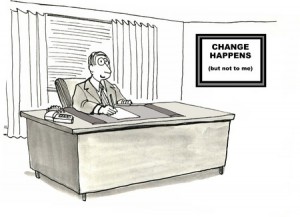
    http://www.123rf.com/ 36332388

    If you doubt that you have a Difficult Person amongst your team, hold the meeting and see who has the last minute crisis.  They will make it sound legitimate but it was contrived in order to avoid Change.

    Because I have dealt with so many difficult people, I am no longer amazed by the lengths they will go to avoid the meeting.  I personally tell them face to face about the meeting.  I personally remind them multiple times by email and in person about the meeting.  I deny them the ability to use the “I didn’t know about the meeting” or the infamous “I forgot” excuse.

    With experience I got good at anticipating their next excuse so I block it.  Yes it is a game.  They try to get out of the meeting and I block their attempt.  As the Change Agent, my job is to force them to be very creative in their excuses.

    When a Difficult Person has no way out, then what typically happens is they become sick.  Genuinely sick.  My best explanation is that they are coming face-to-face with their own issues.

    When this happens it is important to once again to have your head screwed on straight.

    You have to remember you are engaged a win-lose scenario.  Not with the Difficult Person, but with their personal issues.

    I recognize that the Difficult Person is also held hostage by their issues.  Their issues are stronger than them, their colleagues and their managers.  Their issues always win.  The Difficult Person needs to know someone is stronger than their issues by not giving in.

    That is the real Conflict a Change Agent takes on.

    On the day I put the Change into effect I clear my calendar to deal with nothing else.  I know this is the day when the Difficult Person will make their last ditch effort to stop the Change.  As the Change Agent it is my responsibility to handle the grenades the Difficult Person launches.  It is my responsibility to work with my team to make sure the Change happens.

    Standing up to the Difficult Person’s issues simply requires calling upon my super-stubborn inner 3 year old child who only knows the word “No.”

    I’m not aggressive.  I just refuse to budge.  The Change is going to happen.  It doesn’t matter what the Difficult Person says, how many threats they make or how they try to intimidate me, the Change is going to happen.

    It doesn’t matter how many alternative ways they come up with, the answer is “No.”  I am not budging.  The change is going to happen the way the team worked it out.

    I know from personal experience how far a Difficult Person will go to convince you that your proposed Change will have cataclysmic consequences.  They will do their best to make you question yourself and feel incompetent.  (How they are feeling inside.)  But you have to remember, that the Change wasn’t 100% your idea.  It was a collaborative effort, using the collective knowledge and experience of the team.

    The team knows what they are doing.  If any problems arise the team will figure it out.  The team wants to move forward.  And as the Change Agent your responsibility is to the team.

    How does this all play out in the end?

    Sometimes the Difficult Person breaks and suddenly everything is sunshine and roses.  The Difficult Person becomes a great team player.  It truly is magical.

    Sometime the Difficult Person quits and finds a job elsewhere.

    Sometimes you have to take disciplinary action and fire the Difficult Person.

    And sometimes, senior management steps in and sides with the Difficult Person.  The changes never happen and the organization never moves forward.  The workplace becomes deeply dysfunctional and you leave to find a job elsewhere where your Change Agent skills can make a real difference.

    However it turns out, you know you have what it takes to make your organization better.  And it feels really good to know you CAN make a difference!


    Empowered Women Aren’t Afraid To Be Change Agents

    To subscribe to my articles Contact Me

    Follow The Woman In The Room on Facebook

  • What a Mary Kay Lady Taught a Female Engineer

    I often see it cited that one reason women aren’t advancing in the male-dominated workplace is because women don’t have enough female role models.  I always question how much of a factor this really is because I never had an older woman in my profession to be my role model.  I don’t know if a professional role model would have made any difference or would have made anything easier.

    42256454 - portrait beauty product shop manager
    http://www.123rf.com/photo_42256454

    Whenever we discuss the value of role models we have to first think about what it is we expect from our role models.  From the media it seems role models are little more than cheerleaders who motivate and validate that “Yes, someone like me can make it in this career field!”  I always thought the idea that I needed to resemble someone else in the workplace in order to know my value was an absurd notion because I saw my uniqueness as an advantage.

    To me role models should do more than validate that it is okay for us to be in a role.  To me they should challenge our perceptions.  They should open us up to new perspectives and help us grow personally and professionally.  Given that,our role models can come from a variety of places including some very unexpected places.

    Back in 1982 when I began my career as an Air Force 2nd Lt, the highest ranking female officers on my base were 1st Lt.’s.  There were no female senior officer role models because most women left military service once they became pregnant.  This was so prevalent that the Air Force didn’t even have a maternity uniform for the few women that stayed in.  Female service members were simply expected to get out and become “Dependents”  – the official name for spouses and children of military servicemen.

    I was also an engineer and there weren’t any female engineer role models to be found either.  In my town there were 2 other female engineers but both of them also graduated in 1982.  One of my fellow female engineers was an Air Force officer too who joined my squadron and the other worked for the Corps of Engineers.  We were told that there were a couple of other female engineers in a town 200 miles away.  When we looked them up we discovered one had already left engineering and the other was only about 3 or 4 years older than us.

    Given my situation, I fully understand how it feels to be the odd duck in your workplace.  The only person I could completely relate to was the other female engineer in my squadron.  She and I became good friends and together we quickly changed a lot of misperceptions about women in the Air Force and women as engineers.  We forged our own path and our reward was a lot of self-confidence and a strong sense of self.

    So today when I read about women needing role models I question if in return they are missing out on the self-confidence and sense of self we gained.  Looking back It isn’t a trade-off I would want to make.

    Even though there were no older female officers or engineers, I still managed to find both a female role model and a female mentor in women who came from a much more traditional background.  These women were my squadron commander’s secretary and his wife.

    My first squadron commander was a strong leader and by far the best squadron commander I had in the Air Force.  From him I learned that strong men surround themselves with strong people, including strong women.

    His secretary, Marian became my mentor.  I will always credit her with teaching me to see the male-dominated workplace from a female perspective.  She is the one who pushed me down this path of figuring out how women improve (not merely fit into) the male-dominated workplace.   (More on Marian in my next article)

    However, it was my commander’s wife Mary who became my role model on how to be a businesswoman.  She was a Mary Kay lady.

    On the surface a Mary Kay lady who lives in the traditional feminine world of make-up and skin care seems a world apart from a female engineer and Air Force officer.  But Mary smashed the traditional image of a non-working military officer’s wife who lives her life to support her husband’s military career.

    You see, Mary wasn’t just an average Mary Kay lady.

    She was the TOP Mary Kay Lady.  As in the #1 Mary Kay lady.

    Mary had Mary Kay’s largest and most profitable global network of consultants.  She had a global empire before most male CEO’s even knew what globalization was!

    Of course she drove the infamous pink Cadillac.  But what made everyone take notice was that she earned more money than her husband.  A lot more.  The rumors around base as to how much she made were staggering.  When the average household income was about $24,000 per year, it was rumored that she was a self-made millionaire.

    Mary was a role model to many Air Force wives and she helped many other women become wealthy too.  We openly joked that the husband of any woman working with Mary better be comfortable with the idea that his wife would be making more money than him.  We quietly joked that my squadron commander held counseling sessions for such husbands.

    To me, Mary represented the ultimate successful powerful business woman.

    She also became my role model for a military officer’s wife.

    When I went into the Air Force I wasn’t just an officer, I was married to another officer so I was also an officer’s wife.  This was still a fairly rare – there were only 5 female Air Force officers married to other officers on my base.  Within my squadron and wing, being a married female officer wasn’t a big deal because Mary already smashed all traditional perceptions about being an officer’s wife.  When she talked to me about being an officer’s wife the first thing she said was “I don’t bake cookies.”  (Blasphemy!)  She also rarely attended wives luncheons and social events.  She couldn’t, she has a business empire to run.

    http://www.123rf.com/photo_34154137
    http://www.123rf.com/photo_34154137

    However within my husband’s squadron and wing, they had a much more traditional view of a wife’s proper role.  When they found out that I was an engineer, I got the polite “That’s nice.”  But when I showed up to a luncheon in my Air Force uniform, the temperature in the room dropped precipitously.  I had to outside into the -25 degree wind chill to warm up.

    After such an icy reception I didn’t attend another wives’ event for 12 years.  And according to Mary that was fine because I had more important things to do.  I had a career to work and my own money to make.

    Unfortunately I was only around Mary for one year before her husband got transferred.  But her influence always remained.

    When I got out of the Air Force and began working in the civilian sector, I copied Mary.  I wanted to look like her version of a businesswoman and not what society said I should look like.

    Mary was always impeccably dressed, even at the grocery store.  She never looked frumpy like some officer’s wives who wore oversized denim jumpers.  Mary dressed like a feminine businesswoman.  She didn’t follow the Dress for Success prescribed businesswoman attire of a black, gray or navy suit with 2” pumps that was society thrust upon women as the ideal.  Mary wore dresses or slacks that showed off her figure.  She wore 3” heels.  She had colorful accessories.  She never looked drab, boring or unisex.  She looked like a successful woman.

    Following Mary’s example, I indulged in my desire for really nice clothes.  After wearing matronly uniforms for 10 years, I wanted to look young and feminine.  I bought colorful, stylish and well-tailored business clothes.  I wore 3+” heels.  My skirts were almost scandalous at 1-2” above my knee.   I dressed to make myself feel good.  And my copy of Dress for Success was tossed into a bottom drawer and forgotten.

    Many years later when I became a Commander’s wife, Mary still served as my role model.  By then the Air Force had dropped its unwritten policy that officer’s wives shouldn’t work so they could support their husband’s careers.  Too many military families including senior officer’s families were struggling financially and most wives had no choice but to work.  All too often they wound up in low paying jobs even though they had a degree.

    I was working as a project manager for a company that constructed military family housing.  This was something I was very passionate about because as a former engineering officer and military spouse I was acutely aware of the extremely substandard condition of military housing.  I knew how important replacing the old housing was to supporting our military families.

    One day my husband came home and said his boss asked him about me.  His boss “noted” that I seldom attended wives functions on base and I didn’t routinely gather all of the wives in my husband’s squadron in our home for hen parties.  My husband simply told him I worked.

    I looked at him and said “Did you tell him what I do?”

    “No.”

    Mary’s statement “I don’t bake cookies” from long ago reverberated in my head and sent me off into rant.  “You should have!  I don’t go to luncheons because I am too busy.  Everyone in your squadron knows what I do!  If you asked any of them if they would rather have me build them a new home or bake them cookies, they would say they would rather I build new homes.”

    I had my full-Mary on.

    Several months later, I got the opportunity to correct my husband’s boss’s perception of me.  My company was constructing his new home on base.  On the day he was scheduled to tour his new home, I went out the house and waited.  When he came into the home, I introduced myself.  I explained that this is how I spent my time.  He was impressed.

    I felt like I followed in Mary’s footsteps.  She set a new standard for military wives 20 years ago and now I felt like I was doing the same.  I stepped far outside of all of the traditional roles that often box in military wives.

    Because I didn’t have women in my profession in my workplaces, I looked around at what other women were doing and Mary Kay ladies were a continuous source of inspiration.  While not every woman who took to selling Mary Kay was successful, I knew a few who were in traditional low pay dead-end jobs who found their real success in Mary Kay.  They found their self-confidence and their sense of self.  And that is what it all boils down to.

    The role of the role model isn’t to give us someone to copy or validate us.  A real role model is someone who finds their own unique path in life and then has the courage to walk it.  They then inspire us to do the same.

    Empowered Women Are An Example To Other Women

    To subscribe to my articles Contact Me

    Don’t forget to leave a Comment and Share

    Follow The Woman In The Room on facebook

  • The Importance of Alligator Trophies

    I wanted to do a follow up to last week’s article Political Swamp Wars 2016 because I got some great positive 8043279_mfeedback reinforcing a point:  When we are at work, we all need to have a bit of Alligator Slayer in us.  That after all is what our employers expect – they expect us to deliver tangible results.  They want us to have alligator trophies.

    This is very important for women to understand, especially when they are going after a promotion or they are asking for a raise.

    Have you seen this commercial on TV?

    https://www.youtube.com/watch?v=9ilSeJ6B5ro

    The girl wants a raise but is uncomfortable asking for it.  Why?  Because she doesn’t know how to justify her raise to her boss.

    What she doesn’t know and what the older women doesn’t teach her is that the way to justify her raise is to show him her Alligator trophies.

    Have you seen this commercial on TV?

    https://www.youtube.com/watch?v=EIWcfhJ5PHc

    Uncle Ritchie says we don’t need more desk sitters and status quoers.  We need more Chargers and Challengers (Alligator Slayers).  I can’t help but think that this is a huge endorsement for Alligator Slayers to win Swamp Wars.

    Watching the two commercials together we also can’t help but see the different gender messaging about being Doers.  Women aren’t confident Doers.  Men are bold chargers.

    As women we need to start seeing ourselves as Alligator Slayers.  We need to know what our alligator trophies are.

    Going back to using the Presidential election as our universal example of the male-dominated workplace, last week (May 22) Hillary was interviewed on Meet The Press by Chuck Todd.  https://www.youtube.com/watch?v=9t1d7moOULg

    Chuck Todd asked her what her “Big Idea” was in comparison Bernie’s Political Revolution and Trump’s Make America Great Again.  She replied “We are stronger together” and discussed that concept.  Chuck Todd then asked her “How are you going to do it?” because she is a polarizing figure (like Trump).  She responded “That when I have these jobs Chuck I get things done and I work with people across the aisle.”  Earlier in the interview she said that as President she would get “positive results” and make “tangible progress.”

    What struck me was that the interview was a perfect set up for her to list all of her achievements – all of her alligator trophies.

    She said that as First Lady she worked with the Senate to pass the Children’s Health Insurance Program and worked with Congressman Tom Delay to reform adoption and foster care.  Then she said that she worked as Secretary of State “to reduce nuclear weapons between Russia and herself.”  She then stated how she had favorable ratings as Secretary of State.

    That was it.

    She mentioned tangible achievements from the 1990’s but then for her most recent job as Secretary of State she began to falter and basically said – people liked me.   She did no better at promoting herself than the young girl in the commercial!

    Answers like that won’t get you a promotion or a raise in the male-dominated workplace!

    To move up in the male-dominated workplace women have to be able to rattle off their accomplishments!

    Our workplaces assume that our male colleagues have accomplishments because society teaches us that men are Doers.

    Women aren’t automatically seen as Doers.

    So we wind up with thoughts like this.

    13226855_1158411204210591_4966113505142324123_n[1]

    This is not how you want your male colleagues or boss to see you! 

    But both Hillary’s interview and the Secret commercial reinforce that this is who we are because we can’t list off our accomplishments.

    I was taught very early in my career the importance of slaying alligators.  So I have always slayed them.  I also tie the alligators back to improving the workplace financial performance because it is the best justification for a raise or promotion.  Believe me, as a woman competing with men, slapping down a big ole alligator trophy on the desk and saying “Who’s got something bigger?” is very powerful!

    It forces a meritocracy.15755910_s

    Contrary to what society teaches us, women are alligator slayers.  Given my experience I would say women are probably better alligator slayers than men.  In one job my boss questioned why I paid a woman who worked for me so well in comparison to some men.  I explained that in the last 6 months she returned $1.2 million to revenue that was pure profit.  She was slaying some huge alligators to make that happen.  I couldn’t list any alligators the men had slayed.  When I asked him to list their alligator trophies, he couldn’t list any either.  He just incorrectly assumed that because they were men, they had alligator trophies.

    The most effective way for women to compete against men in the male-dominated workplace is to have bigger and better alligator trophies.  Therefore, we need to start seeing ourselves for the Alligator Slayers we are.

    If you haven’t done it, write a list of your jobs, the description of your responsibilities and your accomplishments.  List everything you’ve done even if it seems small and insignificant.  It might be hard at first because we aren’t taught to see ourselves this way.  But keep the list handy and add to it when you think of something else.

    It won’t take long for you to start seeing all the things that you make happen in a day.  And when you start seeing your accomplishments you start having a lot of pride in what you get done.  You then want to do more so you have more pride in yourself.  Before long you see yourself as an Alligator Slayer who has pride in her alligator trophies and isn’t intimidated to ask for the raise or promotion.


    Empowered Women Slay Alligators and Use Their Alligator Trophy Collection to Get Raises and Promotions

    To Subscribe to my articles Contact Me

    Leave a comment and follow The Woman In The Room on Facebook!

  • How Women Can Excel Above Men in Middle Management

    When I was a kid growing up we understood that when people went to work, they did something tangible.  We understood what the mailman, policeman, salesman, doctor, dentist, nurse and teacher did.  Then a new job emerged – the middle manager.  We asked our parents what they did but our parents couldn’t give us a good description.  They really didn’t know.  They just told us we should become one.MP900289529

    Eventually an image of managers emerged.  Managers were smart, well educated, and driven to climb the corporate ladder.  In their upper echelon, they develop strategies, attend meetings and conference calls, make decisions, read reports, meet with clients, play golf, have two-martini lunches, drive expensive cars, live in a big houses and belong to a country club.

    Since managers were selected and promoted into the management ranks, we assumed they were the best and the brightest in our workplace.

    However, in spite of all of the status and air of importance associated with managers, the workforce had a different opinion.  They often thought that if a manager disappeared, no one would care; if they even noticed.

    Their perspective brought us back to the greatest mystery in business: What does a middle manager really do?

    When I entered the male-dominated workplace in the early 1980’s I joined the throngs of people wondering what managers do and why the workplace needed them.  I expected managers to interact and supervise their staff but I hardly saw my managers and rarely talked to them.  They always seemed to be busy but they didn’t produce anything.

    In 1987 I got my first middle management position.  I asked my predecessor what he did.  He showed me to my new office stacked to the gills with 102 unresolved open project folders and I realized he never knew what he was supposed to do as a middle manager either.

    I began to work on my own definition of being a manager.  I interacted a lot with my three departments solving our functional problems.  We rewrote all of our operating processes and procedures.  We tightened communication and coordination.  We all began moving in the same direction together and eliminated people going off randomly on their own doing what they wanted.  Our performance soared.

    Then about 15 months into my job my boss was unhappy in his life so he called me into his office to counsel me.  He told me that I didn’t yell enough at my staff.  He wanted me to follow his example where he had been yelling at and insulting the men in our weekly staff meeting.  He directed me to go down to my Planning Dept. and yell at all the planners.

    At least I knew his definition of what a manager does.

    So I went down and met with my planners.  I told them I was sent there to yell at them and asked them what they would do if I yelled at them like my boss wanted me to.  Their answer was: “We will ignore you just like we do him.”

    I still didn’t get how men thought about management.  At the time I was getting my master’s degree and decided the department head was the perfect person to answer the mysterious question of what a manager in the male-dominated workplace is supposed to do.  In response he set me up to take a one-on-one course with a new visiting professor.

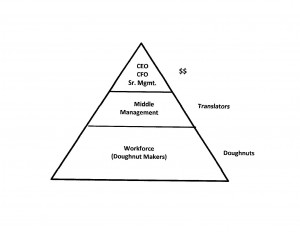
    My new professor explained the role of a manager by drawing a diagram based upon Juran’s interpretation of the workplace vertical hierarchy.  For some reason I immediately renamed it the Dollars to Doughnuts model.

    Dollars to Doughnuts 050616

    This model explains how a company should function holistically.

    At the bottom of the pyramid is the largest group – the workforce.  The workforce is comprised of unskilled, skilled and/or professional workers depending upon the product or service the workplace produces.  The workforce can be of any educational level ranging from uneducated unskilled laborers to highly educated, highly skilled neurosurgeons.  They use processes and systems to produce the products and services purchased by the workplace’s customers.

    I call these people the doughnut makers.  They know how to make the doughnuts and how to operate the shop that sells the doughnuts.  They live in the world of the doughnut shop and they speak in the language of doughnuts.

    At the top of the pyramid are the CEO, CFO and Sr. Management.  They represent the company to the outside world.  They speak in the universal business language of money.  Using the language of money, they can compare themselves not only to other doughnut making companies but to companies in other industries.

    Since the top of the pyramid speaks in the language of money and the bottom in the language of doughnuts, there is a communication problem.

    For example, a senior manager knows the doughnut shop is short on revenue and is busting some budget lines.  So, on his semi-annual scheduled doughnut shop walk-thru he asks the doughnut makers: “What’s going on?”

    The doughnut makers tell him about how the doughnut fryers keep breaking down.  They have to wait for new parts to come in so that means they are down on fryers.  Being short on fryers they have to work overtime in order to make the doughnuts.  But that makes the working fryers run longer which means they break down faster.  They are also short one person because he is busy dealing with broken fryers.  They were so busy dealing with the fryers that the flour and sugar orders got messed up and they had to expedite some deliveries.  But then the flour and sugar supplier changed their weekly delivery date based upon their expedited delivery so they ran short the following week.  They need him to change it back because it conflicts with their heaviest production day.

    This is the truthful answer that drives senior managers right back to their office and to never step foot in a doughnut shop again.  The only response the overwhelmed senior manager can offer is the obvious solution: “Get those fryers fixed as soon as possible.”

    To this the doughnut maker response is – “Duh.  What do you think we are busting our butts trying to do?”

    This is why the workforce doesn’t find value in management.

    The real problem is that the senior manager asked a question speaking “Money” but the doughnut makers replied speaking “Doughnut.”  They don’t understand each other.

    What they need is a translator.  (That sounds like a communication skill and something women excel at!)

    Translation is the real definition of what a middle manager does.

    In Juran’s original model, he said that middle managers convert doughnuts into budgets.  That is true however it is only a partial definition of translation.  I expanded the definition to leverage female traits.

    What a middle manager really does is know how to make money making and selling doughnuts.  That goes well beyond developing budget lines and tracking monthly whether you are over or under budget.

    Making money by making and selling doughnuts requires understanding how the doughnut shop operates and how actions within the doughnut shop impact financials.  Very simple examples of translation are:

    • An expedited delivery of flour will have a $100 delivery charge
    • Two people working two hours overtime will cost $190
    • If the shop makes 100 doughnuts per hour doughnuts cost 20 cents to make.  If they make 120 doughnuts per hour doughnuts cost 18 cents to make.


    Translation begins by focusing on the doughnut shop’s processes and procedures.  We want standardized processes and procedures so we have consistent outcomes.  When the processes are standardized, the outcomes are consistent and it is easy to see the financial results.  With experience we instinctively learn to see what is happening in our doughnut shop and immediately know the financial ramifications.

    What many middle managers do is wait for the month-end financial statement, look for discrepancies, then make up stories that sound plausible to explain the discrepancies to senior management.  They do this because they can’t translate.

    When we become good at translating we don’t have to wait for month-end reports.  We see a variation in how the doughnut shop functions and we know in real time what the financial impact is.

    This then triggers us to work with our doughnut makers to improve the processes, so the variation doesn’t reoccur.  By reducing these variations financial performance improves.  For a middle manager this is your claim to fame.

    The problem is that many of our workplaces don’t operate through standardized processes even if they supposedly have them.  Individual departments or projects tout they are different or unique so the standardized processes wouldn’t work for them.

    The real reason this happens is because in the male-dominated workplace men aspire to autonomy – to being independent and doing things the way they personally think is best.  Standardization works against everything men are taught about being men.  Without standardized processes laying the foundation, male middle managers can’t translate.

    Women however, don’t aspire to autonomy.  We enjoy and know how to work in groups.  Standardized processes don’t threaten us.  We enjoy leading from within, not leading from above and dictating downward.   This makes us perfectly suited to lead our doughnut shop to map out their processes and then improve their processes.

    Translation is the major discriminator between male and female middle managers.  It is how women can distinguish themselves and set a new standard for middle management performance.

    Translation is also what set us up to move up to senior management and excel there too.

    Empowered Women Excel at Translation


    To subscribe to my articles Contact Me

    Don’t forget to Leave a Comment and Share!

    Follow The Woman In The Room on facebook.

  • How To Get Justice When You Are Wronged

    We experience a wrong-doing at work.  It upsets us.  We want justice.  We want management to be just as outraged and upset as us but they aren’t.  They just make it to go away.  This makes us even angrier that this is how the system works.  It isn’t fair.25898150_m

    We have all been there – experienced a wrong-doing that seems to get swept under the rug.  But it also seems that in these situations women are treated more unfairly than men.  Women get dismissed as emotional if not crazy.  Men seem to brush it aside and all go out for a beer together.  To women it doesn’t seem like men care about justice or righting the wrong.

    How do women get justice?

    Let’s go through a scenario.

    We suffered a wrong-doing and we immediately have an emotional reaction – hurt, anger etc.   We tell all of our friends what happened and they are outraged too.  They tell us we need to do something about it.  We need to stand up for ourselves.  Our wrong-doer can’t be allowed to get away with it.  Now we are really upset.  Our friends did what we needed – they validated that we were right to be upset.  Now we are very upset.

    We report the wrong-doing to the appropriate person.  They give us a patronizing look and tell us to calm down.  They will look into the situation.  Over the next few days we watch our wrong-doer.  We are waiting for them to disappear for a couple of hours then come back looking beaten up and disgraced.  We harbor a fantasy that they will be fired and we will watch them take the walk of shame with their box of personal items.  That will make us feel vindicated.  But as the days go by, our wrong-doer is happy and carries on like normal.  We know we were blown off.

    The reason we don’t get justice is due to a series of mistakes.

    Our first mistake is looking for emotional validation by talking to our friends.  (Men do this too.)

    Our second mistake is delving into the drama and emotion of the situation.  This is what we are taught to do because we live in a society that is in love with drama.  So when we suffer an injustice we do as we were taught – we feed the drama monster.  (Men do this too.)

    Once we feed the drama monster he grows quickly.   When our friends feed him he grows even more.   Soon he is really big and fat and ugly.  As we look at him we believe he was created entirely by the wrong-doing.  Therefore the facts of the wrong-doing have to align with and support his existence.  We then write our story of facts to align with and support his existence.  We tell this story to ourselves over and over again until it all feels natural.  We accept that our original perception was incomplete and our current story is true because if it wasn’t our big ugly drama monster wouldn’t exist.  (Men do this too.)

    Monster 1When we present our big, fat, ugly drama monster to other people we want them to be horrified.  We want a dramatic outcry by the masses.  We want everyone to rise up and join us in our feeling of injustice.  We want our feelings vindicated.  (Men do this too.)


    Our drama loving society tells us that if we create enough drama and enough of an outcry then people will be forced to give us justice.

    However, it doesn’t happen.  People abandoned us and we are left standing alone with our drama monster.

    Our fatal mistake was in believing drama gets justice.  In reality, we have to build a factual case to get justice.

    Men and women get two very different reactions when they present their drama monsters.  This is because we are taught to believe that women react emotionally and men react rationally.  As a result women get discredited and men don’t.

    When men are emotional, even very emotional, they are seen as functioning through the right side of their brain.  To act rationally they just need to switch over to the left side.  To do this, you drop him on his head, kick him in the butt or yell in his face.  Men are literally treated as if they have a switch that can be flipped to make them act rationally.  Flip the switch and he is back to normal.

    Once he is back to acting rationally, the problem is solved.  It’s time to go get a beer.

    To women this makes no sense.  What about the wrong-doing that initially caused his emotional response?  Women continue to feel the injustice until the situation that caused the wrong-doing is corrected.  Once they feel justice, then the situation is resolved.

    To the male-dominated workplaces this makes no sense.  Women are told to let it go – let go of the emotion and it will all be good.  Women are treated as if they have a flush valve that once activated will release any excess emotion.  The problem men have is that they don’t know how to activate the valve in women.

    The reason they can’t activate the flush valve is because women don’t have one.  That’s not how women work.

    A few months ago I wrote an article about The Difference Between Male and Female Brains.  In this article I cited a study about the difference in connections between the male and female brain.  The point of the article was to dispel the stereotype and myth that women only respond emotionally.

    Because of the connections in women’s brains, women respond emotionally AND rationally.

    Women are every bit as rational as men but also filter events through their emotions.  Contrary to what we are taught this doesn’t create a weakness.  It creates a tremendous strength – a superpower.  Women see more, pick up on more and understand more deeply.  Women are tuned-in in a way men don’t comprehend.

    The problem women have is that they aren’t taught to use their superpower.  They are taught they are emotional and react emotionally.  And our drama loving society continues to feed that narrative knowing that it discredits women.

    Women have to be taught how to use their superpower to their advantage to get justice.  They have to learn and practice processing events emotionally and rationally simultaneously.  Women aren’t men who separate and switch between emotion and rational thinking.

    When women experience a wrong –doing and have an emotional reaction (just like men) they need to vent (just like men).  They vent to one person who will listen and nod but not feed the drama monster.

    After women vent, they need to start thinking and gathering the facts.

    Rule #1 in gathering facts is to keep your mouth shut.  Tell no one what you are doing.  If you need help use a neutral third party who won’t feed the drama monster.  If you tell your friend, the drama monster will get fed.

    When women keep their mouths shut, their superpower kicks into high gear.  Their emotions become their radar.  By listening to initial feelings, gut responses, intuition and funny little feelings they can read a situation.  They become incredibly situationally aware.

    When you fully understand the situation, you know how to present your case.  You also know how it will be countered.  You can then present the counter to the counter argument.

    Sound complicated?  It isn’t.  It’s what women already do.

    One of my first articles was  about the Rachel Letter.  The name came from the episode of Friends where Rachel writes Ross an 18 page letter – front and back.  Women (and men who have been the recipient of one) know exactly what I am talking about.  This letter has a powerful business application.  (All men just said “Oh no!”).

    Women’s ability to write this type of letter is really about their ability to organize and connect a great number of details.  When those details are connected logically and rationally, we build a case that is hard to dismiss or dispute.  (Maybe this is why women make such great lawyers.)

    Typically when women write a Rachel Letter in their private lives they include emotion and feelings.  In business those have to be removed.  You want to present the facts, just the facts.

    It takes practice to build the skills to eliminate emotion and present pure facts.  I used other opportunities such as writing plans, reports and proposals to learn how to write and state a case.  I also did a lot of briefings and presentations.  For me there was two prong benefit – I got really good at business communication and I could build the detailed case to right any wrong-doing.

    It also takes practice to stop feeding the drama monster.  It takes practice to stop talking to everyone for validation and to start venting so the emotion is processed and can be put to a constructive use.

    Many years ago I knew a woman who caught her powerful husband having an affair with his secretary.  She told no one.  She gathered her facts.  With the help of an attorney she worked out her plan.  She then secretly presented her facts to her husband’s boss.  With no notice, the boss flew in, walked into the husband’s office and instantly removed him from his position.  It was a perfectly executed castration that all of us were in complete awe of.  She got her justice.

    Women can get justice.  For the most part it is a matter of not doing what they were taught – following the drama route.  Their justice comes from empowering their natural superpower.


    Empowered Women Get Justice.


    For more articles on harassment and discrimination go to  The Ugly Stuff article category

    Empower Yourself  – Subscribe to my articles – Contact Me

    Assert and Express Yourself – Leave a Comment & Share this article

    Follow The Woman In The Room on Facebook for more empowering ideas!

  • Do Women Self-Discriminate?

    Recently I read a comment in a post:18692973_m

    “Women want to be treated the same as men except when they want to be treated differently.”

    Then I did a double take – the comment was written by a woman and had over 10,000 Likes.  Wow!

    I couldn’t help but wonder what experiences 10,000 people had to make them all find more than a grain of truth in that statement.  Do women really want to pick and choose when they want to be treated as equal to men?

    I will admit I’ve known some women like that.

    Gender equality means men and women have equal value and equal treatment.  So to understand the comment, I Googled gender inequality issues, reasons, causes, etc.  Most of the articles discussed income inequality and the wage gap.  There were also a lot of general discussions about glass ceilings and gender biases.  The articles all came from the perspective of how society is constructed to hold women back or make it difficult for women to have economic parity with men.

    However the comment and the experiences of 10,000 people say that it isn’t just society holding women back.  Women aren’t doing all they can to advance themselves either.

    After many hours of searching I still couldn’t find any articles that discussed why women pick and choose their moments of equality.  Then buried in one article I found the term “diminished responsibilities.”  The example it cited was men dismissing a woman who wanted to help unload a truck.  “Don’t worry sweetheart, we got this.  You go on back to the office.”

    According to the article if she wants to unload the truck then the men should let her.  That sounds good.  That sounds like equality.

    But wait!

    What about the other 2 women who work in the office?

    Shouldn’t they be out helping to unload the truck too?  Isn’t that equality?  Or do they get to decide that unloading the truck is man’s work so this is one of those situations they don’t want to be treated as equals?

    In the past we’ve excused women from this type of work because it was physical.  However, current workplace safety rules have pretty much negated this excuse.  Equipment must be used to lift heavy objects, even by men who are strong enough to lift the object without equipment.  So there is no reason why women can’t help unload the truck.

    Today there is no reason why women can’t do the overwhelming vast majority of things once considered a man’s job, even physical work.

    So I see diminished responsibilities expanded with four applications:

    1. It is men saying women can’t  do something because it is a man’s job
    2. It is women excusing themselves from doing something because it is a man’s job

    (We can all come up with examples to fit these applications.)

    1. It is women saying men can’t do something because it is a woman’s job.

    (Sorry, I am having a hard time coming up with an example of this except for giving birth, breast feeding and helicopter mothers who never cut the apron strings to their sons.  I can think of a lot of things we let men do but then aren’t satisfied with the results.  So, if you have an example, leave a comment.)

    1. It is men excusing themselves from something because it is a woman’s job

    (We can come up with a long list of examples but they are all considered politically incorrect.)

    If women will stop themselves from doing a man’s job but won’t stop a man from doing a woman’s job, we can conclude that women pick and choose when we want to be equals.

    That makes women sound like hypocrites.

    If we are going to have true equality then we need to eliminate all four applications of diminished responsibilities.  We need to set a new standard where we see most jobs, tasks, responsibilities and accountabilities in terms of being an adult, not in terms of being a man or a woman.

    Actually this isn’t even an equality issue – it is just a fact of modern life.  Today, there are a lot of single people in all age groups who have to carry life’s responsibilities solo.  Men have to cook, clean the bathroom and do laundry.  Women have to take care of their cars, earn a living and manage their finances.   This is just the way it is.

    And yet, we are still using a mid-20th century perspective of inequality.  Too often we are solely focused on others oppressing or discriminating against women.

    We ignore that many women are still sitting back, letting men take the lead and in a secondary role by their own choosing.  Our society still allows women to choose #2 – to see tasks and jobs as men’s jobs and opt out.

    Even though this still perpetuates the idea that women are weaker or inferior to men, we don’t call this politically incorrect, discrimination or inequality.  But it is self-inflicted discrimination.

    As women we have to look in the mirror and see if we are choosing to hold ourselves back – if we only want to assume the perks of equality and not the less pleasant responsibilities and accountabilities that come with it.


    As a society we have to apply equality evenly – between men and women and amongst women.  This means we see men and women as adults who share a common list of responsibilities and accountabilities and have an equal expectation of living up to them.  If we don’t then we all wind up confused and with 10,000 people liking the comment above.  And that’s not good for anyone.

    Empowered Women Don’t Self-Discriminate


    Leave a comment and don’t forget to share!

    To subscribe to my articles Contact Me


  • Run to the Ball!

    A few weeks ago while walking my dog in the park I watched a father hit baseballs to his young son.  The boy standing in place missed several balls as they hit the ground all around him.  His father finally said “You have to run to the ball.  Don’t wait for it to come to you.”  The boy started moving to meet the ball and even though he didn’t catch the fly balls, he got many of them on the bounce.

    I found myself thinking that the father taught his son a great lesson that went well beyond baseball.  Don’t wait for things to come to you, you have to run to them and meet them where they are.

    I could understand the boy’s hesitation.  Running to the ball is scary.  It can hit you in the face and give you a black eye.  Or you can embarrass yourself if you slip on the grass and fall flat on our face.

    Thinking about my trips to the park and watching all the activities boys and men engage in there, it made me wonder how many girls are taught to run to the ball.

    Too many girls are still never told they have to run to the ball.  Too many aren’t even encouraged to get out there on the field and play.  And if they do play and find out they don’t like it, they can quit and go sit on the sidelines.  Girls are allowed to play it safe.

    Boys aren’t allowed to play it safe.  If they don’t like the game or don’t play well, they change positions or find a different game to play.  They have to keep playing so they learn how to make things happen for themselves so they keep advancing themselves.

    When my girls were growing up they didn’t play ball, they rode horses.  At the barn, parents who brought their daughters out for the first time would ask me if riding horses was worthwhile.  I would laugh and say “Be prepared for tears.  Lots and lots of tears.”  Learning to ride a horse and make it go over jumps is hard and sometimes frustrating work.  And of course parents were concerned about their daughters falling off and getting hurt.  “They will fall off.  They may get hurt.  But they will have to get back up on that horse again and keep trying.”    That is the real lesson.

    But are we so afraid of our girls getting hurt – physically or emotionally – that we give them permission to sit on the sidelines?

    What would happen if all girls were told like boys are that they had to play and they cannot quit?

    What if we taught all girls they have to run to the ball and they have to make things happen for themselves?

    Isn’t that real equality?

    Or is our thinking about equality limited to:  If you want to play, then equality says the boys have to let you play.  But if you don’t want to play that’s okay.

    If we allow girls to sit on the sidelines, then shouldn’t be surprised that they are more vulnerable as women.

    We shouldn’t be surprised that women aren’t equally represented in high positions in government and business.

    We shouldn’t be surprised that there are very few self-made female billionaires.

    We shouldn’t be surprised that women earn $0.78 to every $1.00 men earn.

    We shouldn’t be surprised that women stay in a bad situation at home or at work.

    We shouldn’t be surprised about the number of single mothers that are trapped in poverty.

    And we shouldn’t be surprised that society hasn’t fully benefitted from the gifts and talents of women.

    It seems to me that all girls should be taught to run to the ball.  They should be out in the field experiencing what it is like to miss the ball, get hit by the ball and to be laughed at when they slip and fall on their face.

    Only when they are out on the field do they build the character to keep trying.

    And it only when they keep trying that they learn the exhilaration of running and catching the ball they didn’t expect to catch.  It is only then they will hear the crowd cheering “You go girl!”

    What girls choose to do with their ability to go for the ball once they are women is up to them.  But with the character instilled in them as girls, they know as women they can get out on the field and play.  And they know that as they play they will get better and better to the benefit of themselves, their workplace and society.

    Megan Martin getting through an obstacle:  https://www.youtube.com/watch?v=51V-cY414qg

    (Karen O’Connor refusing to fall off her horse: https://www.youtube.com/watch?v=Du3496C7WwE


    Empowered Women:

    Run to the Ball,

    Get Back on the Horse,

    Keep Trying Until They Make it Through the Obstacle

    Keep Going


    To learn more about the empowerment and value of women in the workplace check out my new book.

    Don’t forget to leave and comment and share!


  • Getting the Biggest Bang Buck for Your Time at Work

    As I discussed last week, I’ve been looking into the statements we hear about how women make $0.77 for every $1.00 a man in earns.  To be clear, none of the studies show that this discrepancy is for the same job.  These are overall numbers.  Within the same job title I saw numbers like $0.81, $0.88, $0.92 and $0.96.  Some professions have wide gaps and others are much narrower.11593346_m

    In my experience I would tell you women make 10 – 15% less than men just because men start negotiations from a highly over-inflated opinion of themselves.  Some are laughably high.  I’ve told many men “I’m sorry but I will not pay you more than me.” Once we get down closer to reality, in order to wrap up negotiations, we might settle on a 10% higher salary and another 2 – 3% more in benefits.  My numbers may be a little lower than other women will tell you, but I am a strong negotiator and I don’t have wage disparities amongst my male and female team members.

    When it comes to job performance compared to wage, women over-deliver and men under-deliver.  I am still waiting for the men I interviewed who promised to do all kinds of things to actually show up at work.

    Women are much more realistic about themselves but can easily get another 10 – 12% more than what they settle for.  If you are a mother, play the mother card – because men play the father card.  Men aren’t afraid to say they have four hungry mouths to feed or that they have kids in college and need a few thousand more a year.  I actually did this once and it worked!

    To be at par with their male peers, women should counter a job offer with 15 – 20% more than they are offered.  And if you do like I wrote about last week, and tie your performance to money, you can negotiate at least 15% without feeling like you are presenting a highly over-inflated opinion of yourself that you won’t deliver.

    To close the wage gap we also need to change our attitude as to which types of jobs/careers we choose.  We – as in us women – have to ask ourselves:  Why aren’t we pursuing the higher pay job/career?

    Last year, I met with a large construction company that said they offer women in both traditional and non-traditional roles advancement, but they get turned down.  The women simply aren’t pushing their careers.  Many married women, both younger and older saw themselves as the secondary bread-winner and happy to remain so.  As much as the company wanted to advance women there wasn’t much they could do if the women didn’t want to advance.

    Since then I’ve been paying attention to the media images of successful women and I see a lot of women in fashion, beauty and home products – traditional industries.  I can’t help but think that there is still a strong subliminal message about what careers and roles are appropriate for women.

    Are women still ruling out jobs that men are well paid for believing they are manly jobs and inappropriate or undesirable for women?  Many manly or traditionally male jobs aren’t as physical or strenuous as they used to be and don’t require longer hours.  They just pay more because they were always done by men.

    At the top of my list of jobs women should be in that is very male dominated is construction superintendent.  This is often the highest paying job on a project.  We have all been led to believe this is a manly job.  Wrong!  This is a perfect job for women especially on larger and more complex projects because of the high levels of multi-tasking, coordination, collaboration, teamwork and problem-solving required.  But because we have a stereotyped image of a superintendent as a large, loud man’s man, we can’t picture a woman doing the same job even though she is more naturally suited for the job requirements.

    Likewise, project management in any industry is perfect for women for the same reasons.  And I am sure there are many other traditionally male or manly jobs in other industries that we should question: Why aren’t more women doing those jobs?

    Only women can answer that question.

    To me, if I am going to spend 40, 50, 60 or more hours at work, I want the biggest bang buck for my time.  I look around at my male colleagues – what is he doing, how much is he getting paid, can I do what he is doing and do it better?  I’ve never considered not doing a job because, oh, only men are in that job.

    Finally we have to consider how working conditions factor into the wage gap.  I read that men have 92% of all workplace accidents and fatalities.  This tells us men are taking on riskier work that pays more.   Men are also more willing to take jobs that require working outdoors, shifts, working away from home and travel.  I’ve taken advantage of some opportunities to work in less than ideal locations for the extra money.  I made these jobs into adventures and got some unique experiences while also adding to my nest egg.  Those jobs also became a catalyst for my next advancement.

    Women have a lot to think about to close the wage gap.  We need to consider how much of it is within our own personal power to change by:

    • Considering our job/career choice
    • Knowing our value by knowing what tangible things we make happen
    • Connecting what we make happen to the company bottom line
    • Using better negotiating skills to get paid our value
    • Recognizing ourselves as a valuable asset who can provide many missing skills in the male-dominated workplace
    • Working our careers and taking advantage of opportunities

    While it is easy to blame the wage gap on discrimination or workplaces favoring men, a lot of the causes can be corrected by women themselves.  And that is what we need to do.  After all, that is what empowering ourselves is all about.

    Empowered Women Work to Close the Gender Wage Gap


    Please Comment and please Share

    To receive my articles Contact Me

  • Knowing Your Value is Critical to Getting Paid What You Are Worth

    There is a lot of discussion about how women earn $0.77 for every $1.00 men earn.  In the short media sound bite clips we are led to believe that this is primarily due to wage discrimination and women being poor wage/salary negotiators.  This is misleading.  This is not to say wage discrimination doesn’t exist or that I don’t have personal experience with significant wage discrimination.  However, I will hope most women will do like I did, ask questions, get the facts, state my case and get it corrected. 48649048_m

    One of the principle reasons women earn less than men is due to career/job selection and not understanding the value of the job.

    Our workplaces exist to make money.  In most workplaces the best paying jobs are those that directly impact how much money our workplace makes.  Being able to state in tangible terms how your actions impacted the bottom is the best justification for negotiating more money.

    For example, anyone in sales or business development brings in new customers, clients and work.  They should be able to equate how their actions impacted revenue.

    Most of our jobs have one degree of separation from money.  We have metrics and we intuitively understand how those metrics equate to money.

    • An HR professional reduced annual turnover from 24% annually to 8% annually in two years.
    • A Safety professional reduced lost time incident rate from 1.3 to 0.95 in one year.
    • A Quality professional reduced defects from 12 per 100 units to 0.4 per 100 units.
    • A construction superintendent completed the project 6 weeks ahead of target schedule and four months ahead of contract schedule.
    • A programmer was part of a team that got the new software to market 6 months early.
    • A payroll clerk suggested a new timesheet reporting process and reduced the time to enter payroll by 2 hours per week.


    When we understand how our actions impact the performance of our workplace, we know our value.  When we know our value we want to be paid what we are worth.  In one of my workplaces, I was able to show how a project administrator was worth double her current salary and had a greater impact on the bottom line than some project managers.  While she didn’t get her salary doubled, she did get a significant raise.

    I’ve done this with other women too.  I was asked to cut the salary and benefits of one of my female employees until I showed the nearly $1 million she personally added to the bottom line.  I justified several raises for another woman after she corrected several problem areas and saved the workplace $1.7 million dollars.  And I justified a 15% raise for yet another woman after I documented how she out-performed all of her male peers.

    It all comes down to dollars and cents.  All women need to think of themselves as businesswomen, no matter what role they are in.  They provide a service by doing work.  The workplace pays them for their services.   It is a transaction.  As the value of the services a woman provides increases then what the workplace pays her for those services increases.  Women can’t believe the workplace is entitled to freebies.

    And if the workplace is unwilling to pay fair value for a woman’s work, then she is free to look for an employer who will.  As businesswomen we should always be looking for the best return to maximize our personal bottom line.

    Empowered Women Know Their Value

    To receive articles by email Contact Me.

    Don’t forget to share and leave a comment!

  • How I Got Over My Fear of Public Speaking

    My freshman year in high school I had to give a speech in front of my class.  Before I began I looked out at my audience and saw bored, zoned out faces.  I knew no one was listening and no one cared what I said.  It seemed a waste of their time and a waste of my time.  After that speech I dreaded public speaking.    16489621_m

    When I went into the Air Force, we were told to join Toastmasters so we could learn to be good public speakers.  Being a dutiful 2nd Lt. I attended one meeting.  The speakers did a good job, they spoke well, made their points but it seemed mechanical.  I didn’t feel engaged and I didn’t want to speak like that.    

    Several months later I was asked to participate in an event.  After I accepted I learned I had to make a speech in front of 200-300 people.  I was not thrilled.  The other participants and I discussed topics and most planned to give the typical and expected “why I went into the Air Force” or “what my country means to me” speech.  I knew these safe topics would get me through the speech but they didn’t excite me because they were so expected. 

    That Friday night I sat at home watching TV which consisted of The Love Boat followed by Fantasy Island.  (It was 1983)  Halfway through The Love Boat I was getting the munchies and debated running up to the local Mom & Pop market to get something.  But what did I want? 

    I pictured the aisles of the store and what they contained.

    That is when it hit me.  This is will be the topic of my speech: How to satisfy Friday night munchies.

    During my speech I took my audience on a trip up and down the 5 aisles of the little grocery store many of them knew very well.  I described what was on the shelves and walked them through my mental process of deciding what to put in my basket.  The first aisle was frozen foods so I started with some frozen treats, ice cream with chocolate and caramel sauce.  Down the next aisle were salty snacks.  I debated between pretzels and goldfish crackers electing to get both.  On the other side of the aisle were cookies and who can resist fudge dipped Oreos when you have munchies?  The next aisle had condiments and pickles.  Sour.  Perfect!  Sour will balance out all the sweets.  Green olives!  I love green olives so in the cart they go.  On the next aisle I decided to pass on the fruit cocktail and raisins.  As I turned down the last aisle I knew I what I was looking for – cheese.  I love sharp cheddar with sourdough bread.  But if I have bread and cheese then I also have to get some salami.  I check out and make it back home while Fantasy Island is on but before Tattoo says “The plane.  The plane.”  I laid out my smorgasbord and filled all of my munchie cravings.      

    My speech was a big hit.  All through it I heard people laugh.  I could tell they were following me through the aisles as they nodded their heads and were deciding what they would get.  No one was sleeping or zoned out.  Afterwards I got a big round of applause.     

    From that speech I learned that I have to feel a connection with my audience.  That is what makes me feel comfortable and confident in public speaking. 


    By giving an unconventional speech I learned that I have to feel a connection with my audience.  That is what makes me feel comfortable and confident in public speaking. I wonder what would have happened if I spoke using any of the safe expected topics.  Would I have ever become really comfortable talking in front of large groups? ​

    I never forgot that.  Over the years, I attended a few courses where I was taught the proper way to give a speech.  I’ve disregarded most of what I was taught except for how to use visual aids and Power Point to engage people.  I always felt the formulas I had to follow to deliver a proper speech were too mechanical.  They didn’t excite or energize me.  If I was bored and disinterested in my own talk there was no way for me to inspire an audience.

    When I give a talk or presentation I try to establish a connection as soon as possible.  If the audience is zoned out I start with a funny or quirky statement.  I’m not afraid to show emotion or put on an act.  Sometimes there is one person who is really engaged and I recognize that person and use that connection to draw in other people. 

    Today the way I measure the success of a presentation is if the dialog expands because what I said made people think.  I like it when the audience takes over, expressing their thoughts and views and I become the moderator of a discussion.  We all leave feeling like we learned or accomplished something. 

    As women, we don’t have to follow the old rules of public speaking.  I’ve written a lot recently about how women like to feel amongst or within the group.  This applies to public speaking as well.  Even if we are standing in front of our audience, when we connect with them we feel we are speaking from amongst them.  This is how I learned to be comfortable with public speaking.    

    Empowered Women Aren’t Afraid to be Big Stars!

    Contact me to receive new articles

    And don’t forget to share!

  • You Don’t Have To Have All Of The Answers

    Last week a friend called me completely freaked out about a short notice presentation she has to give.  Her topic is on an innovation idea she’s been promoting to add protein to diets in developing countries.  But without much support to date, she hasn’t fully developed her idea.  This presentation is her first major recognition and opportunity to implement her idea.   17105070_m

    As she talked she didn’t sound like herself.  She was feeling intense pressure to complete months of work on how to implement her idea in the two weeks prior to her talk.  To make matters worse, she didn’t have any details on the environment her audience lives in.  So even if she came up with an implementation plan, she didn’t know if it was even feasible in their environment.  She had a lot of questions and even more anxiety from not having any answers.       

    After listening to her for a few minutes it was clear to me that her perspective was off.  She was caught up in the idea that as “the expert” she had to stand up in front of her audience with a scripted presentation detailing the step by step instructions on how to implement her idea.  What sounded odd is that she expected to deliver a one-directional presentation.  She will talk and they will listen.  She will tell them what to do and they will carry her instructions back to their villages to implement.  It sounded robotic and impersonal which isn’t her personality at all.  She likes to engage and interact with people.    

    Before I knew what I was saying, I blurted out “Stop thinking like a man.  You don’t have to have all the answers!” 

    She stopped talking for a moment, took a big sigh of relief and say “Thank you!”

    She then told me she had been talking to her husband and listening to his advice on how to deliver the perfect Power Point presentation.  I wasn’t surprised.  She then told me about the other presenters who were all men and the topics they were presenting through their Power Point presentations.  Her gut was telling her that Power Point was the wrong way to educate the village representatives.        

    I told her given where she is in developing her idea, she needed a different approach.  She should present what she knows then engage her audience to learn about their environment.  Together they will develop the steps on how to implement her idea in their villages based on their specific conditions. 

    Over the next week, she completely changed how she will deliver her presentation.  She is doing it in a manner she is comfortable with and allows her to interact with her audience.  Instead of feeling disconnected from her audience, she will work with them and amongst them.  The group that is sponsoring her may be a little surprised by her format until they see the difference in the response she receives. 

    What I did was simply reinforce what she already knew – people learn through interaction, not by being lectured to.  Her goal isn’t to impress the audience with how much she knows so they marvel at her intelligence.  Her goal is to teach them some principles that they can then apply in a variety of environments in order to solve an important problem.  This method requires them to think. 

    One of my greatest pet peeves about the male-dominated workplace is that it doesn’t encourage people to think.  Instead, someone from on high passes down procedures and processes they expect everyone else to blindly follow.  But our work environments aren’t uniform and static so passed down procedures don’t always work.  They need to be modified.  Who does this?  In the case of my friend, she will be thousands of miles away.  It will be up to her audience to figure out their own solutions after she leaves.   

    When I teach people new procedures I like to play dumb.  I don’t lay out the process and say “Follow this.”  Instead I ask questions and guide their thinking so they develop the process.  My goal isn’t just to get their buy-in, it is to give them permission to think and solve problems on their own.  As a manager, I don’t want to nor do I have the time to solve every procedural problem.  My staff has to solve problems on their own.   

    Too often women are criticized for not having the confidence to direct others on what to do and not having all the answers.  This is the trap my friend was falling into after talking to her husband and listening to what all the other presenters were planning.  It was stressing her out and making her feel unqualified.  But not having all the answers is a good thing.  Our humility and unanswered questions allows others to step forward with their ideas.  When the group’s collective knowledge is used, we develop better solutions. 

    As women, our strength doesn’t come from ignoring what we don’t know so we can impress others with our expertise.  It comes from voicing all of our concerns and questions and leading the group to discovering the best answers.      

    Empowered Women Encourage Others to Think and Voice Their Ideas

    Contact me to receive new articles

    And don’t forget to share!

  • What Men and Women Can Teach Each Other About Teamwork

    Last week I heard a woman say (paraphrasing) “Women should stop using teamwork as something they are better at than men.  Men play sports and use teamwork more so they are better at teamwork than women.” 41327855_m (1)

    My problem with this statement is that understanding teamwork through sports gives us a limited perspective of teamwork.  Teamwork has many deeper, richer and more powerful applications.  We have to understand how women use teamwork to fully appreciate the true power of teamwork.

    We understand that teamwork is the cooperative and coordinated effort of a group of people acting together in a common cause.  Each person on a team has a function and their actions have to be harmonious with all of the actions of all of the other team members.

    When teamwork is used in sports, the common cause is to defeat the other team and win.  Sports tie teamwork to competition and winning.

    In order for the team to win, it needs the best players.  That drives the team to look for A players.  Realistically, it is difficult to have a team comprised of only A players.  Most teams have a few A players, a lot of B players and few C.  To make up for the shortcomings of the B and C players, the team needs an MVP, a player whose skills are superior.  We learned this in elementary school when broke into teams at recess.  Each team captain wanted to choose first so they could get the MVP on their team.  In my school it was Randy Curly.  Every time it was Randy’s turn to kick in our game of kickball, he kicked a homerun.  Randy and MVP’s secure the win.

    But when we rely on individual stand out performances and MVP’s are we really promoting teamwork and working together?  Or are most team members just fillers used to showcase the MVP?

    When individual team members are allowed to stand out from other team members, it invites competition amongst team members.  There can be ball hogging.  The objective of working together to achieve something great can be lost to individual ego and personal glory.

    Since competition can degrade teamwork, sports don’t always give us the best representation of teamwork.

    Women use teamwork to enable many individuals to function as one entity.  When women work together there is a high level of synergy and intuitive action.  Women are continuously aware of what other team members are doing and when they see another team member needing help, they step in and give that help.  The team continuously rebalances workloads so they all finish at about the same time.

    I am sure there are a lot of women who disagree and are saying “Women don’t work that way!”

    And they are right because women have been taught to emulate men.  They have been taught to replace their natural teamwork with competition.  They were taught they need stand out performances and to be MVP’s in order to compete with their male colleagues.  And when women go into a workplace feeling like the underdog, then their sense of competition is heightened and teamwork suffers.

    There are also many women like me who work with men and don’t get to practice our natural female teamwork skills.  I try using my collaboration and synergy skills with men but it was like playing catch where I throw the ball and no one throws it back.  It wasn’t until I started supervising women and participating in women’s circles that I got to reconnect with my feminine teamwork skills.

    For me the difference between how men and women approach teamwork was driven home a few years ago when I attended a seminar.  The instructors noticed that for the first time they had enough women to form an all-female team for an exercise.  They wanted to see if there were differences between how men and women completed the task.  For the exercise we were given stacks of yellow Post-its and 25 minutes to build something.  All of the women except me were in traditional roles and worked with women.  So I felt a little out of place as they immediately started talking.  I will admit that my mind started racing through stereotypes especially when they decided to build a purse.

    Fearing too much female energy, I decided to balance it with a little male energy by driving the work and keeping us on task.  In other words, I was afraid they would talk too much and we would never get done in our 25 minutes.

    We made assignments and began.  After 5 minutes, with nonstop chatter, I noticed two women trade assignments, soon followed by the other two trading assignments.  They never discussed trading work, it just happened.  Then after 12 minutes, the two groups switched assignments with each other, again without saying a word except for the nonstop talk about shopping for purses.  Inside, I was freaking out.  Scared we would get off track I brought up how we traded assignments.  We took a minute to assess, improve the design and reassign tasks.  The talking never stopped and I learned more about purses than I ever knew.  We finished on time with a perfectly functioning handbag.  It was really cool!

    As for the men, two teams attempted a city scene.   But each team member worked independently and when they assembled their cities they wiggled like Jell-O.  It was obvious they didn’t have the synergy of women.

    The lesson I learned is that true teamwork requires a balance of male and female traits.  When both are present we can have great achievements.  Luckily for all of us, the Super Bowl is our annual national reminder of this.

    Every year in the week leading up to the Super Bowl a sports reporter asks a player who he thinks is the most important player on the team.  And every year the answer is the same – no one is the most important player on the team.  While every player is highly skilled in his position, they are not the league’s best player.  It is how they work together that makes them great.

    Last year, I heard a player explain the team’s performance by saying that they practiced and worked together so much that they got to know each other intuitively.  They learned how to play intuitively and work as one entity.  Listening to him I immediately thought – they achieved the synergy women naturally have.

    Great teamwork is achieved by blending the intuition, collaboration and synergy of women with the driving action of men.  With great teamwork, we have great achievements.

    Championship teams remind us that the greatest feelings of victory don’t come from defeating an opponent, they come from achieving more than you believed you could.


    Empowered Women Elevate Teamwork Above Competition

    Contact me to receive new articles

    And don’t forget to share!

  • Leading From Within – A Leadership Style for Women

    Leading From Within – A Leadership Style for Women

    A common response from women to my website tagline “Empowering Women to Lead the Male-Dominated Workplace” is:

    “I don’t want to lead men.”

    I often wonder why I get that response. Can it be their perception of leadership?

    When we think of leadership, we typically picture a leader who is out in front of his followers.   He is the leader because he was confident enough to step forward, put himself in front of the group and convince them that he knows what to do. Being a leader is a vulnerable position. People often disagree with you and tell you that you are wrong. They challenge you. Some people want to replace you in your leadership position in order to advance themselves or their point of view. Being a leader isn’t easy so I understand why many women don’t want to lead and especially don’t want to lead a group of men.

    But are we only looking at leadership from a male perspective? Is this why women hesitate to lead?

    How can women use their perspective to be leaders?

    As a project manager I was the project leader. I saw myself as the hub of a wheel, coordinating the activities of various functions, departments and personnel who are connected to me through the spokes of the wheel. Unlike our typical perception of a leader, I am not out in front of everyone, I am amongst everyone. Unlike a male perspective of leadership I am not using a hierarchy to give me power over people. Instead I am using a woman’s circular perspective. Standing amongst people presumes leadership gives us as power with people. I am empowered and every member of my team is empowered.

    In project and complex environments, a leader oversees many tasks or functions. The leader isn’t an expert in each one and can’t develop the solution to every problem or the answer to each new situation on his own. The leader must rely on the input of others. When the leader is on top of a hierarchy, interaction is limited and information is filtered as it makes its way to the leader. This style of leadership doesn’t produce the best solution.

    Using a circular perspective, standing amongst people interaction is not limited. The role of the leader is not to direct the solution or answer but to draw out the collective expertise of the group and integrate ideas in order to derive the best course of action. Standing amongst people requires collaboration, synergy, integration and coordination, all traits that women excel in.

    To become comfortable with asserting our leadership, we start by being a good team member. People are assigned to a team because they have skills and expertise the team needs. Each team member steps forward with their skills each time they recognize the team needs them. Team members can’t sit back and wait to be called upon because the leader and other team members may not know the skills are needed. Whenever a team member takes action that impacts another team member, the impacted team member is responsible for stepping forward and letting the team know how they are impacted. To have a fully functioning team, each team member must exercise leadership.

    When we see our workplace taking actions that adversely affects morale or performance we need to make a leadership decision. We can look at our position in the organizational hierarchy and believe we aren’t in the right position to speak up or do anything. Or, we can see ourselves as a team member with a responsibility to speak up. And of course someone with a hierarchal perspective can always challenge us or outright dismiss us. But that shouldn’t be the reason we don’t speak up. In my experience it often comes back to bite them and I find I am listened to a little bit more the next time. So even though there was a delay and the step forward small, my leadership had an impact. We shouldn’t believe that leadership is only about creating a big impact. Leadership is also exercised to make the slow, step-by-step journey of moving in a new direction.

    Leadership is about change. Anyone who wants to change the status quo or wants to improve the status quo must see themselves as a leader. Non-leaders accept things as they are even if they don’t like them. To be a leader you must believe that you have the right to express your point of view and believe in your point of view. That can be scary, especially when you are the only voice with that point of view. But then, that is how many great changes began.

    A good leader leads the people from above them. A great leader leads the people from within them. – M .D. Arnold

    The task of the leader is to get their people from where they are to where they have not been. – Henry Kissinger

    Empowered Women Get Paid Their Worth