
Category: Acting As Empowered Women

  • Do Men Hate Conflict More Than Women?

    Do Men Hate Conflict More Than Women?

    Women are taught to think of men as tough and aggressive.  But then we work with men and discover just how many of them really hate conflict.  They literally run away from it.

    In the workplace, personnel issues can be the biggest source of conflict. The manager may try to hide behind coldness or bravado, but it doesn’t protect him from the raw, honest emotional reaction coming directly at him.

    As women our empathy makes us dread firing someone. But in my experience, our discomfort is nothing compared to men. I’ve seen several men get physically ill at the thought of firing or disciplining someone.  I’ve known several men who had to fire someone, not show up to work that day.

    In one of my workplaces, I watched three senior managers have a secret off-site meeting to develop a plan on how they were going to fire a superintendent on my project. I was shocked by how whimpy these otherwise big manly men were.  When the time came to meet with man being fired, the most senior manager was nowhere to be found. Another suddenly had an important phone call.  And the one manager who was left, as he was sweating bullets, he tried to get me to do it.

    I would say it was the most bungled firing I ever witnessed, but it wasn’t. Even President Trump with his “You’re fired!” television persona, can’t seem to fire people in person.

    Many men have counseled me that the construction site is the domain of the macho men and is managed through intimidation. So why then, am I always going out on site to deal with issues and conflicts the guys avoid???

    Dealing with conflicts and I faced many men who got very aggressive. Early in my career, these men were imposing. But by the end of my career all I saw were overwhelmed little boys crying for help.

    I learned that many men get very aggressive in conflict because they fear it, dread it and hate it so much that they only way they can get themselves through it is by being aggressive. (Men have admitted this to me.)

    When you figure these men out, you discover that the guys who come across as the biggest grizzly bears, are actually the biggest teddy bears.

    Men aspire to be Autonomous.  They want to believe their actions produce the result they want and that is it. They don’t want any other consequences and certainly don’t want consequences not in their control.
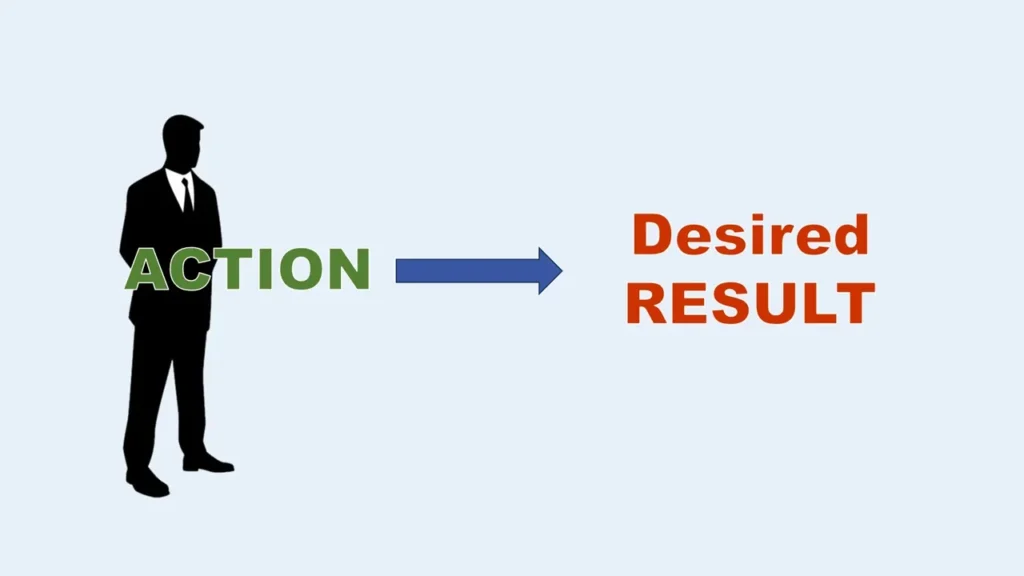
    Man standing next to the word "Action" with an arrow pointing to the words 'Desired Result."
    Men want to take an action, get their desired result and be done.

    In conflict, men know they aren’t autonomous. They know their action will threaten another man’s autonomy and cause him to react. Not knowing what the reaction will be, leaves them unprepared to deal with it. And since they have no control over the reaction, they feel vulnerable.
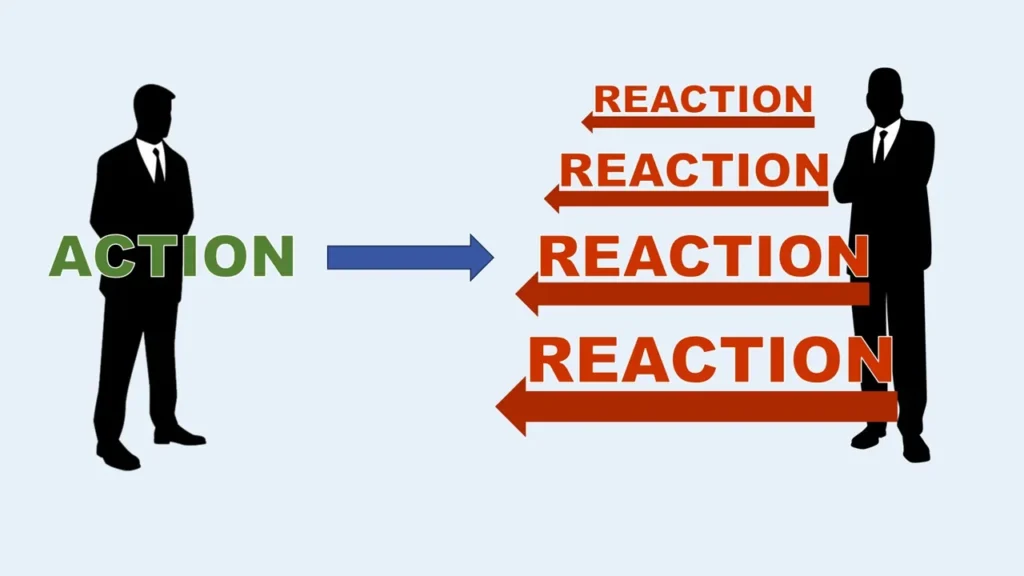
    Men don’t know how another man will react to his action. Will it be a small reaction or a big one?

    When men feel vulnerable, they know they have lost their autonomy. In order to regain their autonomy, they must react to the reaction.

    The need to react goes back and forth and suddenly things go off the rails and a simple issue gets really twisted and complicated. 

    Men don’t deal with complicated well.

    But women do.

    Women aren’t afraid of the reaction, feedback or pushback.  We expect it.  It is a natural part of our group dynamic.

    Before the 21st century and before women were taught to act like men and be aggressive, women didn’t feel the need to react. Our emotions such as empathy and understanding told us we should consider the reaction and what it means.

    Therefore, we aren’t afraid of conflict.  Heck we don’t even consider it conflict.  To us, we’re just talking things out.  We’re figuring out how to make things work for everyone within the group.

    As women in a male-dominated workplace, this is one of the most important transformations we can help our workplace make.

    In today’s workplace, no one is autonomous. Each person’s work impacts other people. If we don’t work in coordination with each other, there will be a lot of conflict.

    As women we can help men (and aggressive women) learn to talk to each other and become comfortable with reactions from other people. Since we all have responsibilities and objectives, we all feel some pressure to get our work done and don’t want to be negatively impacted by other people.

    This is why we need to teach each other to RESPECT each other’s jobs. With respect we can then work together to optimize how we each do our job so we all get the best possible outcome.

    As women we’ve historically been credited with bringing communication and teamwork to our workplaces. However, today too many women believe they must be as aggressive and selfish as the stereotyped man. But by following stereotypes that don’t represent the vast majority of men, women are hurting both themselves and our workplaces.

    As a manager, I always liked conflict because it showed me a problem or issue that needed to be resolved. I saw conflict as an opportunity to facilitate communication and coordination, so we made positive changes in how we did our work.

    This made everyone happier!

    Resolving conflict creates a better work environment.

    Ignoring or being scared of conflict achieves nothing.

    As a woman and team member we are the ones who are best equipped to step forward and resolve conflicts.  We are far better than men at facilitating and coordinating communication to resolve conflicts. Men know this about us, and many hope we will step up and help them.

    However, I don’t want you to think of yourself just as a facilitator or communications specialist.  Those are soft skills that put you in a support role.

    Recognize that you are stepping up and leading your team through its coordination issues.

    Empowered Women Lead Their Workplace Through Conflict

  • How to Have a Well-Attended Meeting

    How to Have a Well-Attended Meeting

    Do you dread attending meetings?

    Do the rest of your co-workers, especially your male co-workers feel the same way?

    Do most of your workplace’s meetings start late because you are waiting for everyone to show up?

    That’s how mine were until I discovered the cure:

    Nothing gets people’s attention in the office more than food. 

    If there are donuts or bagels in the break area, that is where you will find everyone gathering in the morning.  If there is a potluck lunch and the smell of homemade food is wafting through the office, people seem to come out of the woodwork.

    Food makes us feel good.  If you think about every big life event and every holiday, food is an important part of it.  Food creates comradery.

    That is why I like using it to lure people to meetings.

    For morning meetings there is the standard lure of donuts, muffins and bagels.  But don’t forget about fresh fruit with homemade muffins or banana bread. While homemade food is the pinnacle of the food pyramid, a coffee cake or danish from a real bakery (not the grocery store) can rival it.  

    Bring in good food a few times and that guy you’ve been trying to get to attend a meeting, suddenly shows up.

    Personally I hate staff meetings. 

    They are so freaking boring and worthless.  People invent crises just so they don’t have to attend them.  Issues go unresolved because everyone who needs to address the issues are never at the meeting at the same time.  It is frustrating!

    My cure was to hold “staff meetings” at lunchtime. And provide lunch. 

    Actually, I cancelled the traditional “staff meeting.”

    I didn’t need my staff telling me stuff I already knew. With my first work-computer in 1987, I learned to generate reports that gave me all the information I needed. I already knew what was going on and where the problems were.

    So, I created a meeting that wasn’t a waste of time and everyone liked to attend.

    In one workplace, I first broke us down into 4 different groups who rotated responsibility for providing lunch.  After a few weeks of the regular pizza, fried chicken and deli sandwiches, people got creative. They began bringing in homemade food.  (The company reimbursed them for the cost of the groceries.) 

    A casserole dish of homemade enchiladas.

    People love to share their (or significant other’s) homemade specialty. It made all the difference because people opened up.

    We spent the first half hour or so eating and talking. (People started showing up early.) As a manager this is when you find out all the things nobody tells you about. Guys especially love to tell tales and joke around with each other. I learned that the joking was typically based in an issue that needed to be resolved.

    I replaced that whole formal, charts and graphs, bullet point, agenda-driven meeting with informal and productive conversation.

    For the second half hour, we addressed a project problem or a workplace process that wasn’t working.   Many topics came right from my team’s informal conversations.

    With everyone in a good mood from eating and talking first, we had great collaboration and cooperation. We resolved the issue within 30 to 45 minutes.  It is amazing what a team can achieve when everyone is in the right mood.

    Our solutions spread throughout the company. 

    We spent less than $125 per week on food and saved the company hundreds of thousands of dollars. The company didn’t need to hire expensive consultants to rewrite procedures and processes. We did it.

    Our meetings were also a super-cheap way to provide relevant professional development for everyone. I paid for the lunches out of my “training” budget. Everyone got training, not just a select few.

    Consequently, our performance soared.

    Early in my career I also discovered how to use food to promote and advance myself. I used food to crash meetings I wasn’t invited to.

    When management has a meeting you want in on, bring them some homemade muffins, bread or whatever you know how to make to get your foot in the door.  Start up a conversation about the meeting topic and invite yourself to stay. 

    I actually crashed an important Saturday morning meeting with homemade banana bread.

    “I made two of these last night. Since I had to stop by the office to pick up something and knew you guys were working, I brought the extra.”

    It got me in the door and I didn’t leave. From that meeting I got on the project of my dreams.  I then made that project a huge success.

    Using food to crash meetings works. But you have to bring homemade food.  Store-bought is “too canned” and just not effective.  I’ve watched my male co-workers try to copy my technique with store-bought.  It didn’t work.  (I snickered.)

    Being a woman also gives us an advantage when there are important out of town visitors.

    For these meetings lunch is often brought in.  So, on those occasions I was never afraid to play “Hostess with the Mostest.”

     I found out what time lunch was being delivered and I was at the door to greet it.  I escorted the food to the conference room and took my time directing the set up.  As the “hostess” it was my duty to graciously greet our guests and make sure they were well-fed and taken care of.

    No, I wasn’t demeaning myself.

    You see, in these meeting there is always a man whose job it is to introduce people to each other and start conversations.  Typically he is the first one to approach the food.  I would introduce myself and make it clear that I was not the admin, PR or marketing person.

    Often surprised that a woman had my job, this man then introduced me to the other guests. And I was invited to join them for lunch.  After all, that is the courteous and professional way to thank me for being a courteous and professional hostess.

    A catered lunch buffet with a variety of food

    Sometimes I would get invited to stay for the rest of the meeting.  Either way, I made connections but more importantly, I gathered “intelligence” I could later use.

    Meanwhile my male co-workers were walking back and forth up and down the hall trying to figure out how to get into the room.

    Never underestimate the power of food.  Use it.  Leverage it.

    Today many women are afraid to be associated with food whether it is store-bought or heaven forbid, homemade. They fear being cast into the realm of domesticity.  All I can say is:

    This isn’t the 1960’s. Men cook too. You may even be surprised by how many of your male colleagues like to talk about the food they love to cook.

    Remember:

    So, if you can use food to give yourself an advantage, then do it.  After all, your male colleagues aren’t about to stop talking to senior managers about sports or cars because it gives them an unfair advantage over you.

    Empowered Women Use The Amazing Power of Food To Their Advantage

  • 4 Ways To Explain the Unique Value of Women

    4 Ways To Explain the Unique Value of Women

    Many women don’t understand the real and tangible value women bring to the workplace.  For centuries we were led to believe that the all-male workplace functioned just fine without us.  The proof is in all of its accomplishments.

    Thanks to men, civilization has advanced technologically, industrially and philosophically.  All the tangible things in our lives and all the principles we live by are due to men!

    Collage of inventions, a bridge, space shuttle on top of a 747, vary large array antenna, the U.S. Capitol building, the cityscape scene, an aircraft carrier, an oil refinery, cell phone and calculator

    That sounds wonderful…until we look a little deeper.

    Behind the scenes is a messy, chaotic, frustrating and often destructive process. The truth is that the male-dominated workplace doesn’t function very well.

    Throughout my career, I discovered over and over again, the value of being a woman working with men.  My male colleagues needed my female ways of thinking and doing things.  Over the years I came up with a few analogies to remind myself of the value and power of my female ways.

    My first analogy describes how men really work.

    Men want us to believe all their work is solid and complete.

    A wedge of parmesan cheese.

    But it isn’t.

    In reality their work is Swiss cheese. There are holes in everything they do. 

    a wedge of Swiss cheese

    These holes are what create chaos, incomplete work, rework and unintended consequences. 

    Men are taught to be the one who brings the Big Cheese. As women, we’re told to compete with men to bring the Big Cheese. However, it’s very hard to compete with our male colleagues’ boldness and brashness. To them losing to a woman is unacceptable so they gang up on us.

    Early in my career I learned not to compete with them, even though I knew I had a better plan or could do the job better.

    I took a different strategy.

    I looked at their plan or job and compared it to mine. I was looking for all of their holes; all the things that wouldn’t work out right. I then focused on figuring out how to fill in their holes.

    So, when their work didn’t produce the expected results, I could stand up and be the one with all the solutions. I was the one who could fix things. This got me recognition. And when our performance soared, I got the credit.

    No one cared who started the project.

    Over time I discovered that men couldn’t fill in the holes themselves, no matter what they did or how hard they tried. I witnessed all my workplaces adopt management initiatives to improve performance.

    Eventually all of them failed.

    The holes could only be filled in by women’s Pink Zone traits – the way women think and work. 

    A wedge of Swiss cheese with all the holes filled in with pink circles

    When women fill the holes, we create wholeness. And wholeness is the only way to achieve the sustained superior results our workplace wants.

    Looking for and filling in Swiss cheese holes proved to be the most powerful tool I used in my workplaces. I transformed so many ideas, plans and practices and made enormous impacts. My male colleagues kept asking, “How does she do that?”

    My answer was, “I think like a woman.”

    Since my work was always project-based, teamwork was very important.  But in men’s concept of teamwork, all parties aren’t of equal value.  There has to be an MVP.

    There are men who want to prove, “I can deliver this project!”  They give the rest of the team permission to back off and ride his coattails. Team members willingly sit back either because they’re relieved to escape responsibility or they believe they aren’t as valuable. So, they wait for the MVP to deliver that big, beautiful chocolate cake that they can all get a slice of.

    A cupcake decorated with white frosting and a candy pink flower with a lit candle on top

    But in the end, all he delivers is a cupcake that celebrates him.

    As women, we need to think of teamwork as a dessert bar where there are many different kinds of cake slices.  As women, we find it hard for us to choose just one cake. We want to bring a slice of every cake back to our table to sample. We want to appreciate each of them for their unique qualities.

    That is what teamwork is.

    Slices of a variety of cakes that then make one whole cake

    It requires everyone to come to the table, everyone to participate and everyone to emphasize their unique characteristics.


    A marble statue of Atlas holding up the world

    Atlas holds up the world all by himself. He doesn’t need the help of anyone, especially a woman. We’re taught that the workplace is the same. Superior men accomplish great things and don’t need the help of women.

    The foundation for this belief is the Doctrine of Two Spheres. It says men naturally inhabit the Public Sphere and women the Private Sphere. This of course, harkens back to the old stereotypes that see male traits as superior to female traits.

    The concept of the Doctrine of Two Spheres.  On the left a man is standing in a circle with a blue outline and an office building in a background.  On the right is a woman standing in a circle with a pink outline and a house in the background.  The two spheres are separated by a chasm.

    Consequently, for women to have any value in the workplace, we must adopt male traits and compete with men. Women must take a piece of work away from men or men have to surrender it to us. This is how we will achieve equality.

    However, there is another concept:

    Duality refers to two contrasting elements that coexist. They don’t exist in competition or in conflict but rather in a complementary relationship. I think of the value of women in duality with men through the Chinese proverb that says:

    But given our indoctrination as to the nature of men and women, we still see them as distinct and separate. We also want an empirical measurement to ensure there is equality.

    A man on the left half standing in front of a picture of a blue sky and a woman on the right half standing in front of a pink sky

    However, that isn’t Duality.

    In Duality, men and women aren’t separate.

    They are opposing forces who interact and work together in harmony.

    A variation of the yin- yang symbol with one half being the sun and one half being the sky

    This means women don’t have to compete with men. We don’t have to take from men and men can’t take from us. We are inherently equal.

    We each have our own half of the sky – our own way of thinking and acting. We need each other to perform our duty of holding up the sky. Most importantly, the sky isn’t complete and whole unless we lift up our half.

    This brings me to my final analogy.

    I use Yin (pink)and Yang (blue)to represent women and men as two complementary halves of the whole.  They are connected opposites who continually interact and influence each other, creating a dynamic environment. 

    Yin and yang symbol where instead of black and white, the colors are pink and blue representing how men and women interact in harmony with each other.

     In this symbol we often miss noticing Yin and Yang are not represented as a solid color. Yin has Yang’s blue qualities and Yang has Yin’s pink qualities. This is because women and men aren’t different species. We share human qualities.

    As individual men and women, the size of our complementary qualities can vary. Some of us have more, some of us less. How much we express also varies by our situation and environment.

    As connected opposites they both influence and respond to each other. They work in harmony where neither is stronger or weaker than the other. In their dynamic relationship, they continuously balance each other and create balance within their environment.

    More importantly, their harmonious, balanced interaction creates Wholeness.

    Wholeness is where we find sustained, superior performance.

    When men and women interact, work together and influence each other, we become comfortable expressing our complementary traits. We change each other, so we are no longer solidly Pink and Blue.

    Even though we remain predominantly Yin or Yang, we transform into our own unique shade of Purple.   

    We find, balance, harmony and Wholeness within ourselves.

    Yin and yang symbol where instead of black and white, the colors are two shades of purple representing how when men and women interact they change each other and find wholeness within themselves.

    Empowered Women Know They Are One Half Of The Whole

  • Combatting BMOC Syndrome

    Combatting BMOC Syndrome

    Being a woman working in a career-field dominated by men, I’ve run into countless men afflicted with BMOC (Big Man on Campus) Syndrome.

    Usually the first warning sign that a male colleague has contracted the syndrome is his aggressive declaration “I want to be in charge” accompanied by the look and body language that says, “Because I am The Man.”

    Allowed to run its course the syndrome affects the ego, over-inflating it to an unrealistic level.  Soon he is stricken with BMOC Syndrome’s most recognizable symptom – a big head.

    As women, our conditioned response to BMOC Syndrome is to back off and let the syndrome completely infect him.  But, when we do, we allow the disease to spread – and we get infected too.

    In us, the disease presents very differently.  Our typical symptoms  are a diminished ego, a loss of assertiveness and a smaller voice.  Since the symptoms of BMOC syndrome are so radically different in women, our male colleagues refer to it as Little Woman Syndrome.

    When I first began working one of my male colleagues had a very serious case of BMOC Syndrome.  I backed off and let him “take charge.”  I developed Little Woman Syndrome.

    However, after his second bout of the syndrome I realized his BMOC Syndrome also infected our team and workplace.  As a team our symptoms were chaos, disorganization, poor communication and poor performance. In other words, we were a big mess.

    After that experience I decided to dedicate my life to stopping the spread of BMOC syndrome and its devastating effects on women and the workplace.

    After years of combating countless cases of BMOC Syndrome, I am happy to report that I’ve developed a few remedies for the disease’s various stages.

    As women, we typically encounter the first stage of BMOC Syndrome early in our career when everyone is trying to establish themselves – trying to make their mark.  Our infected male colleague becomes offensively aggressive and overly competitive.  He may also develop a brown nose and/or puckered lips.

    As women, we think we have a binary choice when faced with an infected colleague – we can fight him or back off.  As I already mentioned, most of us choose to back off and contract Little Woman Syndrome. Once infected it can become a disease that infects us the rest of our career.

    Some women choose the fight option and try to contract BMOC Syndrome in the name of equality.  They try to be as aggressive and competitive as their colleague.  However, that seldom works because very few women can out-man a man with BMOC Syndrome.  Instead, they wind up letting their male colleague infect them with Bitchy Woman Syndrome.

    Our male colleagues love it when we come down with this!!

    The true remedy to BMOC lies in a powerful third option, one that is homeopathic and natural to women.   We don’t fight or retreat. Instead, we hold our ground.  We stay put.  We become immobile and use the Power of “No.”

    A young woman raises her hands in a dramatic gesture, signaling for attention or a moment to pause. Her expression conveys surprise and determination, capturing a fleeting moment of self-assertion against a minimalistic backdrop.

    By holding our ground, we don’t allow BMOC syndrome to elevate one man’s ego at the expense of everyone else’s.  We keep everyone equal and working as a team.  This allows us to say:

    “No.  You and your ego don’t get to come ahead of this team.  We all have ideas and we will express them.  Together we will resolve this issue/problem/project as a team.  We will work together, succeed and make our mark as a team. So, park your ego and sit down.”

    Using this natural remedy for the first time can be terrifying. We would rather swallow a spoonful of cod liver oil!  However, we have to understand that the ONLY reason it is so difficult is because we’ve been taught women have no natural immunity to BMOC Syndrome.

    And guess who taught us this?

    Men with BMOC Syndrome.

    However, once we take a stand, we are inoculated, we are forever immune to BMOC Syndrome.  Something happens inside our head, heart and body and all we can say is:

    Once we accomplish that physiological change within ourselves, we assert ourselves.  We take on leadership roles. We have achievements for ourselves and our team.

    It feels wonderful!

    Portrait of happy young businesswoman celebrating success with bent arm and fist


    But then our success attracts the second stage of BMOC Syndrome.

    Men who are pre-disposed to BMOC Syndrome become jealous of our success because it’s bigger and better than theirs. 

    They don’t believe a woman should have that kind of success, power, authority or achievement.  All of that should reside within A Man. Consequently, they will try to take our success and claim it for themselves.

    In mild cases of BMOC syndrome, they openly challenge to us.  As the syndrome progresses, they backstab us.  In the most severe cases of BMOC syndrome men actively sabotage us.

    However, before we catch a bout of Bitchy Woman Syndrome, we remember:

    • The reason he is attacking us is because we are better than him.
    • We are The Achiever who has a track record of meeting goals and objectives.
    • We have more clout than him.  Management depends on us and our performance.

    My simple remedy to this is a little attitude and confronting him directly:

    “So, we have X problem.  Do you know how to fix it? What are you going to do?” 

    Many times, if we put him on the spot, we shake his fake self-confidence. We remind him that he has to deliver better performance than us. Our challenge and self-confidence more often than not make him back off.

    Or another remedy is using our clout with our management allies. Again, with a little attitude that reminds them who they rely on, we request that this pip-squeak stop annoying us.

    These remedies work in many workplaces.  But not all.

    In some workplaces, management itself is deeply infected with BMOC Syndrome.  Our colleague knows this so he will us his brown nose and puckered lips on these infected managers to help him usurp you.

    Suddenly, you are removed from your job or role for no valid reason – except – “This area is functioning so well, that A Man has to be in charge of it.”

    A young woman with a horrified expression clenching her hands in frustration

    As a woman, it is the most frustrating experience we will experience because we know that there is absolutely nothing we can do.  We have no recourse.  Of course, we can fight or file a complaint. However, those just lead to us being quarantined because they decided we have Bitchy Woman Syndrome.

    At this point we have to be careful.

    Our natural immunity is down and it’s easy to feel defeated and become infected with Little Woman Syndrome.  We will get advice telling us to take on and be content in a “support role” (traditional female job no real man wants).  People will also tell us the fairytale that if we work hard and show our dedication and loyalty then one magical day these men with BMOC Syndrome will notice us, realize our value and reward us.

    Ha! That will NEVER, EVER happen! The men will live happily ever after, but we won’t.

    To recover, we once again empower our natural immunity and the Power of “No.” We say “No” to contracting Little Woman Syndrome or Bitchy Woman Syndrome.

    When we do this, our brain connects to the intuitive wisdom of women.

    Profile of a person and their brain.  There is a circle showing the connections and energy within the brain

    We realize that the man who usurped us was only after our job title.  He doesn’t want the hard work, responsibility and accountability that come with it.  He can’t do the job and he knows it. 

    However, we don’t fall for the trap he has laid out for us.  Instead, we use our womanly wisdom.  We:

    1. Accept that we were kicked to the curb. We lost our role and title.  We also lost the work, the responsibility and the accountability.
    2. Accept that we can work our fingers to the bone but we will never be rewarded.
    3. Remember that we are the Achiever, not him. He can’t do the job on his own.

    Using our womanly wisdom, we become infected with Empowered Woman Syndrome.

    Empowered Women don’t do somebody else’s job for them.  Empowered Women make men do their damn own job, especially when they usurp ours.

    So, when our usurper demurely comes to us, requesting us to “help him out” and keep doing our previous duties, because “we are so good at them and we are a good team player,” we say:

    “No.  You wanted the job.  You got it.”

    Then we turn and walk away.

    He wanted the title, he got it.  He also got the responsibility, the hard work, long hours and the accountability.

    Many women are afraid to say this because we think he will go running to management, complaining we aren’t a team player. 

    But – we should dare him too.

    Remember those managers have BMOC Syndrome so I guarantee their response will be:

     “What do you mean you need a woman to help you?  You’re The Man.  We expect you to do the job.  We put you in that position to prove whatever a woman can do a man can do better.”

    So, for our usurper, running to management is a really bad idea.

    Remember we set the standard for the job and now he has to measure up to it.  We let him figure out how to do it all by himself – after all, he’s The BMOC.

    Meanwhile, we enjoy our time being kicked out to the curb and the frilly, girly duties we were assigned.  And because we are women, we keep an eye on our usurper and wait patiently. We know he is screwing up our job and we know he will fail.

    Some of my usurpers quit and walked out the door.

    Some were fired.

    Others just wiggled their way into a new, less demanding job.

    Yes, I’ve been usurped a lot.  There is a lot of BMOC Syndrome out there.  But that’s okay because in response, I’ve contracted a very severe case of Empowered Woman Syndrome.

    And I learned that BMOC Syndrome is no match for Empowered Woman Syndrome.

    Eventually, I always got my job back.

    However, before I took it back, I had one condition.  I knew that when my usurper asked to be paid more than me and the BMOC managers agreed because he’s The Man

    My Empowered Woman Syndrome required me to now be paid more than him because I am The Woman, and I have to clean up the mess made by The Man.

    Empowered Women Aren’t Intimidated by BMOC Syndrome

  • We Need More Women As Achievers

    We Need More Women As Achievers

    When men and women go into the same trade, vocation or profession they take very different career paths.  Men tend to take the path that leads to the higher paying jobs and advancement while women take the path to lower paying government, secondary and support jobs that don’t offer as much advancement.  This is a significant underlying cause of the pay gap and why women aren’t advancing in society and the workplace.

    As women we need to ask ourselves:

    After all, that was a point of equality – to give women the same opportunities to achieve as men.

    One major problem is we still believe a lot of the misrepresentations and false narratives that tell us that we aren’t suited for these paths. However, s a woman who followed men and took their most aggressive career paths, let me just say:

    “Ladies, we should be all over these paths.  We are definitely well-suited for them and in many cases, better suited.”

    To correct our misguided perceptions, let’s first understand that all of our employers see us as Doers and that we are in a transactional relationship with our employer.  (We do work and they pay us for that work.)  Our employers then divide us into two Doer groups:

    • The Active Doers work directly with producing our workplace’s product and service and therefore have a direct impact on performance, profitability and viability. 
    • The Support Doers work in the background helping the Active Doer be successful.

    Secondly, we know that all of our workplaces have goals and objectives they have to meet such as:

    • Sell more product and increase revenue by $X or X%
    • Win that big contract
    • Finish the project by this Date with a margin of $X
    • Deliver a new product by this Date
    • Improve efficiency and deliver $X to the bottom line

    To meet these goals, our workplaces turn to the Active Doers to “make it happen” and “git’er done.”  There is pressure, often intense pressure on the Active Doers to meet these goals.  The Active Doers who meet them, whether they are in management or part of the workforce, are then elevated to a small and elite group of Achievers.

    In return for their effort and their direct impact on workplace performance, Achievers demand promotions, higher pay and bigger bonuses.

    Many of us have a very stereotypical perception of Achievers.  They are bulls in the china shop – aggressive, brash, very confident, risk-takers and driven.  To reach their objective they bulldoze through people and obstacles creating a rampage chaos in their wake.

    A Caterpillar bulldozer

    But, no one cares because they got the job done!

    As women, in our Support Doer roles, we see the mess the Achievers leave behind, and our job is to clean it up. Our job isn’t easy however, we get a sense of satisfaction from it, knowing that the Achievers aren’t so perfect.

    If we’re lucky, we’re rewarded with a “thank-you” but no big paycheck or bonus.

    This is the scenario most workplaces are stuck in, but it is so 20th century.  In the 21st century this is NOT how you become an Achiever, individually or as a workplace.

    Super Bowl LII gave us a great example of how to be 21st century Achievers.

    It was 4th down and the Eagles were on the 1 yard line.  They decided to go for the touchdown instead of the field goal.  Everyone saw it as a gusty, risky move and they assumed the Eagles would rely on brute force to bulldoze their way through the Patriot’s line to reach their objective.

    But they didn’t.

    In a very creative play, Nick Foles who was the quarterback, didn’t receive the snap. Instead, he ran to the side and into the endzone to be the receiver who caught the ball and scored the touchdown. Consequently, he was credited for the touchdown and awarded the game MVP.

    Singling out and elevating one person ignores everyone and everything else that went into making the touchdown. The touchdown and the game weren’t won just because of one person’s superior performance.

    As a woman who took the Achiever career path, I used the Team of Achievers approach and I always out-performed my male colleague Achievers.

    I learned to use it when I was just 23 years old. My task was to coach and train a team for a competition.  My team was comprised of a very young man and woman who had less than 1 year of experience.  Our competitors were all men who had 15 – 30 years more experience.

    Using the conventional male-dominated workplace wisdom of the time, my team and I were a joke. We were mocked, openly laughed at and called the “Kindergartners” because of our youth and inexperience.

    However, we WON in our category.

    We also achieved the highest score among all the teams in all of the categories in the competition.   We earned the title Best of the Best.

    Nuclear bomb detonation

    Most importantly, we blew up all of the conventional male wisdom of what it takes to be a Top Achiever.

    For years I carried in my wallet a picture of my team accepting their trophy to remind me not to listen to all the nay-sayers who said I couldn’t achieve, or all the Achiever-Wannabes who tried to stop me because they didn’t want a woman showing them up.

    That picture was my reminder to using the Team of Achievers approach to succeed far beyond expectations.

    As I kept succeeding, I reinforced over and over and over again that as a woman, I brought a unique value to the team that my men cannot.  When women are part of the team and our traits are blended with men’s traits, together, we create unprecedented achievement. And that feels really good.

    It feels really, really good to achieve. It is a feeling of euphoria that you want others to experience.  However, many people are afraid to do what it takes to experience it.

    Many women are afraid to achieve because we believe too many false narratives about hierarchies.  From our feminine perspective we believe that if we raise ourselves up, we automatically diminish someone else.  Using a male perspective, we believe that male-dominated career paths are all about competition and quests for power.  We believe that if we achieve then we will be attacked and we don’t want that confrontation.

    A diverse group of professionals gathers in a circle, embodying the spirit of collaboration and innovation. The words 'Success', 'Vision', and 'Growth' float around them, symbolizing their shared goals and aspirations in the dynamic world of business.

    Achievers don’t care about gender, race, education, religion, ethnicity or any of that stuff because the feeling of Achievement diminishes all that other garbage.  Achievers want to be surrounded with other Achievers because they know that together they can achieve more.

    A lot of women get discouraged in our careers, because we choose career paths that are too low for us and run into Achiever Wannabes.  When we out-perform the Wannabes, we reveal that they are just a Wannabe and not the Achiever they espouse to be.  The Wannabes then work to discourage and even sabotage us to protect their imaginary status.  And all too often, we let them.

    When we run into Wannabes who attack us, we don’t stay and fight them.  Instead we move our career path up and leave them behind.  We seek out people who perform at our level and want us to be part of their Team of Achievers.

    Many men don’t want the responsibility and more importantly the accountability that goes along with being an Achiever.  They are still believe achievers are MVP’s who work alone and act like the bull in the china shop.  They don’t understand the Team of Achievers approach.

    This is where women come in.

    Watch an office of full women who work in secondary and support roles.  They talk, collaborate and help each other out.  As women we inherently understand teamwork, shared responsibility and shared accountability.

    This is why we gravitate to secondary and support roles and stay there.  We believe our collaborative nature is a detriment in what we believe is a cut-throat, achievement-oriented environment. 

    But we are wrong.

    Our desire to help people, support people and make them feel good about themselves is exactly why we should step into team leadership positions. 

    As a woman Achiever working with men Achievers, I found that my best opportunity wasn’t being the team quarterback or wide receiver.  There were a lot of men who wanted those positions for the stereotypical personal glory that comes with it.  Even though I was a good quarterback, I saw my greater opportunity was in being the team coach.  Not only was it a great fit for a woman Achiever, none of the guys wanted to be the coach.

    Coaching word cloud concept.
    www.123rf.com 33148930

    As the coach my job was to create teamwork, develop each team member and design the plays that made us a Team of Achievers.  I had to bring together the Active Doers and the Support Doers together into a cohesive and synchronized team.  I didn’t fill my teams with A players, just with people who wanted the opportunity to experience being an Achiever and the great feeling that comes with it.  Together we racked up a long list of Achievements.

    All of our workplaces need to transition to operating through Teams of Achievers but to do that they need women to leave the Support Doer career paths for that of an Achiever.  There is a goldmine of opportunity for women in the higher paying career paths of all professions and especially the male-dominated professions that women avoid.  We don’t need to compete with the men who all want to be the star quarterback or wide receiver because the coaching positions are wide open.  As the coach we then take on the role of the Leader of Achievers and we make a real difference by delivering the feelings pride and self-worth we hoped we could deliver in our low paying support positions.

    Empowered Women Lead Others to Achievement

  • The Other Side of #MeToo

    The Other Side of #MeToo

    In 2017 I was cycling by myself when I suddenly fell and did the ultimate face plant.  I don’t remember the fall, just waking up with my head laying across a man’s leg.  I heard him call 911 and report my list of injuries. 

    I remember him telling me I broke my wrist and me telling him my wrist didn’t hurt but a spot on my arm was killing me.  I asked him to apply pressure to the spot to relieve the intense pain.  I also remember my fear of going into shock and talking to him about it.  He told me I wasn’t in shock and kept talking to me to keep down my anxiety.

    He sat with me on the hot pavement for over half an hour directing others who stopped to help as they figured out how to guide the paramedics in.  My head remained resting on his leg as the paramedics examined me.  They finally moved me onto a board.  Somewhere in my befuddled mind I thought about how uncomfortable this man must have been sitting on the hot pavement, keeping me comfortable and calm.

    As I was loaded into the ambulance I heard him say he would take care of my bike and meet me at the hospital.  As promised, he met me in the emergency room.  From there, he contacted each of my daughters who lived in other towns and informed them of my accident.  He continued to stay with me as I went through a series of x-rays and tests.  He helped me talk to the doctors, explain the accident and understand my injuries.  He was still there four hours later when one of my daughters arrived and explained my condition to her.  He continued to stay with me, postponing dinner with his family until I was released later that evening.  He helped me to my daughter’s car.

    He took my bike to the shop to be repaired and a few days later brought it to my house.  That day I finally got a chance to talk to him coherently.   I learned that he is someone who’s work we all know even though we don’t know his face. I thanked him profusely for all he did for me.

    He was my hero.  My knight in shining armor.  Proof that chivalry isn’t dead and gentlemen still exist. I told my daughters I wished more men were like him.

    Then a few months later, my hero made national news.

    He was caught up in the Hollywood #MeToo sex scandals.  He was accused of a horrific sexual assault that allegedly took place many years ago. 

    He was instantly professionally ruined.

    Like so many others, I found myself in a predicament:

    My gut reaction was to want out – out of having to think about this and the confusion I was feeling.  The exit door was very clear.

    Businesswoman walking out an open door

    I could immediately condemn him just like his Hollywood A-lister friends did.

    Jumping on the condemnation bandwagon is the easy way out.  Condemning him was Personally Expedient.  It would rescue me from my predicament and from having to do the messy work of figuring out the Truth.

    This thought suddenly put me on the other side.

    I remembered all the times I spoke up and sought justice on behalf of someone who was being bullied, harassed, or accused of something and was dismissed because it was Personally Expedient.

    Whether it was a manager, HR or a witness, they didn’t want to get involved because it was uncomfortable and messy.  So, they took the exit door.

    This is what most people do.  I know there are many people who read the first half of this article and condemned the man without knowing the full story.  They did it because it was Personally Expedient.

    Finding the Truth is messy and uncomfortable.  When you seek the  Truth you can be bullied, harassed, cancelled and threatened by people whose only objective is to distance themselves from the situation – they just want to make you go away.

    I know from my experience that finding the Truth requires an open mind and cleansing yourself of preconceptions because the journey to the Truth can take you in many different directions. 

    Sometimes the true situation is as presented by the accuser. 

    Sometimes it isn’t. 

    Sometimes seeking the Truth takes you down a long path where you discover there is an even larger problem where the true source of the abuse is well-masked and well-protected.

    A lesson everyone needs to take away from #MeToo is simple:

    Statue of Justice at Old Bailey Courthouse with raised scales and sword. Justice isn't blindfolded

    So, the next time you hear a story about an abuser or harasser, don’t immediately jump on the condemnation bandwagon because it is Personally Expedient.  You don’t know the Truth yet.

    Likewise, the next time someone reports an accusation, don’t dismiss them because it is Personally Expedient.  And don’t just offer empathy, consolation and/or outrage because that is also doing what is Personally Expedient.

    Do more. 

    Do what is Right. 

    Seek the Truth

    And get Justice for the wronged individual.

    Empowered Women Seek The Truth

  • Women, Conformity, Validation and Confidence

    Women, Conformity, Validation and Confidence

    It is common to hear that in comparison to men, women lack confidence and therefore seek more validation.   I’ve never believed this was a natural trait of women but a product of our conditioning.  As we grow from girls into women that conditioning is continuously reinforced so throughout our adulthood we continue to seek external validation.

    As children, both men and women are taught to meet someone else’s expectations and in return earn praise.  But as boys move to manhood, they naturally move to being more autonomous.  Their view the world and what they want to do is more important to them than how other people view the world and what other people want them to do.  This gives men a better sense of self and self-determination.

    It is why men seem more confident.

    Women don’t seem to inherently make this same transition to independence of thought.  We remain more aware of others than men do.  This awareness is a very powerful female trait but it is misapplied and exploited by society, media and social media.  This exploitation teaches women to elevate the thoughts, opinions and ideas of others and subjugate our own.   

    This is why women seem less confident.

    A major difference between men and women is how we perceive ourselves.

    A solid blue circle

    Men believe their individual thoughts and ideas are the whole of thoughts and ideas.

    A circle divided into 4 equal parts

    Women recognize that our individual thoughts and ideas are one part of the whole. 

    When women are conditioned to believe other people “know better,” we diminish our individual thoughts and ideas as an inferior part of the whole.

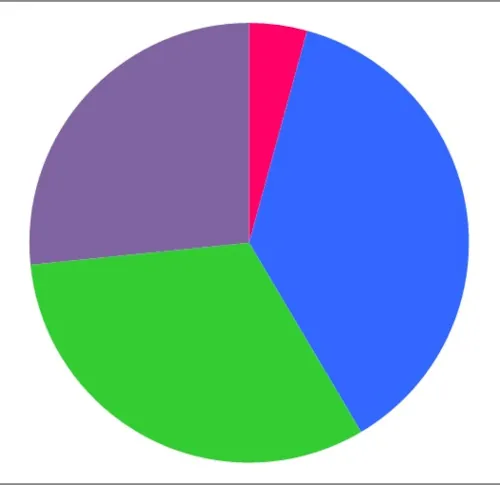
    A circle divided into 4 parts of 3 equal parts and 1 significantly smaller part

    Our conditioning tells us that in order to regain our full value, and confidence, we need external validation.  Various groups within society are more than willing to tell women:  

    “If you think, look and act within the parameters of our defined box, we will validate and accept you.

    Women then listen to the ideas of various groups.  We choose which group we want to join and which box we will fit conform to.  When we conform to their box, we lose some or even all of our individuality.

    3 beautifully wrapped gift boxes with bows and 1 plain brown box

    As a woman who’s spent her entire adult life in male environments, I see the stark difference between how men and women are conditioned to be confident about who they are.  I’ve heard all of the messages telling me to choose a box. 

    But because I’ve worked around men and their thinking, I developed a strong sense of self and tuned out those messages. 

    Instead, I developed my own responses to all the voices telling me who I should be:

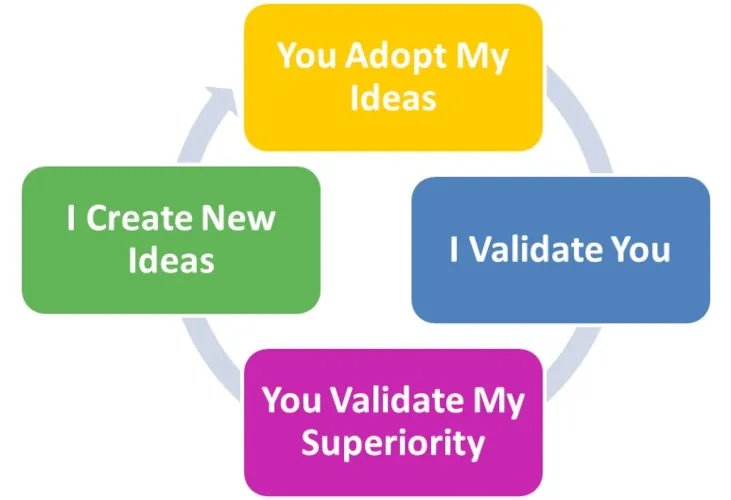
    There is no shortage of people who want to convince us that they are smarter and better than us.  I’ve learned that many of these people (men and women) have a need to need to feel superior to others.  They need others to look up to them in order to validate their own sense of worth.

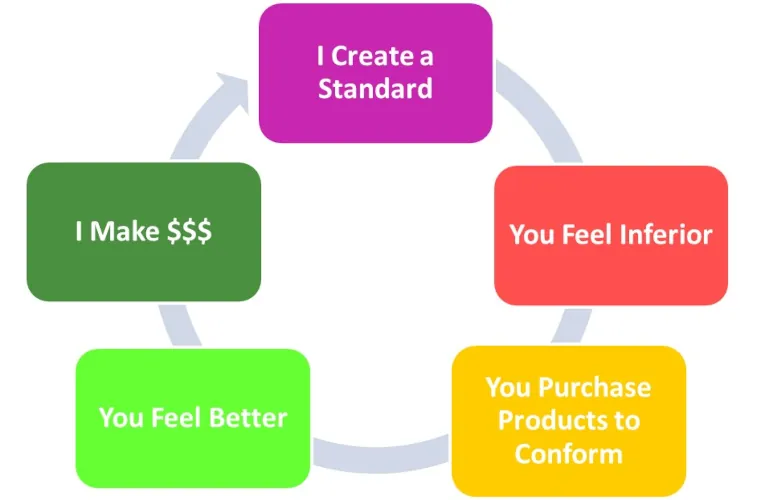
    Many others do it because women make up the vast majority of consumers.  If they keep the validation cycle going, they make a lot of $$$.

    And of course there are the media, social media, and politics who manipulate us with validation and acceptance for their own purposes.

    When we elevate other people’s opinions above our own, we disempower ourselves.  We don’t voice our ideas, thoughts and opinions.  We don’t express who we are.  We deny our value and our equality.

    Women we need to take a lesson from men and have a stronger sense of self.  This doesn’t mean we ignore other people and their ideas.  It means we think highly enough of ourselves so we are a full and equal participant in our family, team, workplace, community and society.

    When we step outside the box that confines us, we find a big world of ideas, concepts and thoughts.

    For many women going outside the box is scary. 

    Boxes are safe. They have well defined and validated boundaries that provide us security.  However, the price we pay for that security is a denial of being our complete true selves and the personal fulfillment that comes with it.

    When we explore outside the box we are exposed to lots of ideas, concepts and thoughts that we can evaluate.  We can figure out if they fit into and add value to our life and who we are.

    Two businesswomen standing outside an open box

    We find there are lots of “standard ideas.”  Some fit into our lives.  Some don’t.

    We learn other people have unique ideas.

    Some fit into our lives.  Some don’t.

    We learn we have unique ideas.  Some people will benefit from our ideas. Others won’t.

    When we are willing to step outside the box, we can go on the lifelong journey of pulling all of this together and discovering the unique person we are.  That person is so much more open, colorful and interesting than the person inside the box.

    Outside the box the only validation we seek is from within ourselves.  We validate that we are being true to ourselves.  This truth becomes our source of genuine confidence.

    When we live our lives as our unique selves, we also give other people permission to be their unique selves.  We destroy the boxes that confine people, make people think small and let people diminish others.

    Women have a unique opportunity to change the world by allowing everyone to be their full unique self.  But first, each of us has to choose to get out of our box and be our true selves.

    Empowered Women Live As Their True Self

  • Dealing With Men Who Go On Rants

    Dealing With Men Who Go On Rants

    It seems like a really intimidating situation for any woman.  But it isn’t – if you understand what is really going on.

    Like us, men get frustrated.  But unlike women, men don’t “tend and befriend.” They don’t go running to each other to talk about their feelings or what is bothering them.  They tend to bury it and keep it inside, periodically letting little bits of their frustration come out.

    Many men were conditioned to keep it all bottled up inside.  They then use alcohol, smoking, drugs etc. to help suppress their feelings. But then at some point it builds up and they explode – they yell and scream in a long expletive filled rant. 

    For women, being at the receiving end of the rant can be nothing short of traumatic.  It can (and has) driven many women out of the male-dominated workplace because we don’t know how to handle it and we take it personally.

    To deal with these situations we first have to recognize that the rant isn’t about us. So even though the anger and frustration is directed at us, we don’t have to receive it and absorb it.

    We also must recognize that many men work in high pressure jobs where the finger of blame is pointed at them. They are under pressure to make things happen or risk losing their job.

    Hand with a pointed finger and Blame written above

    You must win this contract.

    You must make $X in revenue.

    You must fix this problem by X date

    Even men who aren’t under this kind of pressure they can still have the perception that they cannot fail in order to protect their image or status. Consequently, they put a lot of unnecessary extra pressure on themselves.

    In either case some men just have a hard time dealing with the stress and pressure of their work environment.

    Rants are simply about their frustration, stress and being overwhelmed.

    Women are often at the receiving end of these rants because men typically pick out “the weakest person” to unload on.  They don’t think “the weak person” will fight back or stand up to them

    Men don’t want to rant to a person who is going to remind them of their perceived “weakness’ or “failure.” They just one directional rant where they can release the emotion.

    So, as hard as it may seem this is why we shouldn’t take these rants personally or believe they say anything about us.   They aren’t about us, they are about him. They are about his stress and frustration.

    Boy lost and sad sitting alone in forest

    As women we are in a unique position to provide that help.  We can put our empathy and understanding into action and ask him, “What do you need to get done and what help do you need to get it done?”

    Contrary to what we are taught, men are much, much, much more receptive to opening up to women if women just ask the simple question “What do you need help with?” 

    Men like having a woman, they can trust, who they can be vulnerable with.  They like having a Girl Friday to whom they can say “I need X done” and she replies “I’ll take care of it.”  That task can be trivial, or it can be significant.

    Our willingness to help opens up a goldmine of opportunity for women especially since it is usually our boss or a manager who needs help.  We can use it to get our foot in the door, work on issues above our pay grade, give us exposure to the Bigger Picture and build a key relationship.  It is an advantage of being the woman in the room that we should take advantage of.

    We should also consider that sometimes men unload on us because of issues in their personal life.  They need someone to talk to.  The man I mentioned at the opening of this article, screamed at me because he was working away from home and his wife just called him to tell him she had brain cancer.  His outburst was a huge cry for help.

    Of course, not every man will want the help. But we can still help him, even if he doesn’t know it. We do it – not because we are doormat – but because we want to lead our workplace to becoming a supportive team environment.

    And it’s amazing how many men will come back later and thank us.

    Women who don’t work in a predominantly male environment, may be surprised (shocked)about how much men open up and confide in a female colleague. They will open up and talk to us about anything and everything!!

    So, with more women in the workplace, men can find a woman they trust to talk to and vent with. Then as we work through issues, and come together as a team, the number of the emotional rants decrease. 

    This is just another advantage of women in the workplace.

    Empowered Women Offer Their Help

  • The Importance of Trust When Working With Men

    The Importance of Trust When Working With Men

    It can be intimidating to be a woman entering an all-male workplace.  Even though the reception is professional you aren’t sure it’s an accurate representation of the environment.  You don’t know what your male colleagues really think about working with a woman in their career field and what they are saying about you behind your back.

    I’ve navigated this situation many times.  I was successful because I didn’t look at the situation from my perspective but through the perspective of my male colleagues.

    I know.  Many women don’t like me to say that.  They believe men simply need to get over their biases and just accept that a woman can do the same job as them.

    However, that response fails to recognize that most of the men are in a situation they are absolutely clueless on how to handle. 

    They need help.

    That is why I go into this situation seeing myself as the bigger, more secure and confident person who can help my male colleagues learn and grow.  I see beyond myself and my personal interests to recognize that my male colleagues – in spite of their bravado – also have trepidations. 

    To men trust is enormously important. They want to know that the presence of a new person will not negatively impact them.   That is how they define Trust.

    As a woman, I only had to look to the negative stereotypes to figure out my male colleagues’ “Trust issues” with a female colleague.  Unfortunately, most of them heard about or experienced women that men couldn’t trust. This put an extra burden on me so they needed to Trust that I would:

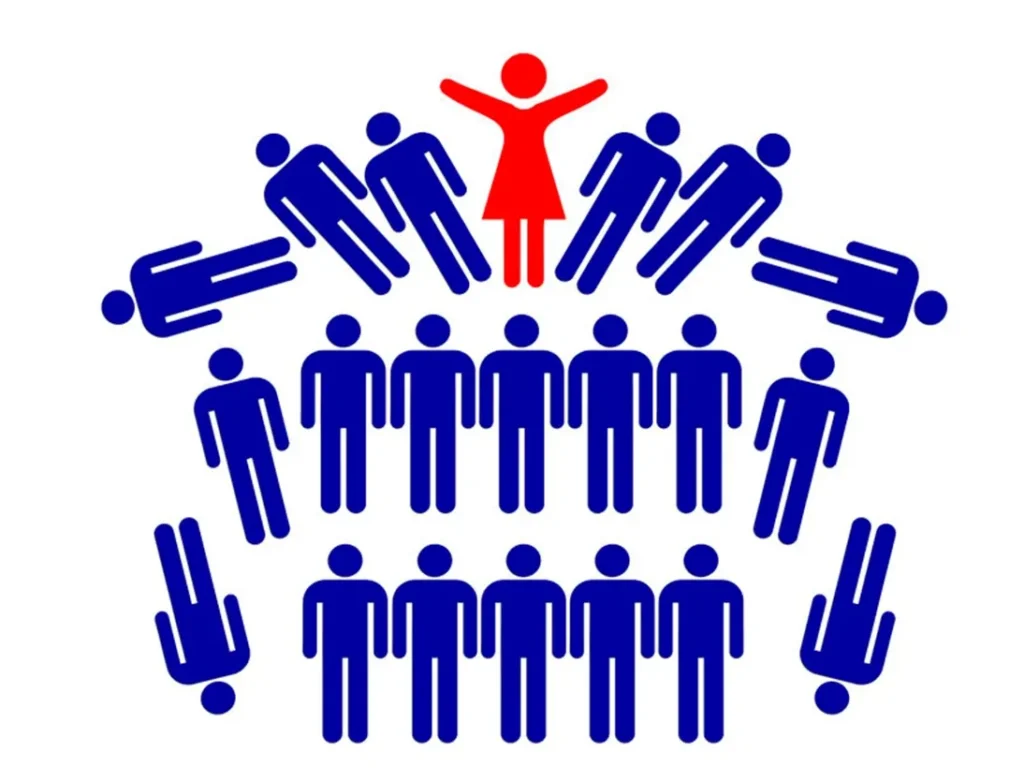
    Red figure of woman standing at top of organization hierarchy with two rows of blue male figures beneath her. To the side are several male figures tumbling down that the woman pushed aside
    • Not be a man-hating feminist with an agenda to take down as many men as I could.
    • Not be a DEI hire with special privileges.
    • Do my job thoroughly, completely and accurately so none of my work was dumped on them.
    • Be willing to work hard, get my hands dirty and put in the hours needed to get a job done.

    My male colleagues also had some positive expectations of women that I used to build Trust.  They learned these from working with women in traditional support roles. And while a few of my male colleagues bravely admitted men knew these were true, they told me not to expect men to admit to it.

    • Men knew women were much better at communication. They needed women in writing assignments and for creating presentations. Women could transform their garbled ideas into logical, flowing expressions.
    • Men knew women are far better at details and forming complete ideas and solutions.
    • They knew women had a smartness, wisdom and intelligence that they needed to listen to because it could keep them out of trouble.
    • Women had a different kind of strength. We can handle a tough situation better than men. So, when men really needed to be bailed out, they knew they could depend on women to rescue them.

    As women, we need to understand that all of the items I listed are starting points for building Trust.  Men have fears so we can’t play into those. Instead, we focus on our strengths and demonstrate that our presence doesn’t create a burden.

    From my experience I know that the male-dominated workplace is very flawed. And men, no matter how hard they try, can’t fix it on their own because the critical flaw is that their workplace is too male.  Therefore, when women come into a male-dominated workplace, we are a natural enhancement if we assert ourselves properly. 

    However, many women immediately stumble and create unnecessary challenges for themselves. We focus too much on being a woman. We focus on the negatives of biases, discrimination, harassment and what men need to do to make us feel accepted.  We create obstacles to building Trust which damage our relationships and careers.

    Any woman entering a male environment must recognize that Trust is the foundation on which working relationships are built.  After we create Trust, then we can earn Respect.  Trust and Respect then work in conjunction with each other to build alliances with our male colleagues.

    Those alliances are what we use to advance our career.

    Empowered Women Build Trust

  • Finding Solutions to Advance Women

    Finding Solutions to Advance Women

    In order to advance women in the workplace, women need solutions for the unique issues and challenges we face.  That is why I started this website.

    When I began, the women who had worked deep in the male-dominated workplace weren’t sharing the lessons they learned. So, through this website my original intent was to share a lot of “How To’s” such as:

    • How to get your voice heard and take command of the conference room when you are the only woman in a meeting with 25 loud, opinioned men who all want to be in charge.
    • How to prevent sexual harassment and what to do when it occurs.
    • How to get a lot of recognition for your achievements without being an obnoxious braggart.
    • How to recognize and seize the hidden opportunities in your workplace that will propel your career forward
    • How to deal with women in traditional roles when you are the first female manager and upset the decades old informal power structure.
    • How to be a leader as a woman.
    • How to be confident when you don’t have all the answers.
    • How to approach any job so you always out-perform your male colleagues
    • How to deal with very competitive male peers.

    These are the solutions women need.  However, as soon I began putting these solutions out there, I met resistance.  I quickly discovered that women had a larger, more fundamental problem:

    Our perceptions about the male-dominated workplace are based on narratives written over 40 years ago.  And these narratives have been repeated decade after decade. Consequently, young women today think they are facts. They aren’t.

    What women don’t know is:

    Even now when I speak to a group of women, I sometimes get lambasted by women who want to protect these old narratives.  Meanwhile the women who have been “the woman in the room” as computer programmers, mathematicians, procurement specialists and statisticians are quietly sitting, nodding their head in agreement with what I am saying.

    It seems many women are focused more on protecting the narratives, than on advancing women. They don’t want to hear how their bad workplace experiences come from the bogus narratives. They don’t want to know how the male-dominated workplace really functions.

    We know that if we want to succeed in an environment, then we have to understand that environment. 

    Therefore, if women want to advance in the workplace, one of the first solutions we have to put in place is and understanding of how the male-dominated workplace functions.

    Here are some basics:

    • Men and the male-dominated workplace are driven by a quest for Autonomy, independence and self-determination. (Women’s narratives say they are driven by a quest for power and domination over others.)
    • Trust and respect are paramount in the male-dominated workplace. (Women’s narratives eradicate men’s trust.)
    • Men fear blame. In some men that fear is intense. (Women’s narratives blame men.)
    • A good sense of humor is critical. (If you have never LMFAO at a Trump tweet, you will have problems working with men.)

    The result of not understanding of how the male-dominated workplace really functions is having a devastating effect on advancing women.  Too many women see themselves as powerless.

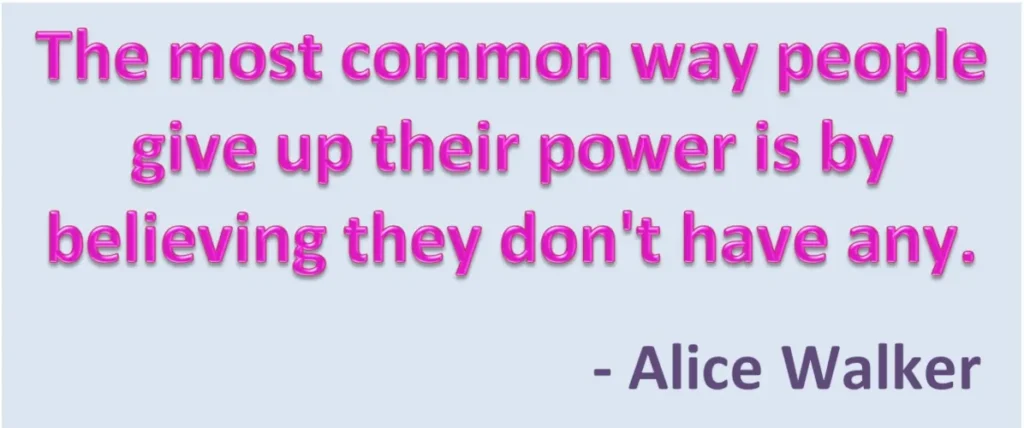
    Quote by Alice Walker saying: The most common way people give up their power is by believing they don't have any.

    Consequently, too many young women accept that the only way women can become empowered, and advance is when men decide to give up some of their power and give it to women.  Since this idea follows the dictionary definition of empowerment, women accept it as a real-world truth. We accept that this is the way the world works.

    Out of all of the narratives this definition of empowerment is the most devastating to women.  To remedy this woman must adopt men’s attitude towards empowerment:

    Women need to understand that our full empowerment and equality already exist.  They are just sitting there waiting for each of us to pick them up and do something with them.  We just have to choose to do so.

    Cartoon of a girl sitting in a chair saying "It's fine. I'll wait."

    As women we should never accept that we aren’t fully empowered.  And when someone says we aren’t we should do what men do – challenge them.

    But many women resist accepting this perspective on empowerment and equality. Why?

    I found one answer when I first began talking about my career. I wasn’t cheered for my success. Instead, I was slammed with comments that I was lying or making it up. Women didn’t want to hear that a woman was successful in a male-dominated job.

    Why not?

    Because I could then turn to them and ask:

    The truth is that the old narratives give women an excuse not to try. They give us an excuse to play it safe and stay in our traditional roles and protect our feminine privilege.

    The fundamental, underlying reason women don’t want me speaking out is because I was willing to give up my feminine privilege in order to achieve equality and advance my career.

    Feminine privilege says women can assume less responsibility in the workplace but still have the same pay and promotion opportunities as men who take on more work, responsibility and accountability.

    But that is not how the workplace functions. Ultimately the workplace is merit based. So, we need to prove we merit the same opportunities, pay and promotions as men because we take on the same work, responsibility and accountability as men.

    I know that the male-dominated workplace is a goldmine of opportunity for women. My blogs, videos and book can help women advance and achieve their full potential.

    We just have to choose to do it.

    Empowered Women Give Up Their Feminine Privilege To Achieve Their Equality.

  • Embrace Your Quirks

    The true secret to success is being yourself – your true authentic self, full of strengths, weakness and quirks.

    We all gladly embrace our strengths.  We love to show them off.  But we should also be proud of our weaknesses and quirks because through them we find real strength.

    Embracing our weaknesses and quirks demonstrates confidence.  Declaring them out in the open makes us strong.

    We are taught our weaknesses and quirks are something we should be ashamed of so we try to hide them.  That makes us vulnerable and insecure.  We are afraid of being found out. But when we put them out there – no one can hold anything over us – there is nothing left to expose.  We have freedom.

    For example, I can do many things as well as a man.  I like to cycle and I like it when I pass men with big calves.  It makes me feel good.

    But don’t ask me to throw a ball.  I throw like a girl.  No, actually a 6 year old girl throws a ball better than me.  When I was in middle school and we tried for the Presidential Fitness award, I was the top girl in all of the physical tests except for throwing the softball.  I didn’t get the Presidential Fitness award because I couldn’t throw a freaking ball.

    I can make business decisions and solve problems all day long.  But don’t ask me where to eat.  My mind literally goes blank and all I can say is “I dunno know.”  On weekends I get dressed to go out to eat but then drive around in circles because I can’t decide where to go.  I wind up going home to eat.  Now that’s a quirk!

    And I cannot tell left and right.  All through elementary school I put my left hand, then my right hand then my left hand over my heart for the pledge of allegiance.  My family knows that if I am driving and they tell me to turn left or right, they have to point.  Ironically I can do izquierda y derecha  (Spanish) with no problem.  Weird huh?

    Laugh at me.  It’s funny. And I’m not embarrassed.  It is who I am.

    At work when we share our little quirks with each other we find out that each of has a peculiarity to laugh at ourselves about.  We discover that we can help each other deal with our quirks and it feels good to help them.  My colleagues learned that when they ask me to go to lunch, I would reply “Sure, where are we going?”  I would go anywhere and eat anything as long as I didn’t have to decide.

    Our quirks are what make us real, authentic and unique.  They show we are human.  So embrace them and share them.

    Empowered Women Embrace Who They Are, Quirks and All


    To learn more about empowered women checkout my book. 

    Follow The Woman In The Room on Facebook

  • Don’t Let a Skill Become a Trap

    www.123rf.com 61070833

    When I began my career my male colleagues didn’t know how a female engineer would be different from a male engineer.  They soon discovered the difference – “She can write!”

    At first I laughed because engineers are notoriously bad writers so it wasn’t difficult to do better.  But then I saw the danger in this acclaim.

    Instead of being seen as engineer, I could be seen as a woman only and get pushed into a traditional female role.

    One year later my fears became a reality.  I was moved to a new job where my overwhelmed boss discharged me to help write performance reviews and award packages.  I sat in the back corner of the small room occupied by the two secretaries with a typewriter on my desk.

    I knew I had to change my situation.

    I soon discovered an upside to my new location – everyone talked to the secretaries.  I soon learned about every issue and problem in our department.  I realized there was a big beautiful world of opportunity out there – I just had to figure out how to get out from behind my desk.

    Opportunity soon knocked when a supervisor came to the secretaries begging for their help in rewriting the Wastewater Treatment Plan.  The secretaries quickly volunteered me.

    Eureka!!!

    I had a perfect excuse to get out from behind the desk.  I told the supervisor I needed to understand how things worked so off we went to the shops and the wastewater treatment plant where I talked to the men about operational issues.  I gladly took over rewriting the plan.

    The next thing I knew I had the Snow Removal Plan, the Vegetation Removal Plan, the Flood Control Plan and the Traffic Control Plan sitting on my desk to update and rewrite.

    Writing these plans took me all over the Air Force base I worked on and exposed me to the larger base mission.  I met and talked to everyone.  I learned how my department was supposed to support the mission and where it was falling short.  By the time I left that assignment I had more operational knowledge than any of my male peers.

    At my next assignment I sold my knowledge to my Commander and landed a new job normally given to someone with at least 6 more years of experience.

    About a month into my new job, my supervisor was pulled away to handle a crisis.  He gladly dumped some of his responsibilities onto me, especially the monthly presentation to the Wing Commander, which we called “the monthly bloodbath.”

    I should have been terrified but my earlier experience taught me how Wing Commanders and senior officers wanted information presented to them.  I changed up the presentation and to everyone’s shock I survived my first presentation.  Over time those monthly presentations made me very comfortable in public speaking.  I had a new and valuable skill.

    I also I realized technical knowledge coupled with strong communication skills is very powerful.  Too often the person giving a presentation is just a speaker – they aren’t the person with operational authority.  I however had operational authority – I could present issues, answer technical questions, implement the decisions and then discuss the results at the next presentation.  I eliminated the middle man (my supervisors) and established direct communication to higher level decision-makers.

    I became the person they came to, to get things done.

    After leaving the Air Force I continued to combine technical knowledge and communication skills.  I got a job conducting an operational audit for a government contractor where I uncovered a serious problem.   My report went right up the chain to senior management.  They loved my report and I was soon offered a new job writing proposals.

    My writing skills were once again front and center and giving me the opportunity to develop more  professional skills – proposal writing, marketing and contract negotiations.

    I took the job.  However, I remained leery of being seen more as a writer than engineer.

    Many years later I proved to myself that I was correct to be leery.  I had two job offers on the table – one to write proposals and one to run an operational department.  The job running the department paid 33% more.

    I realized I always had my priorities right – operational and technical skills were more important.  They were the key to better pay and advancement.  Communication skills were supplemental – useful to distinguish and leverage myself, but they should never be my primary workplace skill.

    All through my career I used both my skills.  If I established myself with technical skills, I then used communication skills to distinguish myself.  Likewise, if communication skills could get my foot in the door, I used them and then found an opportunity to apply my technical expertise.

    Many men have a hard time understanding how I could do this because the male-dominated workplace believes you can only excel at one skill.  Consequently I’ve been asked countless times: “Are you an operations person or a proposal writer?”

    I answer: “I do both” and watch their heads explode!

    For women it is easy to fall into the trap of having to choose between our skills.  These choices often maneuver and trap us into more conventionally female jobs that pay less and deter our advancement. 

    This is why we should never conform and never choose.  Instead we should learn new skills, leap frog them over each other and leverage our skills to distinguish and advance ourselves.

    Empowered Women Use All of Their Skills


    Find this article helpful?

    Sign up to receive more and check out my New Book!
    Follow The Woman In The Room on Facebook
    Take a quick moment to share


  • Have a 21st Century Concept of Management

    Recently I shared a Facebook post in which Shira Goodman, CEO of Staples recalls her best career advice:

    “Be open to making lateral moves.”

    I agree – making lateral moves is what propelled my career too. However, we often think that we should stay within our functional area so we can build the relationships we need to work our way up the corporate ladder.  But that theory is so mid-20th century!

    To get ahead in the 21st century we need to think about how a 21st century company really functions.

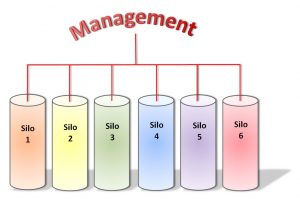
    First, take a look at your company’s organizational chart(s).  You will probably see lots of functional silos.  This reflects 19th century management theory when manufacturing drove our economy.

    The male-dominated workplace however still loves these functional silos because they allow men to use an expertise to acquire status.  That expertise can be in a skill/profession, client type, region or project/production phase.  As men work within their silo gaining knowledge and experience they master their functional area and become our awe-inspiring experts.

    Take a moment to think about how you think about experts.

    We expect experts to know the best way to do something.  We don’t question the experts.  We expect that a workplace that has lots of experts in their functional silos to perform the best.  But do they really?

    Let’s do a 21st century reality check.

    In the course of doing your work, how often do you interact with people from different functional silos?  Probably quite a bit.

    And how often do you or your co-workers have problems getting the right or complete information from people in the other functional silos so you can do your job quickly and efficiently?

    Probably a lot.  If you think about it, you will probably realize you waste a good part of your day trying to correct work passed to you from other people.

    The problem is that the old functional silo structure assumes that the experts can best complete their work without the interaction (distraction) of others.  Sometimes that work is then “handed-off” to another functional silo to complete by itself.  However, the handed-off work is often completed in a manner that suits the first silo but not the second.  This causes rework for the second.

    While this system works well for silo managers and the experts, it doesn’t work well for the workforce who interact all day long with people from multiple silos.

    21st century workplaces are more complex and therefore require integrating work across the silos so the big picture work gets done efficiently.  Silo managers can no longer just look down through their silo – they must look across all silos and integrate the work of their silo with that of the others.  They must bring all the functional areas and people together to function as one entity.  This is the primary responsibility of 21st century management.

    The old mentality of working your way up your silo doesn’t prepare managers to integrate work.  However, someone who has moved from silo to silo understands how work has to get done from the perspective of more silos.  They understand the integration necessary for the company to perform better. They will be better managers.

    The male-dominated workplace and academia however, still don’t appreciate the power of integration because it reduces the status of their expertise.  They consider people who move from functional area to functional area as a “jack of all trades but master of none.”

    But integration of activities and functions is an expertise.   It is an expertise that requires communication, coordination, collaboration and multiple task management skills.  These are skills women excel at far better than men.  This is why women need to aspire to middle and senior management positions in the 21st century.

    So, if you are one of those people who has moved between functional areas a lot and believe your career options are limited because you don’t have one big area of expertise, change your perspective.  You just may be an integration and efficiency expert.  Go for that management position!   because you have skills that  do not.  You will outperform your siloed male colleagues.


    Empowered Women Manage Through Integration


    Find this article helpful?

    Sign up to receive more and check out my New Book!
    Follow The Woman In The Room on Facebook
    Take a quick moment to share